

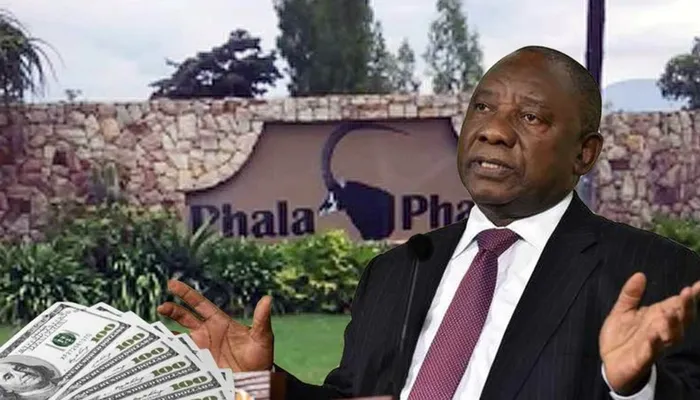
The Independent Police Investigative Directorate (IPID) has recommended disciplinary action against two members of the SAPS in connection with the alleged cover-up of the 2020 theft at President Cyril Ramaphosa’s Phala Phala farm.
Image: IOL graphics
The Independent Police Investigative Directorate (IPID) has recommended disciplinary action be taken against two SAPS officers, including a senior protector of President Cyril Ramaphosa, over their alleged role in covering up the 2020 Phala Phala farm theft.
The report relates to a February 2020 burglary at Ramaphosa’s Limpopo farm, where millions in foreign currency were allegedly stolen.
Those implicated are Major General Wally Rhoode, head of the Presidential Protection Service, and Constable HH Rekhoto.
Rekhoto is attached to the Presidential Protection Services Unit at Head Office, Pretoria.
The findings follow the declassification of IPID’s report into the conduct of Presidential Protection Service Unit members after a PAIA application by ActionSA and the African Transformation Movement (ATM).
Suspended Police Minister Senzo Mchunu had previously indicated the report would remain classified.
IPID said its investigation identified Rhoode and Rekhoto as “the individuals who were mostly involved in the alleged cover-up of the theft from the President’s farm”.
“Both members were approached and were given the opportunity to respond to the allegations made against them,” the report said.
Rekhoto provided a sworn affidavit in January 2023.
Rhoode, however, failed to respond to IPID’s questions, despite indicating he would do so after the State of the Nation Address (SONA).
“IPID investigation, therefore, necessitated the analysis of the available evidence gathered,” the report said.
According to IPID, Ramaphosa informed Rhoode in 2020 of a break-in at his Phala Phala farm involving stolen cash from animal sales.
Rhoode reportedly undertook to report the matter but failed to do so in line with Section 13(2) of the SAPS Act, which requires officers to inform their commanding officer of a crime.
Instead, he said he reported the matter to a subordinate rather than the national police commissioner Khehla Sitole, who only learned of the incident through media reports after his retirement.
“Major General WP Rhoode failed to register or ensure that a case docket of housebreaking and theft was registered,” the report found.
IPID further concluded that Rhoode carried out an “unlawful instruction” by conducting investigations outside his mandate and without opening a formal case.
The report details how Rhoode allegedly led an unofficial operation to track down suspects and recover the stolen money.
It found that suspects were interviewed at the farm, and that individuals not formally authorised appeared to be involved.
“The only inference one can draw is that [they were] part of the team … to trace and track the suspects … thus insinuating unlawful apprehension and interrogations,” IPID said.
IPID also found that Rekhoto travelled to Cape Town in March 2020 under false pretences.
Official records stated he was attending meetings with the Presidency. However, the report found he was in fact conducting surveillance on suspects linked to the Phala Phala theft.
“Constable HH Rekhoto misrepresented himself by saying he was going to attend meetings,” the report said.
He was unable to provide proof of such meetings, including minutes or attendance registers, and instead submitted only draft investigation notes.
The report said both officers falsified travel documentation and misused state resources.
IPID found that Rhoode abused SAPS resources by authorising unnecessary travel and duplicating roles, resulting in “fruitless and wasteful expenditure”.
It also raised concerns about trips to Upington and Namibia involving presidential envoy Dr Bejani Chauke, who is not classified as a VIP under SAPS policy.
“Major General WP Rhoode namedrop[ped] the President’s name every time he conducted his unauthorised investigations,” the report stated.
Meanwhile, the IPID recommended disciplinary action under SAPS regulations.
These include failing to comply with legal obligations, conducting investigations outside official duties, mismanaging state funds, falsifying records, and acting in an “improper, disgraceful, and unacceptable manner.”
The report said that the conduct of both officers “detrimentally affects the image of the Service” and warrants expedited disciplinary proceedings.
Meanwhile, ActionSA national chairperson Michael Beaumont said the party’s parliamentary team will write to the Portfolio Committees on the Presidency and on Police to institute an urgent inquiry into the failure to comply with the recommendations of the IPID report.
“The fight to secure this report has been ongoing for a year. IPID delayed consideration of ActionSA's PAIA applications, citing technical issues such as downed email systems, and refused subsequent appeals.”
“It was only after ActionSA prepared court papers that the Acting Police Minister, Professor Feroz Cachalia, declassified the report. Even then, follow-up applications were ignored until the report was finally received yesterday (Thursday),” he said.
On Wednesday, the Constitutional Court said it is at an advanced stage in preparing its long-awaited judgment on the Phala Phala matter.
Constitutional Court Chief Registrar Simoné-Lanique Tjamela, in response to the EFF, said that the preparation of the judgment is at an advanced stage, and its delivery is expected within a month.
The EFF has criticised the delay, noting that more than 480 days have passed since the hearing - far exceeding the judiciary’s guideline that judgments should generally be delivered within three months, unless exceptional circumstances apply.
On Wednesday morning, the EFF protested outside the Constitutional Court.
The case, heard on November 26, 2024, centres on the EFF’s bid to revive the Phala Phala saga.
The party approached the apex court in 2024 to challenge Parliament’s December 2022 decision not to adopt the Section 89 panel report, which found that Ramaphosa may have a case to answer.
IOL Politics