

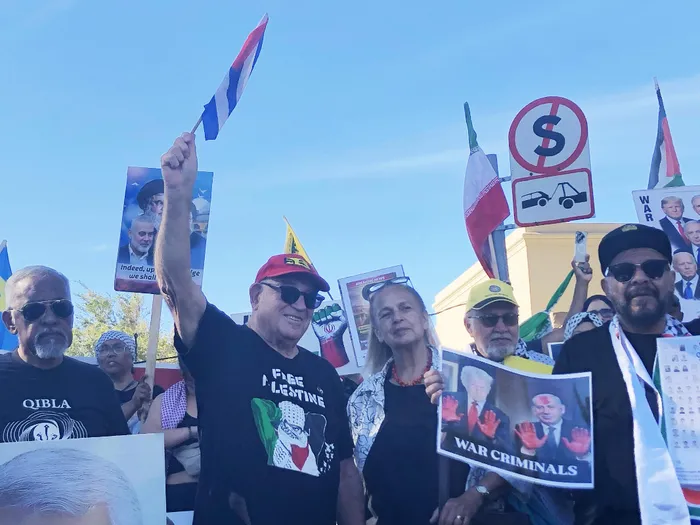
Ronnie Kasrils, veteran of the anti-apartheid Struggle, at the anti-imperialist protest outside the US Consulate in Cape Town on Friday.
Image: Lilita Gcwabe
A coalition of workers, political parties, civil society organisations, and community leaders gathered outside the US Consulate in Cape Town on Friday for the third consecutive anti-imperialist protest, renewing calls for an end to ongoing conflicts in the Middle East and beyond.
The demonstration builds on similar actions earlier this year, including a January protest, where groups voiced opposition to US foreign policy and expressed solidarity with countries such as Venezuela.
On April 10, protesters waved Palestinian flags and chanted "Free Palestine" and "Free Iran", among other slogans, as they condemned what they described as US-led imperialism affecting countries including Iran, Yemen, Lebanon, Cuba, and the Democratic Republic of Congo.
Programme director and member of the Palestine Solidarity Committee, Yusuf Chikte, opened proceedings by invoking the legacy of Chris Hani, whose assassination anniversary falls on April 10.
"They tried many years ago to assassinate Chris Hani, but we say 'Long live Chris Hani'," Chikte told the crowd. "Long live the militancy and radicalism of Chris Hani and the anti-imperialist stand he took.”
Chikte drew parallels between Hani’s assassination and that of other global political figures, framing the protest as part of a broader struggle against what organisers called global oppression.
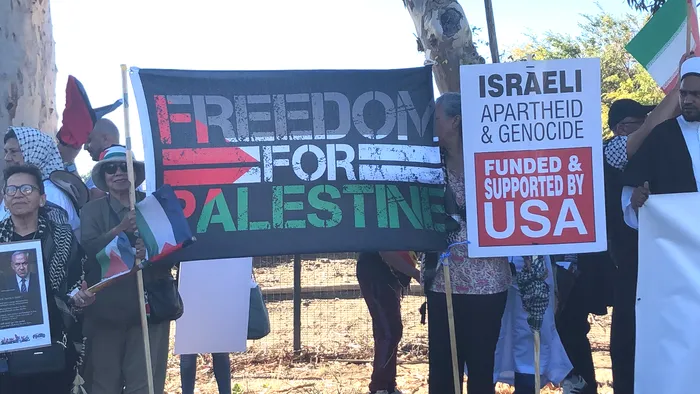
"Freedom for Palestine" reads a banner held at the protest outside the US Consulate in Cape Town.
Image: Lilita Gcwabe
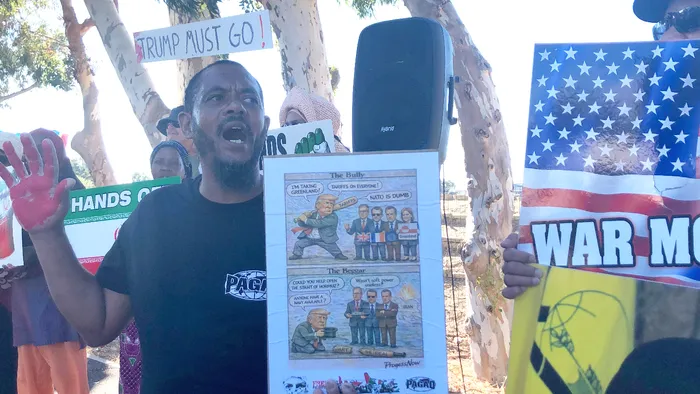
A protester from a civil society group symbolically displays “blood” on his hands to represent the violence of war, while holding a comic strip depicting Donald Trump as a bully. A “Trump Must Go” poster is seen in the background during the anti-imperialist protest.
Image: Lilita Gcwabe
Among the speakers was Ronnie Kasrils, anti-apartheid Struggle veteran and former Intelligence minister, who described the protest as the start of sustained nationwide action.
"This marks the beginning of a sustained mass action across our country. We will not stop until America and Israel cease their war on the people of Iran, Palestine, and Lebanon."
Kasrils said the movement would intensify in the coming weeks.
"This is just the beginning. We are taking this struggle to every corner of South Africa," he said.
He also took direct aim at the US leadership, adding: "We are here to tell Trump and his allies that we will not be silent in the face of war mongering and the bombing of innocent people."
Kasrils accused the US and Israel of escalating global conflict, referring to them as "war mongers".
Recent developments have seen intensifying airstrikes, civilian casualties, and mounting fears of regional destabilisation, particularly as fighting spreads to Lebanon and threatens key global oil routes.
The Strait of Hormuz, a critical global shipping route, has been disrupted, contributing to rising fuel prices and economic uncertainty worldwide, including in South Africa.
The protest also featured messages aligned with international labour movements.
While the World Federation of Trade Unions has consistently called for global solidarity against war and economic exploitation, it (the federation) has also broadly supported anti-war mobilisation and criticised Western military intervention.
Speakers further linked global conflicts to African realities, alleging that foreign intervention contributes to instability and resource exploitation in regions such as the Democratic Republic of Congo and Sudan.
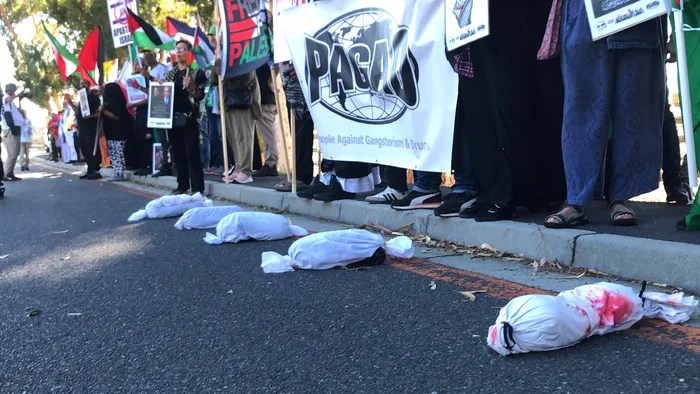
Representations of bodies were laid at the feet of protesters as part of a symbolic display highlighting the human cost of war.
Image: Lilita Gcwabe
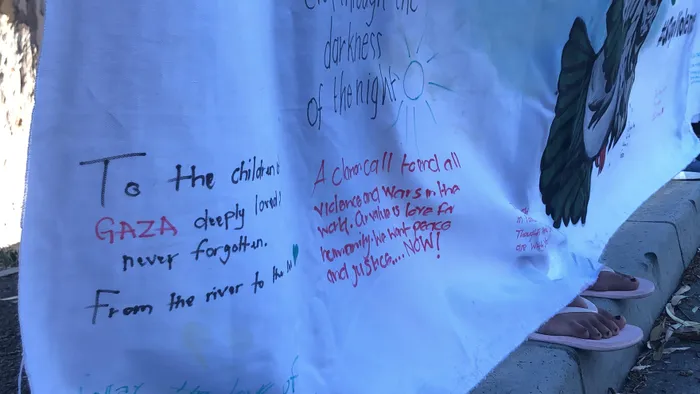
"To the children of GAZA deeply loved" reads a message on a banner held at the anti-imperielist protest on Friday.
Image: Lilita Gcwabe
Academic Ighsaan Taliep addressed the crowd, calling for collective resistance.
"We are here to register our collective outrage at US imperialism and Israeli settler colonialism," he said.
"We believe that people have the power to bring down oppressive regimes."
Political backing for the protest came from a range of parties, including the ANC, EFF, Al Jama-ah, GOOD Party, and the uMkhonto weSizwe Party.
ANC Western Cape leader Khalid Sayed also reflected on Hani’s legacy, describing him as a symbol of resistance.
"One of the first onslaughts on our sovereignty came as we entered democracy, and this continues today," Sayed said. "The US consulate continues to undermine our sovereignty."
Trade union federation Cosatu was represented by Melvyn Bruyn, who echoed calls for peace.
"We are here once again to tell the US government to stop the war that is killing innocent women and children daily. We are calling for a ceasefire," he said.
Organisers said the anti-imperialist coalition, formed earlier this year, plans to continue rolling protest action in the coming weeks as part of a sustained campaign.
lilita.gcwabe@inl.co.za