

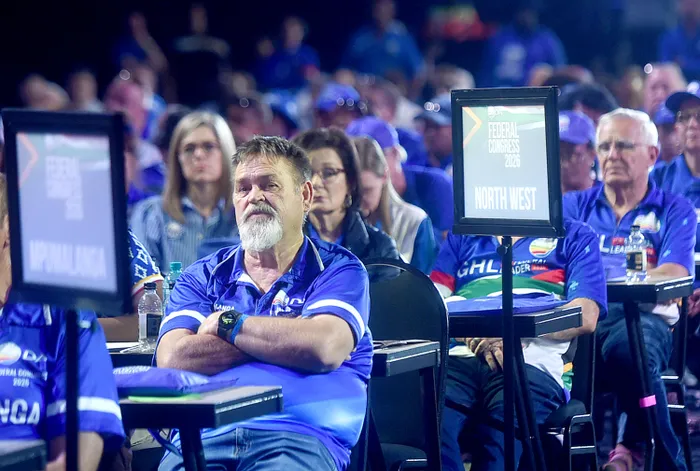
Party members following proceedings at the DA Federal Congress in Midrand on Sunday.
Image: Picture: Itumeleng English/ Independent Newspapers
The election of Geordin Hill-Lewis as Federal Leader of the DA has drawn a mix of cautious optimism and critical reflection from political analysts, following what the party has described as its largest and most orderly Federal Congress to date.
Held in Midrand and attended by around 2,400 delegates, the 2026 Congress marked a significant leadership transition, with Hill-Lewis taking over from John Steenhuisen, while Solly Msimanga was elected Federal Chairperson, replacing Helen Zille.
Political analyst Professor Ntwanano Mathebula described the Congress as a reflection of the DA’s organisational growth and institutional maturity.
“We have seen one of the largest Federal Congresses in the history of the Democratic Alliance, and that can be read together with the growing numbers we have seen in the party,” Mathebula said.
He pointed to the party’s recent electoral performance, including by-election gains, as evidence of sustained momentum, while also highlighting the absence of internal disputes during the Congress as a positive signal.
“There are no reported incidences in relation to compliance with the rules and policies of the DA, which must be applauded because it strengthens internal democratic processes,” he said.
This, according to Mathebula, reinforces the DA’s long-standing positioning as a party that prioritises constitutionalism and internal governance discipline.
Despite the scale of the Congress, Mathebula said Hill-Lewis’ victory was largely anticipated.
“It was a given that Hill-Lewis would be elected,” he said, suggesting that internal dynamics within the party, including the influence of senior figures like Zille, played a role in shaping the outcome.
Hill-Lewis’s rise comes after Steenhuisen opted not to seek re-election, effectively opening the path for new leadership at the top of the party.
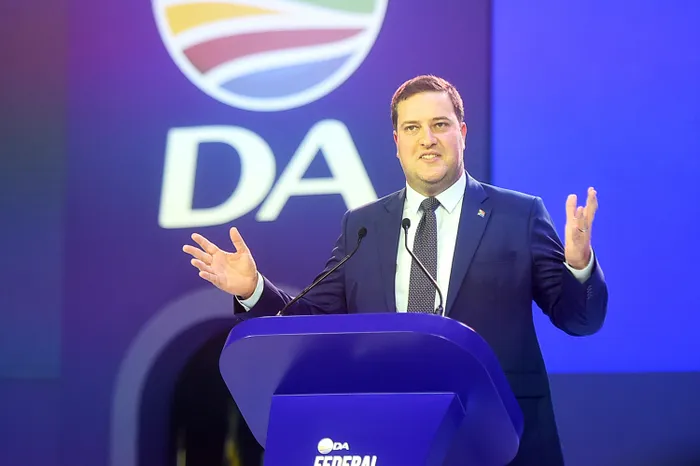
Cape Town Mayor Geordin Hill-Lewis has been elected leader of the DA.
Image: Picture: Itumeleng English/ Independent Newspapers
Analysts have also focused on the composition of the DA’s newly elected leadership, noting what some see as early signs of transformation, alongside lingering concerns.
Mathebula pointed to the election of Siviwe Gwarube as First Deputy Federal Chairperson as a notable development, alongside the inclusion of Cilliers Brink and Solly Malatsi in key roles.
“There is some form of transformation starting to show,” he said.
Another analyst, Professor Andre Duvenhage, told the SABC that the DA at the moment is currently the most representative of all parties in the country and that was reflected in their choices of leadership. Despite that, he added that Hill-Lewis was a favourite from the beginning.
“He made an exceptional presentation this afternoon. He reflected on the contribution of his predecessors. Among them, Tony Leon for his opposition role, Helen Zille for her ability to govern the Western Cape, Mmusi Maimane for making political connections on different levels and John Steenhuisen for representing the DA at the highest level,” he said
Mathebula, however, argued that more progress is needed, particularly within influential structures such as the Federal Council.
“When you look at the deputy chairpersons of the Federal Council, that is where we want to see more transformation,” he said, noting the continued dominance of established figures in those positions.
The issue of representation remains central to the DA’s long-term electoral strategy, particularly as it seeks to expand its support among black voters. Hill-Lewis, in his acceptance speech, acknowledged this challenge directly, emphasising the need for the DA to connect with voters who have historically not supported the party.
“We must earn trust the old-fashioned way, community by community, street by street,” he said.
Analysts say this approach will be critical as the DA heads into the upcoming local government elections, widely seen as a key test of the party’s national ambitions.
Mathebula noted that dissatisfaction within the ANC could create an opening for the DA, but warned that perception remains a barrier.
“Black voters must see the DA as a transformed organisation, something they can opt for when we go to elections,” he said.
The Congress comes at a time of shifting political dynamics in South Africa, with coalition governance becoming the norm and opposition parties increasingly positioning themselves as viable alternatives to the ANC.
Hill-Lewis has made it clear that the DA’s ambition extends beyond coalition participation to outright leadership of the national government.
“I am not satisfied with being a junior partner,” he said. “Our ambition must be to lead the national government.”
For analysts, the challenge now lies in whether the DA can translate organisational strength and governance track record into broader electoral appeal.
“The DA is positioning itself as a credible alternative. The question is whether it can build the kind of broad-based support needed to challenge for power at the provincial and national level,” he said.
karabo.ngoepe@inl.co.za