

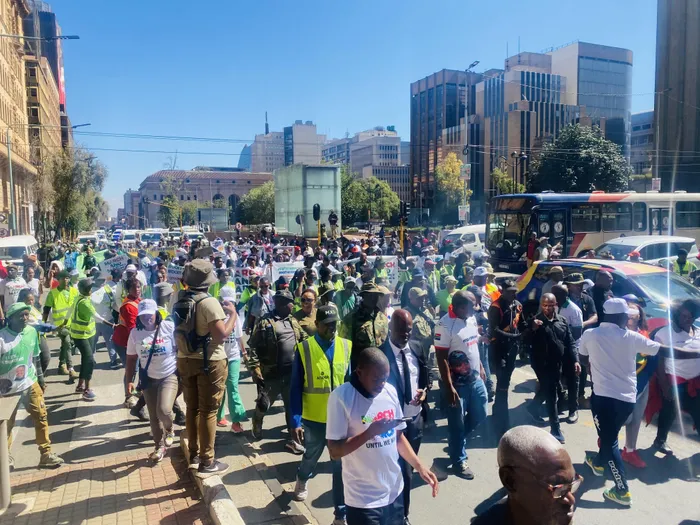
March and March protests in Johannesburg and Durban have intensified national concern over rising anti-migrant sentiment amid unemployment, misinformation and political rhetoric, with tensions warning of possible escalation.
Image: Simon Majadibodu/IOL
The recent wave of “March and March” protests and anti-migrant mobilisation in Johannesburg and Durban has intensified national concern over rising tensions linked to undocumented migration.
Government, policy experts and civil society are warning that South Africa is entering a more volatile phase shaped by unemployment, political rhetoric and misinformation.
The demonstrations, which have taken place in parts of Johannesburg’s inner city and Durban, have seen organisers calling for stricter immigration enforcement, tighter border controls and mass deportations of undocumented foreign nationals.
In several instances, businesses temporarily closed amid fears of looting and unrest, as movements such as March and March and Operation Dudula featured alongside other community groupings.
The developments have revived concerns about xenophobia, with analysts saying the mobilisation reflects a recurring cycle of anti-foreigner sentiment that intensifies during periods of economic strain and weak service delivery.
Minister in the Presidency Khumbudzo Ntshavheni said government views the mobilisation as part of broader attempts to exploit socio-economic grievances for destabilisation.
“We have seen consistent attempts to mobilise uprisings in the country. Small or minor issues are used to mobilise the uprisings. They have failed, and they will fail this time around,” she said.
Ntshavheni said citizens have the right to protest over illegal immigration concerns, but warned that violence would not be tolerated.
“South Africans are within their right to protest against the spiralling illegal immigration challenge, but violence linked to those protests in the past is not acceptable, and law enforcement must deal with the instigators of such violence,” she said.
She also warned against tribal mobilisation and identity-based exclusion, including incidents where individuals were reportedly asked to produce identification based on language.
Ntshavheni further condemned fake videos and images circulating online, saying they were intended to distort perceptions of South Africa internationally.
“The fake videos and images are not only fake, but they are intended to undermine the good reputation of South Africa internationally and undermine South Africa’s pursuit of a better Africa agenda,” she said.
She said government has strengthened migration enforcement through the Border Management Authority, which has deported more than 500,000 undocumented migrants, alongside spaza shop regulation and small business support measures.
Cabinet has also directed the deployment of 10,000 labour inspectors to intensify workplace inspections across agriculture, construction, hospitality and transport.
Spokesperson for the Minister of International Relations and Cooperation, Chrispin Phiri, said migration must be understood as a global issue.
“The challenge of international migration is a global phenomenon. We welcome the opportunity to discuss the push and pull factors behind it,” Phiri said.
He said responses must consider sending, transit and receiving countries, including how South Africa manages undocumented migration within a complex global system.
The Inclusive Society Institute said migration must be viewed through two lenses: protecting social cohesion and distinguishing between legal and illegal migration.
It warned that trust between communities is under strain, particularly around perceptions of undocumented migration.
“There is no inherent objection to legal immigration conducted within the framework of the law,” it said, but warned that current tensions are driven by “the perception, and in many cases the lived reality, of widespread illegal immigration,” which fuels pressure on services and community frustration.
The institute said unemployment, political dynamics and weak data systems are driving renewed mobilisation, allowing misinformation and perception to dominate public debate.
It also warned that immigration is increasingly used as a political tool, reducing complex socio-economic challenges into narratives that scapegoat foreign nationals.
Meanwhile, Independent political analyst Goodenough Mashego said responses to the protests should not focus on suppression but on reflection, arguing that many participants are deeply embedded in the same informal economies they are protesting against.
He said individuals involved in such movements should interrogate their everyday reliance on migrant labour and services, including domestic work, repair services, retail trade and informal business structures.
Mashego said many township economies are already economically interconnected with foreign nationals, including in property rental arrangements and small business operations.
He said participants should ask themselves critical questions about their own role in sustaining the system they are protesting against, arguing that some are “complicit” in the very dynamics they condemn.
“I think they should not be quieted. But the people that are taking part need to have introspection, am I abetting illegal immigration or am I contributing to illegal immigration?"
Cici Sebego, a sociology and community development facilitator, said the sentiment is historically rooted rather than spontaneous.
She said colonialism, apartheid and inequality continue to shape perceptions of competition and exclusion.
Sebego warned that once violence enters mobilisation, it becomes xenophobic through dehumanisation.
She said unemployment and service delivery failures often redirect frustration toward migrants, a process she described as “boundary construction”, where communities define who belongs and who does not.
Ahmed Kathrada Foundation spokesperson Anele Gcwabe said it reflects the reorganisation of long-standing sentiments that have previously manifested through movements such as Operation Dudula and earlier waves of xenophobic violence in 2008.
“What defines these moments is not their core message, but their timing and form,'' Gcwabe said.
She said periods of high unemployment, inequality and frustration with poor service delivery create fertile ground for mobilisation, where foreign nationals are often scapegoated for systemic failures.
She added that exclusionary language in public discourse has become increasingly normalised, particularly when adopted or tolerated by political or community leaders, lowering the threshold for mobilisation.
“March and March should therefore be understood as part of an established cycle where unresolved structural challenges, weak accountability and misinformation continuously reproduce similar movements under different names,'' said Gwcabe.
On the drivers of renewed mobilisation, she said multiple structural, political and social factors are at play.
She said high unemployment, rising living costs and limited economic opportunities create deep insecurity in communities, which is often redirected toward foreign nationals perceived as competitors for jobs, housing and services.
She added that these tensions are intensified by failures in service delivery and weak local governance, where communities often feel abandoned by the state and turn to informal or populist forms of mobilisation.
Gcwabe said political rhetoric also plays a key role, warning that when leaders adopt or tolerate anti-immigrant language, it “legitimises grievance-based narratives and blurs the line between civic engagement and exclusionary action.”
She further warned that misinformation circulating on social media and messaging platforms accelerates mobilisation, particularly unverified claims linking foreign nationals to crime or economic decline.
“These narratives are often repeated without challenge, reinforcing fear and resentment at community level,” he said.
Gcwabe also pointed to weak accountability, saying that in environments where there are few consequences for incitement or participation in xenophobic acts, such mobilisation becomes normalised over time.
She said civil society organisations, including SERI, Lawyers for Human Rights, Scalabrini Centre, PASSOP, the Consortium for Refugees and Migrants in South Africa, Sonke Gender Justice and Gift of the Givers, play a key role in response efforts but lack scale without stronger state coordination.
However, she warned that their impact remains limited due to structural constraints.
He said civil society cannot operate at the scale required to address unemployment, inequality and service delivery failures, adding that their work is often resource-constrained and project-based.
She said they also operate in environments where anti-foreigner sentiment has already been normalised, making dialogue and education efforts more difficult, especially without consistent political support.
Gcwabe said: “While civil society interventions are necessary and meaningful, they cannot succeed alone without coordinated governance and visible socio-economic intervention from the state.”
On prevention, she said stronger political leadership, improved local governance, public education and accountability for incitement are essential to stopping the normalisation of anti-foreigner sentiment.
She added that migration policy processes, including the Immigration Amendment Bill, must be properly implemented and clearly communicated to avoid uncertainty being redirected toward foreign nationals.
She also called for greater public engagement in policy processes, saying informed participation can reduce misinformation and political manipulation.
Gcwabe said that anti-foreigner sentiment will only be reversed if South Africa addresses both structural inequality and the narratives that sustain scapegoating.
IOL News