

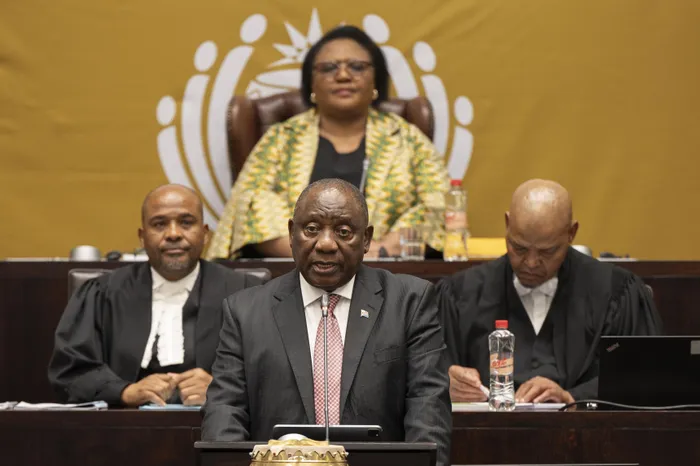
All eyes are on President Cyril Ramaphosa and National Assembly Speaker Thoko Didiza after the Constitutional Court set aside the 2022 National Assembly decision not to refer the report on Phala Phala to an Impeachment Committee.
Image: Armand Hough / Independent Newspapers
President Cyril Ramaphosa and Parliament have been thrust into the spotlight, with both expected to be in compliance with the judgment of the Constitutional Court on the Phala Phala farm scandal.
On Friday, the court upheld a court challenge by the EFF and the ATM when it set aside the vote of the National Assembly, taken in December 2022, when it declined to refer the report of the Independent Panel to an Impeachment Committee.
It declared the parliamentary rule, which deals with the removal of the president, inconsistent with the Constitution and provided a read-in provision pending an amendment.
The court ordered that the report of the Independent Panel be referred to the Impeachment Committee established in terms of the National Assembly Rules.
Legal expert, Advocate Paul Hoffman, said the judgment is a very big win for the Constitution and for the concept of accountability.
“The effect of the judgment is that the impeachment of President Ramaphosa will be taken forward unless he resigns or calls an election, which has been discussed in his Cabinet office,” Hoffman said.
Ramaphosa’s spokesperson, Vincent Magwenya, said the president respected the judgment and reaffirmed his commitment to the Constitution, the independence of the judiciary and the rule of law.
“The president has been consistent in providing his full assistance to the various enquiries into this matter. President Ramaphosa maintains that no person is above the law and that any allegations should be subjected to due process without fear, favour or prejudice,” said Magwenya.
Several parties, including those in the Government of National Unity, have committed to participating in the Impeachment Committee, citing their interest in accountability, constitutionalism, transparency, and the rule of law
Hoffman stated that it appeared that Ramaphosa was prepared to uphold the rule of law and to be guided by what the court has said in all judgments.
“So it is likely that the upshot of the matter will be that, if the president doesn't resign in order to avoid the impeachment hearing, the activities at Phala Phala will be examined by a committee of Parliament,” he said.
Although Parliament said on Friday it will carefully study and consider the court’s judgment and its implications, the EFF has already fired a letter to National Assembly Speaker Thoko Didiza.
EFF chief whip Nontando Nolutshungu demanded that Didiza urgently initiate the necessary processes to refer the matter to the Section 89 Impeachment Committee of the National Assembly in compliance with the order and reasoning of the Constitutional Court.
ATM spokesperson Zama Ntshona has demanded that the Impeachment Committee be convened without delay.
Parliament has already developed some procedures to give effect to the Section 89 inquiry.
In 2018, Parliament set out a process to be followed when an MP gave a notice of a motion to initiate proceedings in a Section 89 inquiry, including the appointment of an Independent Panel to conduct a preliminary inquiry.
A panel led by retired Chief Justice Sandile Ncgobo found that there was prima facie evidence that the Constitution and laws were violated.
The procedure on removal of the president does not go beyond the tabling of the Independent Panel’s report.
However, a similar process to former Public Protector Busisiwe Mkhwebane’s impeachment is likely to be followed, and a multi-party committee will be formed.
Political analyst Andre Duvenhage observed that the EFF has asked Didiza to immediately implement the Impeachment Committee to give effect to the judgment.
“They must first get a committee on impeachment. Maybe the committee will advise about the process, and then the committee will present their case to Parliament, and there will be decisions taken based on taking the process forward,” Duvenhage said.
Hoffman echoed the sentiment that Didiza must appoint members to the Impeachment Committee in proportion to their representation in Parliament.
“The committee will decide whether the impeachment should go forward or whether there are adequate explanations for the various adverse indications in the intolerable report,” he said in reference to the conclusion of the committee’s impeachment inquiry.
Political analyst Dirk Kotze agreed that Ramaphosa will now have to appear before the Impeachment Committee.
“It will follow the same procedure as that of the former Public Protector, Busisiwe Mkhwebane. So it means that there will be a person who will serve almost as an evidence leader, as the one who presents the charges against him, and then the evidence will be presented from both sides,” said Kotze.
He also said once the Impeachment Committee has concluded its work, there will be a vote by the National Assembly.
“For a decision to be made in favour of an impeachment, it needs a two-thirds majority,” said Kotze.
He stated that what was uppermost now was the procedure in handling the impeachment process.
“The end result might not be very different from where we are at the moment. The only difference is that depending on how the process in Parliament unfolds, it might become quite embarrassing for President Ramaphosa, because they might present evidence that he doesn't like to keep out of the public domain,” said Kotze.
Hoffman said Ramaphosa previously offered to resign but was persuaded to stay by the ANC.
“So on this occasion, he may dig in his heels and say, ‘look, I wanted to resign last time round’ … There is quite a strong argument, but I think there's a lot of logic in him resigning, if his party will let him,” he said.
But, political analyst Sandile Swana said the ANC has to find a dignified way of making sure Ramaphosa leaves office before the impeachment is concluded.
“He will be guided by the ANC. He offered to step down long ago. So the question now that is left is the modalities and the timing of the stepping down,” said Swana.
mayibongwe.maqhina@inl.co.za