

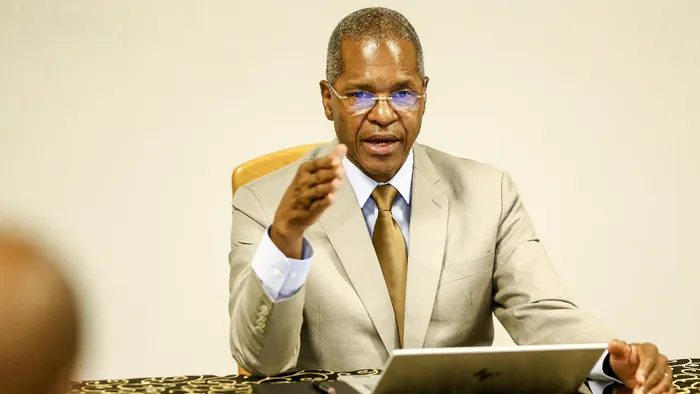
Cooperative Governance and Traditional Affairs Minister Velenkosini Hlabisa said his department is forging ahead with reforms aimed to address instability in coalition governments.
Image: Leon Lestrade / Independent Media
Parties entering into coalition governments after the 2026 local government elections will be forced to sign legally binding agreements as part of reforms introduced by the Department of Cooperative Governance and Traditional Affairs (Cogta).
This was revealed by Cooperative and Traditional Affairs Minister Velenkosini Hlabisa when he tabled the department’s R423.4 billion budget in the National Assembly on Wednesday.
Hlabisa said the department was forging ahead with reforms within the sphere of local government.
He said the Local Government General Laws Amendment Bill will be introduced in Parliament to improve governance and operations efficiently, along with the Municipal Structures Amendment Bill and the Coalitions Bill, to address instability in coalition governments.
“Political parties that will form coalition governments post-November local government election will be required to enter into formal written agreements outlining their commitments and responsibility.
“These agreements will be legally binding and will help to maintain stability in the municipal council,” he said.
Hlabisa also said the Independent Municipal Demarcation Authority Bill will strengthen transparency and accountability, while the draft Fire Services Bill will modernise the fire services governance.
“These reforms are about one thing: stabilising municipalities so that service delivery becomes reliable, predictable, and consistent.”
Hlabisa further said the preparations for the local government elections were firmly on track.
The Inter-Ministerial Committee on municipal elections was in place, finalisation of council numbers and delimitation of 4,488 wards with the Independent Electoral Commission engaged in on-going work such as voter registration.
“The key principle guiding us in preparing for the local government elections on 4 November 2026 is that the elections must be free, fair, credible and beyond reproach,” he said.
The minister said the review of the 1998 White Paper on Local Government was completed under the theme that every municipality must work.
“This is not a slogan, it is a commitment,” he said about the document that recognised that the current policy framework no longer fully reflects the complex realities experienced by the municipalities.
“The revised White Paper recognises that local government today operates in a far more complex environment than in 1998. It provides a renewed and realistic framework to strengthen governance, accountability, and service delivery to give effect to this,” said Hlabisa.
The IFP leader was tabling the department’s budget for the second time under the Government of National Unity.
A total of R422.5 billion has been allocated for cooperative governance and R900 million to traditional affairs, in an effort to strengthen local government, support the institution of traditional leadership and ensure that cooperative governance functions effectively across all spheres of government, said Hlabisa.
“This budget, honorable members, is not an accounting exercise. It is a delivery instrument. It must translate into functioning municipalities and improve lives, reforming the local government system.”
He also said South Africans rightly expected municipalities to function effectively and deliver services consistently.
The minister observed that municipalities cannot function where appointments are irregular, leadership was unstable, and accountability weak.
“We are, therefore, strengthening competency-based recruitment, professionalisation of municipal administration, performance management systems, and ethical leadership.
“The introduction of the code of ethical leadership, together with the ethics training program, is reinforcing accountability.”
Hlabisa also said despite persistent challenges in local government, encouraging progress was beginning to emerge in municipal audit outcomes.
“Fifty nine municipalities have improved their audit outcomes, and 41 municipalities have achieved clean audits. This tells us something important. Where there is discipline, monitoring and consequence management, improvement follows.”
However, Hlabisa said far too many municipalities continued to struggle.
“Weak governance and financial mismanagement remain a serious concern. With targeted interventions in distressed municipalities, the government continues to provide differentiated support to municipalities experiencing severe governance, financial and service delivery challenges.”
He said Cogta will not hesitate to intervene where municipalities fail communities.
Hlabisa noted that the country was experiencing increasingly frequent disasters with the Western Cape, Eastern Cape, Northern Cape, Free State, North West, and Mpumalanga being affected recently.
“We must strengthen early warning systems, preparedness, risk-informed planning, and climate resilience.”
mayibongwe.maqhina@inl.co.za