

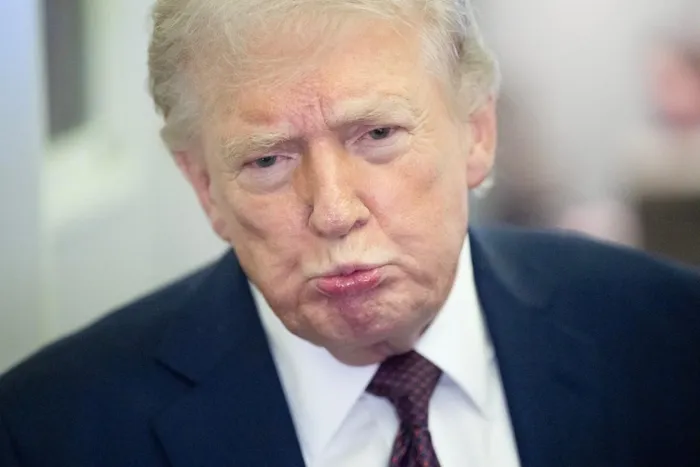
The US and Israel's recent military actions against Iran have led to unexpected consequences, revealing a failure in strategy and intelligence. Retired Brigadier General Vuyisile Radebe explores the ramifications of the conflict and the challenges faced by President Trump in acknowledging the reality of the situation.
Image: AFP
The surprise US and Israeli "decapitation strike" against Iran on February 28, 2026, which killed Ayatollah Ali Khamenei, the Shiite spiritual leader, including a host of other Iranian leaders, was conducted with the forlorn hope that the strike would lead to the collapse of government and the subsequent breakdown of law and order.
According to the planners, the precision strike would be swift, the Iranian government would collapse under the weight of the resulting chaos, while the opposition, already prepared by Israeli intelligence and awaiting the right moment, would then rise and immediately fill in the void by forming a pro-Western government amenable to Israel and US dictates. True to Carl von Clausewitz’s dictum that "no campaign plan survives first contact with the enemy", the Iranian government did not collapse; instead, it recovered, reorganised, and fought back. The US-Israeli decapitation plan, reportedly conceived by Mossad, the Israeli intelligence agency, was assessed to be sound by their American counterparts.
The American “OPERATION EPIC FURY” was initiated and Iran responded with its own “OPERATION TRUE PROMISE 4”, a sustained wave after wave of missile and drone attacks on Israel and US military bases and assets in the Middle East.
What is currently at play in this volatile region is not only the manifestation of the worst intelligence failures in history, but also, the real risk of an unending spiral of escalation among the warring parties that threatens to plunge the entire world into a serious crisis hitherto unforeseen. The Middle East is the crucial supplier of energy to the world, and a sustained disruption of the supply chains and the destruction of the energy infrastructure are leading to skyrocketing prices, raising concerns of a long-lasting global recession.
The Middle East conflict is likely to fast-track the decline of the US as a global hegemon and sink Israel further into a deeply reviled and isolated pariah state – a country referred to by the erstwhile Secretary of State General Alexander Haig as the ‘unsinkable US aircraft carrier’ in the Middle East.
In a climate where the weaponisation of information leads many to form opinions and shape responses on the basis of incomplete and often distorted facts about the conflict, it becomes necessary to take heed of Aristotle when he teaches that ‘if you would understand anything, observe its beginning and development.’ Let us therefore look back to gain a better understanding of the present.
Iran’s nuclear program was established with the help of the US in 1957 as part of President Eisenhower’s ‘Atoms for Peace’ Initiative, with the first reactor coming into operation a decade later in 1967. This cooperation included the transfer of Highly Enriched Uranium (HEU) from America to serve as fuel for the Tehran Research Reactor. Germany and France also contributed to Iran’s nuclear program by building reactors in Bushehr (1975) and Darkhovin (1977), respectively.
The cooperation between the US and Iran, which extended into the spheres of intelligence and security, suffered an irreversible setback following the 1979 Iranian Revolution, which established an anti-American theocracy under the supreme leader Ayatollah Ruhollah Khomeini. Since then relations between the two countries have remained perpetually strained, characterised by the US and its allies seeking to sanction and isolate Iran as a so-called sponsor of terrorism. Successive US administrations have been consistent in pursuing this policy, threatening to use military force if necessary to alter Iran’s behaviour and prevent it from acquiring nuclear weapons.
Despite the diplomatic success resulting in the 2015 Joint Comprehensive Program of Action (JCPOA) agreement, from which the US withdrew in 2018, the neo-conservative faction of the US political establishment, in alignment with Israel regional ambitions, were never too happy with anything short of an outright overthrow of the radical Iran government on the pretext it’s close to building a nuclear bomb. This hoax of an ‘imminent Iranian nuclear threat’ was spread even though the assassinated Supreme Leader Ayatollah Ali Khamenei declared a fatwa in the 90s prohibiting Iran from acquiring nuclear weapons. Meanwhile,Israel, which always trumpets an existential threat emanating from nuclear-armed Iran, is the only undeclared nuclear-weapon state in the Middle East, and a non-member of the NPT.
The Israeli nuclear program started in the early 50s with the help of Western countries such as France, which built the first reactor at the Dimona facility situated in the Negev Desert. By the year 1966-67, it is reported that Israel had already built a nuclear bomb. This period coincides with the end of the 6-day Arab-Israeli war, where a victorious Israel annexed large territories of Egypt, Lebanon and Syria. Experts estimate Israel to be in possession of about 90 plutonium-based nuclear warheads, with a Plutonium stockpile enough to build a further 100 to 200 warheads in times of national security crisis. This number tallies well with former US Secretary of State General Colin Powell’s leaked 2016 emails which put Israel’s nuclear warheads at approximately 200.
A research analyst from the Centre for Arms Control and Non-proliferation, Shawn Rostker, in an interview with a French newspaper, Le Devoir, dated July 25, 2025, asserted that ‘It’s an open secret that Israel has nuclear weapons, even though [its leaders] have never officially confirmed or denied it’. On these matters, Israel maintains a policy of strategic ambiguity – neither agreeing nor denying the allegations. Given the 1986 revelations by the Israeli whistle-blower, Mordechai Vanunu, regarding the country’s nuclear program at the Negev Desert, and the symbiotic relationship between the US and Israel, it is inconceivable that the US did not know from the outset about Israel’s nuclear arsenal. In the face of all the publicly available information, to date, there has not been any diplomatic outrage levelled against Israel from Western governments, demonstrating yet again Western hypocrisy at its best when it comes to Israeli violations of international law and other gross atrocities committed since its creation in 1948.
The US and Israel never planned for a prolonged war with Iran. With military and other resources over-stretched from engagements on multiple fronts, it is reported that the two aggressor nations entered the war heavily invested in a ‘shock and awe’ strategy that would end in a quick victory. However, it is week five, and stockpiles of critical munitions are beginning to grow thin. For instance, in the National Interest Journal article by Harold Kaas dated March 15, 2026, its reported that in the first 72 hours of ‘OPERATION EPIC FURY’ the US used an estimated 400 Tomahawk cruise missiles, almost 10% of the available Tomahawk stockpile – an amount exceeding the total of such missiles produced in the past five years costing between $2million and $4million each, depending on the variant.
Iran, on the other hand, mainly uses swarms of Shahed and Geran drones that cost as little as $30,000 apiece. Moreover, the US reportedly produces only 90 Tomahawk missiles per year, with no industrial capacity to increase production not only of Tomahawks, but also of other weapon systems across the board as well. This explains the US call to allies, including Ukraine, to repatriate their weapon systems and munitions to the Middle East theatre of war with Iran.
The Strait of Hormuz remains largely closed to maritime traffic, with Iran establishing a toll and charging each passing vessel a $2 million fee in Chinese Yuan (RMB), thus accelerating the de-dollarisation process and dealing another blow to American financial world hegemony. Energy prices are skyrocketing, and the global economic outlook from leading institutions such as the World Bank is grim. To compound matters, the Strait of Al Mandeb has also been closed as the Yemeni Houthis have joined the war on the side of Iran.
Iran has attacked and damaged more than 27 military bases, including military equipment and other assets worth billions of dollars. The US sensor capabilities, air defences and air superiority have been severely degraded. In response to US overtures for a ceasefire, Iran has put forward a 10-point plan which include, among other key conditions, right to nuclear enrichment, reparations for war damages, lifting of all sanctions, maintenance of control of the Strait of Hormuz, American guarantee of non-aggression with Iran, to name but a few.
The strategic end-state of the conflict launched by the US and Israel on February 28 was regime change through decapitation of the Iranian leadership and replacing it with a pro-Western government. The US-Israeli project has failed. As Iran continues to wreak havoc and fire devastating waves of missiles and drones at Israeli cities, American military bases and strategic assets in the Gulf region, Trump’s claims that the Iranian navy, air force and missile capabilities have been totally destroyed are portrayed as untrue.
The reports that the US and Israel are running short of interceptor missiles, with almost 80% of Iranian missiles hitting their intended targets, put Trump under pressure to frantically search for an off-ramp to the conflict – without conceding defeat. He paints a picture of a beleaguered President,trying very hard, without success, to maintain the façade of American military superiority in the face of a humiliating strategic defeat.
Although at great cost to the world, the war on Iran will eventually come to an end at some point, President Trump will have to the face the reality of the situation and save whatever little respect still remains of what former President Obama referred to as ‘the strongest military force that the world has ever known’.
Perhaps at a more personal level, President Trump should stop running away from the skeletons in his closet.

The US and Israel's recent military actions against Iran have led to unexpected consequences, revealing a failure in strategy and intelligence. Retired Brigadier General Vuyisile Radebe explores the ramifications of the conflict and the challenges faced by President Trump in acknowledging the reality of the situation.
Image: Supplied
* Brig Gen (ret) Vuyisile J.S. Radebe is a master’s graduate in Military Science. He is a founder and Executive Director of Africa Global Security Institute (AGSI). He is keenly interested in Peace and Conflict Studies, Private Military and Security Companies (PMSCs), Global Disarmament and Geopolitics.
** The views expressed do not necessarily reflect the views of IOL or Independent Media.