

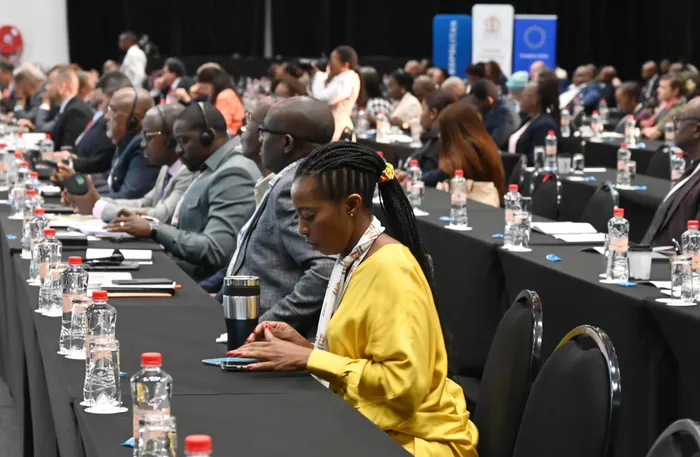
Public Protector Advocate Kholeka Gcaleka talked about accountability and also the under resourcing of the entity
Image: Ayanda Ndamane/ Independent Media
Public Protector Advocate Kholeka Gcaleka says genuine accountability in government must go beyond written responses or public statements, emphasising that honesty, learning from mistakes and consequence management are central to restoring public trust.
Speaking during a panel discussion on accountability and action, Gcaleka said some state functionaries misunderstood the meaning of accountability.
“Some state functionaries believe that by merely responding to the Public Protector, to Parliament, or even to the media, they are being accountable. That’s not accountability; it’s merely responding,” she said.
“Full accountability starts with honesty. If there are gaps in what you should have done, be honest about those, and about the lessons learnt. But a critical feature of accountability is consequence management. Where there is no consequence management, we cannot say there has been accountability.”
Gcaleka said the Public Protector’s constitutional powers were specifically designed to enforce accountability through remedial action and public reporting.
“The Act calls on the Public Protector to publicly report on matters that have been finalised. The rationale behind that is for the public to know what we have done against state functionaries, and for the public to hold them accountable. That is what democracy is about,” she said.
She said the Constitutional Court had confirmed that the Public Protector’s powers to take remedial action are binding.
“Our power is to take, not make, remedial action. That means it’s mandatory,” Gcaleka said. “Once the Public Protector has taken remedial action, state functionaries need to implement it, reform, and ensure there is change from their improper conduct which prejudiced members of the public.”
Gcaleka criticised officials who ignore her office’s findings, saying that silence cannot be equated with accountability. She added that her office was working to strengthen its powers in line with Constitutional Court judgments, including proposed amendments submitted to the Department of Justice in 2023.
“Currently, the Public Protector can only take civil action against the non-implementation of remedial action, but we don’t have the money to do that for every case. We have therefore proposed that non-implementation, which is unlawful, should be treated as a criminal matter,” she said.
Gcaleka said her office has already seen progress in compliance with remedial actions.
“In 2022, the implementation of our remedial action was sitting at 2%. Just three years later, we are at 54%. It’s still low, we want to reach 100%, but we have seen a significant difference,” she said.
She also addressed concerns about under-resourcing in the Public Protector’s office, saying that additional funding had been secured to boost investigative capacity.
“The Public Protector’s office has evolved. We started off with eight people, but as our democracy matures, the challenges faced by citizens have grown. We have received additional funding for the next three years, which will go into resourcing our capacity and capabilities,” she said.
On the Tembisa Hospital saga, Gcaleka said her office had previously investigated the irregular appointment of the hospital’s CEO and found the process unlawful, which led to the official’s removal.
“In that case, we found that the appointment was not in line with legal and policy prescripts. These irregular appointments often lead to maladministration and ultimately corruption,” she said.
“When people want to commit corruption, they put in place people they know will execute those actions. That is a pattern we continue to see.”
Gcaleka said her office would continue to work with institutions such as the Special Investigating Unit (SIU) and the Asset Forfeiture Unit to address systemic corruption.
“Corruption is an ecosystem; it is not a singular act,” she said. “We must all work together to break that ecosystem and restore accountability.”
Meanwhile, Organisation Undoing Tax Abuse (Outa) researcher Dr Rachel Fischer said citizens also had a role to play in ensuring clean governance.
“Access, accountability and action, those are the three A’s we must focus on,” Fischer said.
“We need accessible and transparent institutions, digital infrastructure, and lifestyle audits to identify ghost workers and stop the waste of public funds. We have the names and the evidence; what we need now is action.”
mandilakhe.tshwete@inl.co.za