

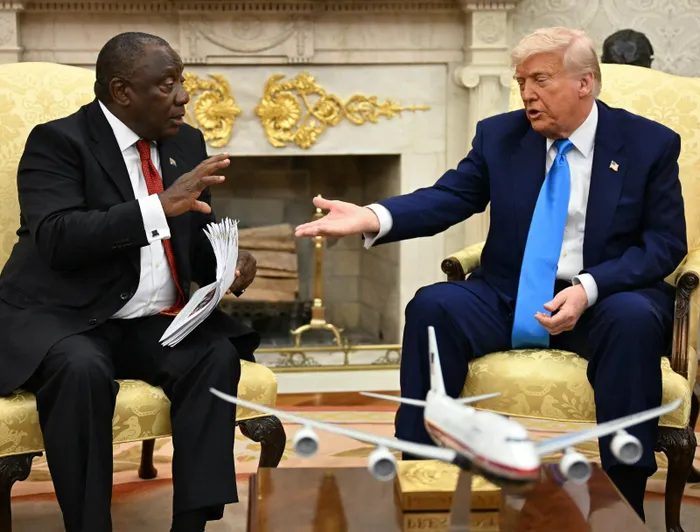
President Cyril Ramaphosa with Donald Trump in the White House.
Image: File
While experts agree that there won't be any consequences for South Africa, as threatened by the United States of America (US), after the recent deportation of Kenyan nationals who had illegally taken up work processing the applications of Afrikaner “refugees” to the United States, they do note that the relationship must be handled sensitively.
The US Embassy in Pretoria said that it condemned the government’s recent detention of US officials performing their duties to provide humanitarian support to Afrikaners.
“Furthermore, the public release of our US officials’ passport information is an unacceptable form of harassment. This can only be seen as an attempt to intimidate US government personnel in South Africa on official business.
“The United States will not tolerate such behaviour toward its government’s officials – or toward any of its citizens – who are legally and peacefully operating abroad. The public release of personal identifying information puts the official in harm’s way.
“Failure by the South African Government to hold those responsible accountable will result in severe consequences,” they said.
Department of International Relations and Cooperation (Dirco) hit back, stating that the recent deportation of seven Kenyan nationals by the Department of Home Affairs was conducted in strict accordance with South African immigration law.
“These individuals were engaged in work without the necessary work permits. The government will not negotiate its sovereignty and the implementation of the rule of law.
“Separately, we have noted an unsubstantiated allegation regarding the private information of US officials. South Africa treats all matters of data security with the utmost seriousness and operates under stringent legal and diplomatic protocols. We categorically reject any suggestion of state involvement in such actions,” Dirco said.
“Official channels have been opened with the United States Government to seek clarity on this allegation and to reinforce that our bilateral engagements must be grounded in mutual respect and factual dialogue.”
Political economist, Professor Isaac Khambule, said that the US is blowing hot air around the situation.
“They understand government protocols as well as issues of bilateral relations and how nations are supposed to behave, especially embassies in foreign countries. In this case, they know very well that they were at fault.
“They need to go through proper channels for them to be able to hire people to assist their embassy in the country in terms of processing these applications. So what we're seeing right now is just two countries that are at loggerheads, but the US definitely knows that it is in the wrong, and there won't be any consequences for South Africa.”
He also echoed Dirco’s sentiment that the US was trying to undermine the country's sovereignty.
“They understand our labour laws. They understand what it takes for them to bring in external people to work in the country because the Kenyans are supposed to go through diplomatic channels in order for them to be given the visas that would allow them to work, instead of using their tourism visas. And in this particular case, as I've mentioned, it is an issue of undermining the country's sovereignty.
Khambule also highlighted that the US itself has the issue of ICE, and they are busy cracking down on illegal immigrants who are working in the country, “so they can't then come to South Africa and then say we want our people there to work without any legal paperwork, whereas on the other side they're also cracking down on the same thing”.
“That on its own just screams of hypocrisy from the US.”
Political scientist at the North-West University, Professor André Duvenhage, said this diplomatic matter leaves us with a lot of questions and that South Africa cannot afford to be in a negative relationship with the US at this point.
He was also doubtful of whether the US actions undermine the country’s sovereignty.
“When are you undermining someone's sovereignty? If you have trade relations and someone has trade interests within your country, is it undermining your sovereignty? I don't think that to be the case.
“You can have two sovereignties in conflict, but sovereignty as a concept is relative, especially within a global environment where we are seeing more and more economic interactions within a global context,” Duvenhage said.
“I think that the whole sovereignty thing is pure rhetoric. I think there's no direct attempt to undermine South Africa's sovereignty. I think there are fundamental differences about policy issues which are bringing the two sovereignties into conflict with each other.
“If we turn the argument around, South Africa saying they won't provide the United States of America with strategic minerals, is this an undermining of their sovereignty? I don't think it is the case, but you can define sovereignty in more than one way,” he said.
“The point that is clear to me is that this is going to have an impact on South Africa's economy.
“Those who have the power are dealing the cards, and to me there's no doubt that South Africa in no way can compete with the United States. I think the best will be for South Africa to reposition itself internationally to start working on their own internal dispensation in many ways.
“And that internal dispensation means we need to get our own house in order so that it can promote economic growth and development, and then the money will automatically flow to South Africa. It's not going to be dependent on presidents Donald Trump, Vladimir Putin or Xi Jinping or whoever the case may be. We need to start at home.”
theolin.tembo@inl.co.za