

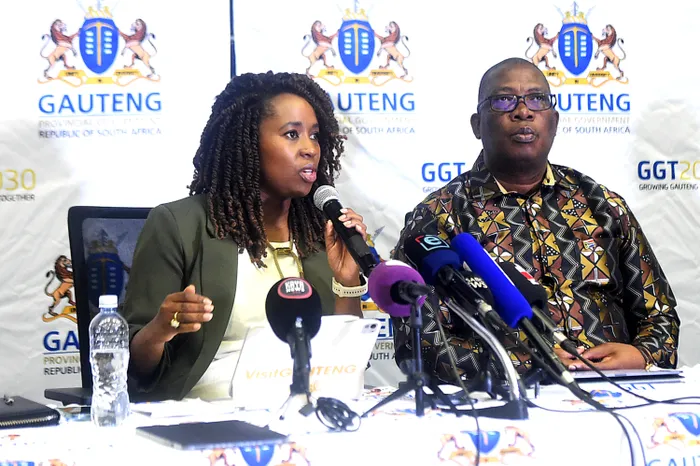
Gauteng Premier Panyaza Lesufi and MEC Vuyiswa Ramokgopa addressed the media on the province's latest intervention following the recent Foot-and-Mouth Disease outbreak
Image: Itumeleng English / Independent Newspapers
Gauteng Premier Panyaza Lesufi and MEC for Agriculture and Rural Development, Vuyiswa Ramokgopa, have launched a comprehensive provincial response to the Foot-and-Mouth Disease (FMD) outbreak that has affected over 261,000 animals.
On Tuesday, during a joint media briefing, the MEC indicated that the province's accelerated multi-stakeholder approach includes R16 million in funding, nearly 300,000 vaccine doses, and strict quarantine measures as the province battles one of South Africa's most severe livestock health crises.
The recurring disease, which has persisted for several months, has necessitated national and provincial interventions.
Consequently, there are reports that the Minister of Agriculture, John Steenhuisen, has proposed that the national government should consider declaring a national state of disaster in response to this outbreak.
Officials have tracked the origins of the Gauteng outbreak to April 2025 in the West Rand Municipality, where investigations revealed the likely cause as being attributable to the illegal transport of cattle from an infected zone in KwaZulu-Natal for auction.
The provincial government has indicated that as of January 23, 2026, the province is actively managing 195 lab-confirmed outbreaks. It is estimated that more than 261,000 animals are affected in Gauteng.
Ramokgopa said the province's rapid response approach aligns with the National FMD Control Strategy but aims for earlier suppression of the virus and progression towards disease freedom in the province.
The MEC further stated that, while the National FMD Control Strategy aims to regain FMD-free status, regulated under the Animal Diseases Act for over 10 years, the goal of the provincial government is to quickly suppress the virus and achieve disease freedom status as soon as possible, while complying with national and international World Organisation for Animal Health (WOAH) standards.
"Our approach brings together experts from veterinary science, law enforcement, transportation, environmental management, and the social sector, including community leaders, to make a strong and unified response possible.
"This strategy focuses on containing the outbreak first, following the regulations, expanding vaccination to improve herd immunity at the provincial level, and clear communication to get public support and change attitudes," the MEC said.
According to the Gauteng Department of Agriculture and Rural Development (GDARD), some of its key actions to date include R16 million funding from the Comprehensive Agricultural Support Programme (CASP), currently being used for vaccines, tests, cleaning supplies, and mobile units to help stop the spread of the disease.
As a result, the province revealed that more than 286,000 vaccine doses have been administered, and 90,000 more have been ordered.
"All farms that have been infected are under strict quarantine, and new cases are being investigated. While in its effort to raise awareness, the department is conducting direct consultation with farming communities to ensure compliance and combat the scourge of misinformation," the MEC added.
siyabonga.sithole@inl.co.za