

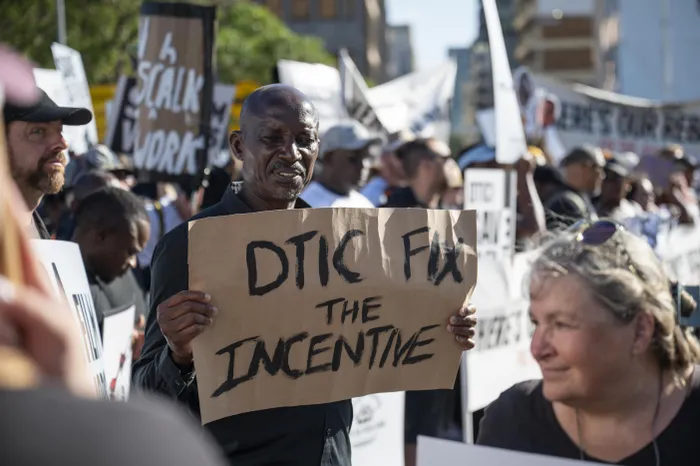
Picketers outside Parliament last month said that without the incentive, there are no jobs available.
Image: Armand Hough / Independent Newspapers
Minister of Trade, Industry and Competition Parks Tau and his deputy, Alexandra Abrahams, appeared before Parliament’s portfolio committee where, alongside film industry stakeholders, they accounted for the issues raised in last month's protest, and other issues hurting the sector.
Filmmakers, producers, actors, crew members, and other workers in the sector united in January to protest outside Parliament. The protest was organised by a coalition of industry bodies calling for urgent reform of the stalled incentive system.
Leaders of the coalition said that since the Film and Television Production Scheme had stopped working effectively, the industry had been in decline.
In a presentation on Tuesday, the Department of Trade, Industry and Competition (DTIC) Director-General Simphiwe Hamilton explained that the incentive functioned as a grant, and that it has been oversubscribed since 2021 due to exceeding demand.
Hamilton explained that in 2020/21, virements were made to shift funds from the Film and TV incentive scheme due to the likelihood of underspending as most productions were deferred as a result of Covid-19.
In 2022/23, R1.2 billion (-R68,366,024 from the scheme) was shifted by the incentive branch to the Social Employment Fund. In 2023/24, the film incentive budget was reduced by R136 million (if compared to 2022/23), with the overall branch budget reduced further by R1 billion. There were also zero approvals in 2024/25 and 2025/26, due to the high contingent liability.
Hamilton added that the financial incentive commitments approved in a given financial year shall be disbursed over the subsequent two financial years.
Tau and Abrahams, while answering questions from MPs, fingered the National Treasury as partly responsible for the current difficulties.
“We are also on the same side to the extent that we believe that, in fact, the incentives programme needs significant re-capitalisation. Specifically, there are programmes that have incurred more negative impact as a result of budget reallocation.
“And there's a rationale, of course, for why incentives were created for these programmes because the economic case was made for why you need the incentives to grow the industry and to help it contribute to the growth of the country's economy,” Tau said.
“In a situation where a programme underperforms, Treasury responds by reallocating to other programmes. In this situation, we believe that the relocation was not appropriate, and we have continued to raise the matter with Treasury.”
Abrahams added that they are committed to addressing the issues raised by the film industry and are invested in revising the incentive scheme so that it functions optimally, which includes moving away from one-size-fits-all modelling.
“To give you a case in point… a foreign film company might have the money to put together a production, and might probably need a tax discount later on, but that can't be the same for an emerging film producer in South Africa.
“That person would require a cash transfer to enable them to set up production.
“So, we are talking about trying to build the scheme such that it has those different tiers for different-sized firms,” Abrahams said.
“That's one model, but the limitation we have, and this is why we keep raising the National Treasury thing. We don't set tax policy in South Africa as the DTIC. We might have a correct perspective on how we think this thing works, but we still need the National Treasury to come on board and approve that modelling. So that work is under way,” Abrahams said.

Independent Producers Organisation Deputy Chairperson Wandile Molebatsi holds the memorandum as Department of Trade, Industry, and Competition Portfolio Committee Chairperson Mzwandile Masina signs. Pictured with them is Member of Parliament representative for the DA, Mdolundi Mdluli.
Image: Supplied
Delon Bakker and Wandile Molebatsi from the Independent Producers Organisation thanked the committee for hearing the complaints raised in their protest and what they raised in person.
“We talk a lot about numbers, and we talk a lot about a policy framework... (and) about policy certainty in the regulatory environment. And as a business person, I've never been able to understand it the way that I do now,” Molebatsi said.
“I'm really looking forward to engaging with the department and understanding how we can actually build this regulatory environment together, because we really believe that our sector is patriotic, but we are here to solve a problem that we all face as South Africans. We believe that we can be that solution for the country.”
The portfolio committee Chairperson, Mzwandile Masina, said that given the importance of the sector, there is a need to strengthen communication and resolve existing issues.
Masina said it is important for the DTIC to engage the sector on guidelines to facilitate issues of compliance.
“We acknowledge that there is a challenge with funding of incentives, while we understand our country's fiscal constraints, the DTIC and National Treasury need to engage to ensure that there is a clear position that will provide certainty and improve investor confidence.”
theolin.tembo@inl.co.za