

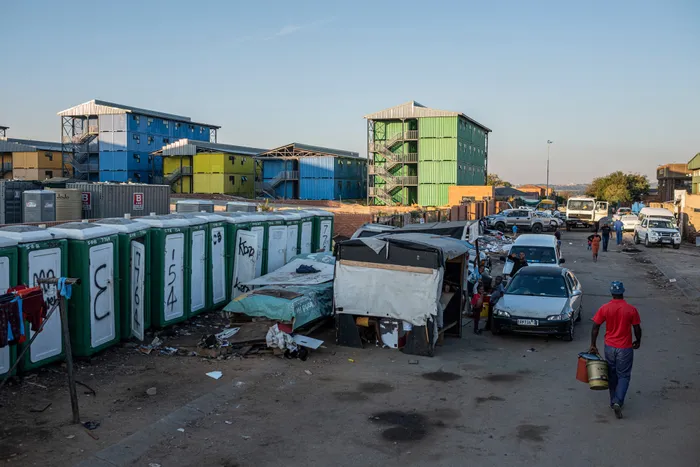
The killing of Abahlali baseMjondolo's Zweli Mkhize has raised concerns about the so-called “shack mafia”, who sell land to the poor.
Image: Emmanuel Croset / AFP
The assassination of Zweli “Khabazela” Mkhize, Abahlali baseMjondolo (AbM) treasurer of the eNkanini branch in Gauteng, has exposed the existence and operation of the so-called “shack mafia” in many parts of the country.
This is after the movement revealed that Mkhize was fighting for the land at the time of his assassination. Mkhize was shot by two gunmen last week while visiting a friend at the eNkanini settlement in Allandale.
AbM spokesperson Thapelo Mohapi said some people wanted to use the land for profit and sell it to the poor.
Mohapi added that Mkhize has been clear that the land is not for sale, especially to the poor.
AbM is a prominent South African shack dwellers’ movement formed in 2005 to protest against evictions and poor living conditions.
Security expert and former Interpol ambassador Andy Mashaile said the “shack mafia” is involved in these killings.
He said this is an unknown syndicate that operates in informal settlements, which works hand in hand with local councillors, selling stands to the poor.
Since its inception, the movement has reported the loss of at least 25 leaders (excluding Mkhize), with 14 identified as targeted assassinations.
The shack dwellers’ movement attributed these killings to political motives, often involving local “elite” networks or state actors, linked to struggles over land and housing corruption.
Local ANC councillors have been implicated in some hits, and despite these killings, only a few convictions have been secured by authorities.
In 2016, two ANC councillors were sentenced to life imprisonment for the 2014 assassination of Thuli Ndlovu.
In July 2023, Khayalihle Gwabuzela (also known as Khaya Ngubane), a local ANC Youth League member, was found guilty of the 2022 murder of eKhanana leader in Durban, Ayanda Ngila, and sentenced to 15 years in prison.
Two brothers, Samson and Mhlanganyelwa Ngubane, were arrested for the murder of Nokuthula Mabaso in 2022, but were later released after a post-mortem report allegedly disappeared.
A 2024 report by a human rights organisation, Amnesty International South Africa, states that members of the AbM face intimidation, harassment, threats, attacks, and deaths while authorities continue to fail to protect them.
The report highlighted incidents of police failing to respond and take measures to protect members of AbM when they were threatened, refusing to open investigations and collect evidence around threats and attacks against them, and a declining trust in the police because of the police’s poor response.
Mashaile said the law enforcement authorities are also involved in this syndicate.
“According to my research, some station commanders are aware of this syndicate and the involvement of police, but they are not doing anything about this situation because they are allegedly benefiting,” he said, adding that this has been going on for some years
He said this syndicate is also made up of taxi associations, those in toilets and water tanks businesses, adding that this is a serious organised crime with a serious amount of money.
Meanwhile, the Madlanga Commission and the Parliamentary Ad Hoc Committee are conducting investigations into explosive allegations of corruption, political interference, and criminal infiltration within South Africa's criminal justice system. These investigations were triggered by July 2025 claims from KwaZulu-Natal Police Commissioner Lieutenant-General Nhlanhla Mkhwanazi, who alleged that criminal cartels infiltrated law enforcement.
Amnesty International said this situation is very worrying, not just for members of AbM but for all human rights defenders in South Africa.
The group added that the killing of human rights defenders with impunity creates a climate of fear that impacts their ability to carry out their work.
“Amnesty International South Africa is also urging the government to consider developing and adopting domestic legislation for the protection of human rights defenders in South Africa. South Africa currently has no legal or policy framework that recognises and protects human rights defenders. This gap must urgently be addressed,” said the organisation.
A non-profit organisation working to fight crime, Corruption Watch, said the killing of social justice activists, just like the killing of corruption whistle-blowers, is a crisis that must be urgently addressed.
Media Liaison Officer Oteng Makgotlwe added that the assassinations of members of AbM are not isolated incidents of murder.
“They appear to be an attack on the movement itself and an attempt to silence its members. They should not be tolerated, nor should they be treated as isolated cases. There should be a dedicated effort to address these coordinated acts of criminality,” he said, adding that to have such an important movement in “our” communities lose so many of its leaders in such a short space of time is extremely worrying, saying punishment must be intensified against those intending to silence social rights activists.
In his 2026 State of the Nation Address (SONA), President Cyril Ramaphosa declared organised crime to be the “most immediate threat” to South Africa’s democracy, society, and economic development.
Ramaphosa announced that the government will move to consolidate intelligence at the national level to create a more unified response to sophisticated crime.
manyane.manyane@inl.co.za