

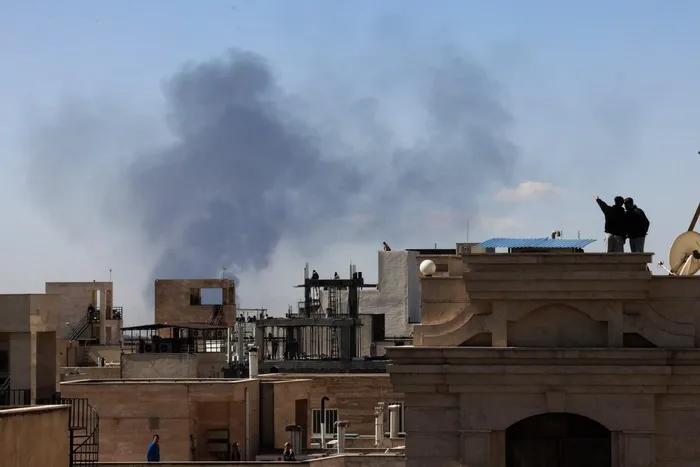
South Africa and other countries across the world cancelled international flights due to ongoing conflicts between Iran, the US, and Israel.
Image: ATTA KENARE / AFP
The Department of International Relations and Cooperation (DIRCO) on Sunday said that it is in communication with South Africans stranded in the Gulf nations following the US and Israel strikes on Iran and the subsequent retaliatory attacks.
South Africa and other countries across the world have cancelled international flights due to massive airspace closures in the Middle East, saying this was to ensure safety and avoid the conflict zone.
The US and Israel launched a massive and coordinated military offensive against Iran on Saturday.
DIRCO spokesperson Chrispin Phiri said no South Africans stated that they are in distress so far, while the deputy director-general, Clayson Monyela, said the department is in communication with South Africans stranded in the region and is reviewing evacuation contingencies.
"So far we have not lost anybody. The South Africans we know of are all accounted for. We are monitoring the situation. But the challenge is that unfortunately, it is not possible to move people out to those places because there is no means to do that," Monyela said.
The departments said evacuations of South Africans in Gulf nations can't take place until the bombing stops
International bodies including the United Nations and the African Union have called for a de-escalation of tensions.
The operation, codenamed “Epic Fury” by the US and “Lion’s Roar "by Israel, involved airstrikes across at least 24 of Iran’s 31 provinces.
US President Donald Trump and Israeli Prime Minister Benjamin Netanyahu confirmed that Iran’s supreme leader Ayatollah Ali Khamenei was killed in a strike on his compound in Tehran. Iranian state media has since confirmed his death and declared 40 days of mourning.
Other high-ranking officials reportedly killed include the Chief of Army Staff, the Defence Minister, and the head of the Revolutionary Guard.
Strikes hit military airfields, missile and drone launch sites, and Islamic Revolutionary Guard Corps (IRGC) facilities in cities like Tehran, Isfahan, Qom, and Karaj. Iranian authorities reported at least 201 deaths and 747 injuries. Internet services across the country have been largely down for over 24 hours.
The IRGC confirmed it launched a massive wave of retaliatory strikes across the Middle East through missiles and drones targeting 27 US bases and regional allies, including Israel, Qatar (Al Udeid Air Base), UAE (Dubai and Abu Dhabi airports), Bahrain (5th Fleet headquarters), and Jordan.
As a result, Airports Company South Africa (ACSA) confirmed that at least 14 international flights were cancelled from March 1, 2026, until further notice.
ACSA said this is primarily due to the closure of airspace over the UAE and Qatar.
The disruptions saw eight cancellations (seven outbound and one inbound) in OR Tambo International. Four outbound flights have been cancelled at the Cape Town International, while King Shaka International cancelled two outbound.
“Passengers are strongly advised to contact their airlines or relevant embassies directly for the latest schedules and status updates,” read the statement.
Air India and IndiGo have cancelled all Middle East destinations and are rerouting international flights to Europe and the US. Pakistan International Airlines (PIA) also suspended services to the Gulf.
Meanwhile, socialite and reality TV star Eva Modika announced that she is currently stranded in Dubai and has publicly appealed to President Cyril Ramaphosa and DIRCO for urgent government assistance.
In a statement issued on Saturday, Modika said she is stuck in the UAE due to rising Middle East tensions that have led to the suspension of flights and the grounding of major airlines such as Emirates and Etihad.
She claims to have suffered financial losses of approximately R250,000 after professional bookings as a DJ and media engagements were cancelled.
Modika appealed to President Cyril Ramaphosa and DIRCO to urgently intervene and assist South African citizens who are affected and currently in the region.
Ramaphosa expressed “deep concern” and called for “maximum restraint” from all parties as he called on all parties to exercise maximum restraint and to act in a manner consistent with international law, international humanitarian law, and the principles of the United Nations Charter.
“Article 51 of the UN Charter provides for self-defence only when a state has been subjected to an armed invasion. Anticipatory self-defence is not permitted under international law and self-defence cannot be based on assumption or anticipation,” he said.
United Nations (UN) Secretary-General Antonio Guterres also condemned the “use of force” by the US and Israel, stating that the strikes violated international law and the UN Charter. He also condemned Iran’s subsequent retaliatory strikes across the Middle East for violating the sovereignty of multiple nations, including Bahrain, Iraq, Jordan, and the UAE.
International relations expert Professor Theo Neethling said that although it remains difficult to anticipate the outcome of these developments, a central concern is whether Iran could descend into prolonged instability, similar to the post-intervention turmoil experienced in Iraq and Libya.
“This is by no means an implausible scenario. Closely related is the question of political succession in Iran: who will assume leadership, and with what degree of authority and legitimacy. Much will depend on how this transition unfolds, he said, adding that attention will also turn to the response of BRICS, particularly its African member states, Egypt and Ethiopia, as well as China.
“These developments raise a broader question about BRICS itself: does it function as a cohesive and consolidated grouping capable of coordinated political positioning, or is it primarily a loose alignment of states with divergent interests?”
manyane.manyane@inl.co.za