

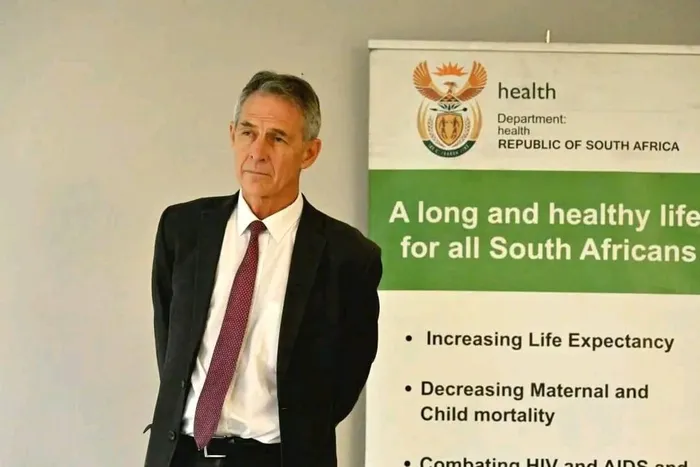
National Department of Health Deputy Director-General: NHI, Professor Nicholas Crisp, highlighted legal and communication challenges in the quest for Universal Health Coverage.
Image: Facebook/ National Department of Health (South Africa)
The implementation of South Africa’s National Health Insurance (NHI) and its aim of achieving Universal Health Coverage (UHC) face hurdles, ranging from legal battles to crucial communication gaps and public mistrust.
Discussions during Tuesday’s webinar hosted by the Human Sciences Research Council (HSRC) brought these challenges to the fore, highlighting the complexity of transforming the country’s healthcare landscape.
National Department of Health Deputy Director-General: NHI, Professor Nicholas Crisp, said the NHI Act says that the government must implement this equitable means of distributing healthcare, purchasing healthcare for all, based on financial resource availability, and must implement it progressively as those funds become available.
However, he said he is spending a lot of time defending them in court cases.
“We have, at the moment, I think, 15 court cases. Some are in the Constitutional Court, some are in the High Court,” Crisp said.
He highlighted that last week, the government agreed to pause any implementation while they were ready to publish the first proclamation, pending a review by the Constitutional Court regarding public participation challenges. The Board of Healthcare Funders and the Western Cape government argue they were not properly consulted during the Bill’s development and the Act’s assent. These will be addressed in May, aiming for a decision by October or November. Subsequently, the department will focus on other challenges pending in the High Court.
Moreover, in court papers, one of the biggest concerns that is voiced about private sector costs is the cost of insuring oneself against professional indemnity costs.
Crisp noted that they made significant efforts to communicate from the public sector, but they no longer have a budget for NHI communication.
“Last year, we went on a brand awareness portion of our communication campaign and spent R26 million,” Crisp said.
He also announced the launch of NHI Change Champions to inform staff and counter public misinformation about the NHI, noting that many widely believed ‘facts’ are unrelated to the Act or the UHC framework.
World Health Organisation (WHO) Team Lead: Health Financing and Governance Unit/Health Systems and Services, Dr Ogochukwu Chukwujekwu, said effective communication is paramount. They observed good, well-intentioned reforms in various countries failing or underperforming because the objectives, entitlements, available services, and benefits were not appropriately communicated to the population and other stakeholders.
HSRC Senior Research Director: Office of the CEO, Professor Charles Hongoro, said there is a need for dialogue.
“I completely believe that what tends to happen if there’s no dialogue and communication, is that some narratives come to the fore rather than what exactly is actually happening. And that can be quite dangerous in terms of public perceptions and trust of what NHI is all about,” Hongoro said.
He said NHI is one of the country’s most transformative policies. If implemented as currently envisaged, it will have a long-lasting impact on achieving UHC, as shown by the WHO. It will prevent people from falling into poverty due to health costs, leading to a healthier society. This requires accepting the starting principles of human dignity, social solidarity, equity, and fairness.
“If we buy into those arguments, then surely the question should be about how we implement this without creating economic challenges, as other people would argue. How do we create this in such a way that it aligns with the existing capacity that’s there? Because people are arguing again. They think that if NHI is implemented, every hospital will be flooded with people. I don’t think that’s what it means,” Hongoro said.
thobeka.ngema@inl.co.za