
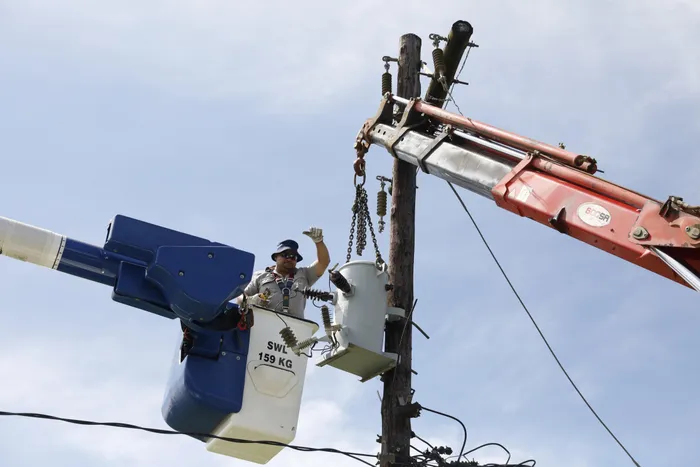
An Eskom technician is removing an electricity transformer that residents of Hardingsdale Farm, in Pietermaritzburg, used to illegally consume electricity.
Image: Doctor Ngcobo / Independent Newspapers
Eskom is suffering annual losses of R6 billion in KwaZulu-Natal, primarily because 50% of its 1.2 million provincial customers are engaging in electricity theft. This theft is often facilitated by material that is itself stolen from Eskom.
These figures might be higher as electricity is also stolen from various provincial municipalities.
The high rate of electricity theft in the province was revealed on Thursday when the power utility’s technicians, accompanied by heavily armed private security officers, paid an unexpected visit to an informal suburb, Hardingsdale Farm, in Pietermaritzburg, to confiscate material used by the residents to illegally connect electricity to their homes.
“The revenue that we are not about to collect because of losses in KwaZulu-Natal is R6 billion per year. Therefore, how can we stay afloat?
“Losses that we suffer are close to 50% of the customers that we have, but there are areas where we have losses that are over 70% of the revenue that we do not collect,” said Eskom’s Senior Manager for Customer Services, Dadewabo Mbhele.
Mbhele said there were six transformers that were identified as having been stolen from Eskom, but only five were recovered. She said others that were also confiscated could not be linked to Eskom.
“Those people might have been informed that Eskom was coming, and they removed some of the transformers before we arrived to recover six Eskom transformers, but we only got five. Those transformers, conductors, and electricity poles were stolen from Eskom,” she said.
Responding to parliamentary questions in 2024, the late Public Enterprises minister Pravin Gordhan stated that Eskom had, in the 2022/23 financial year, lost R18,953,668.45 through the theft of transformers.
Mbhele said the equipment would be used to open cases of theft with the police, adding that the suspects were expected to be identified and arrested.
“That is why we have to take the evidence, and the police were taking photos before we took the equipment.”
She said in the province, there is no municipality without electricity theft.
“In the Pietermaritzburg area, we have 90% of people who do not pay for electricity, but we do meet with council leaders in council chambers to show them pictures of what we are picking up on our infrastructure and ask them to assist us by encouraging people to buy electricity.”
She said there is organised crime in the electricity theft.
“They are organised, and they have real money and contractors to erect infrastructure for them. Where we can prove in court that there have been crime issues, we can make an arrest. These things take a little bit of time,” said Mbhele.
This suburb, popularly known as Claridge, said Mbhele, has more than 1,000 houses, mostly state-of-the-art, and many of them are double-storey.
“This place is occupied by people who are pretty well off if you look at their socioeconomic measures, but for the past seven years, they have been using electricity for free by tapping off from the Eskom line as well as the Msunduzi Municipality line.”
Mbhele said Eskom was estimating that Hardingsdale residents were illegally consuming electricity worth R25 million a year for more than seven years.
She said that, through a profile that has been conducted, it has been established that the residents could afford to pay for their electricity consumption.
“As South Africans, we must pay for the electricity that we receive,” she said.
Residents of the suburb have complained that their plea for legal electricity had been ignored.
Mbhele said the delay in installing electricity was because the land had not yet been rezoned for residential settlement.
“It can be that there is impatience from the community, who are desperate for the services, but these are things that could have been taken care of before consuming electricity for free.”
She said that removing and confiscating illegally connected overhead cables and transformers was Eskom’s way of protecting its infrastructure.
“We need to restore the culture of paying for services back to the people. We must understand that even a water pump cannot run without electricity, and we have to understand the importance of electricity, and if we cannot collect electricity bills, we cannot expand the infrastructure, and infrastructure will continue to fail if we don’t pay for the services, so that we can inject the money back,” she said.
She explained that those who are too poor to afford to pay for electricity are being accommodated through the indigent programme, which gives access to free basic electricity.
“This could be a child-headed home, or whoever can contact their local councillors to be accommodated in that programme.”
She said Eskom might win the war against electricity theft by installing smart meters, as that would make it easy to control the network.
A resident, Langalibalele Moloi, said he started applying for electricity and water supply in 2012, but there is still no electricity.
“It is always a promise after promise. We are told that it is because the area has not yet been rezoned, and we don’t know what is happening,” said Moloi.
He said the suburb has been without electricity due to non-payment after Eskom switched off more than eight months ago.
The lack of electricity is making life difficult for residents, with one unnamed resident noting the negative impact on education.
“Since we don’t have lights, children cannot study and do homework when it is dark.”
The issue stems from rezoning problems, which, according to Innocent Ndlovu, community leaders estimate would cost about R3 million to fast-track with the municipality. This cost was deemed too expensive, despite some members having considered paying it.
In the meantime, some residents have installed solar systems on their roofs to cope with the lack of power.
bongani.hans@inl.co.za