

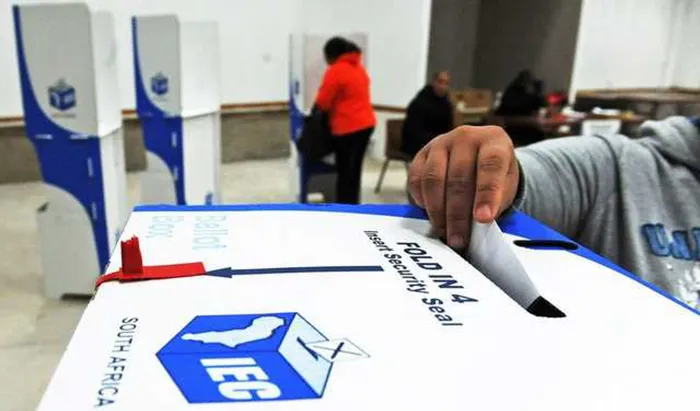
The IEC has urged South Africans to use the online self-registration platform, RegisterToVote.org.za. The national voting weekend is June 21-22, 2026.
Image: IOL
With a R2.6 billion budget, a transparent voter management system, and a senior, professionalised management at voting stations, the Electoral Commission of South Africa (IEC) has declared its readiness for the 2026/2027 local government elections, beginning with the national voter registration weekend of June 20-21, 2026.
The electoral body urged South Africans eligible to vote to register where they live, as local government elections do not provide a legal facility to vote outside the voting station of registration. It said this requirement ensures voters participate in a ward election that has a relationship with their place of ordinary residence.
The IEC also called on citizens to use the online self-registration platform, RegisterToVote.org.za
It stated that between November 2025 and March 2026, 260,205 new registrations were recorded. Of these, 128,113 voters registered through the IEC’s Voter Management Devices (VMDs), while 132,092 registered via the online self-service portal.
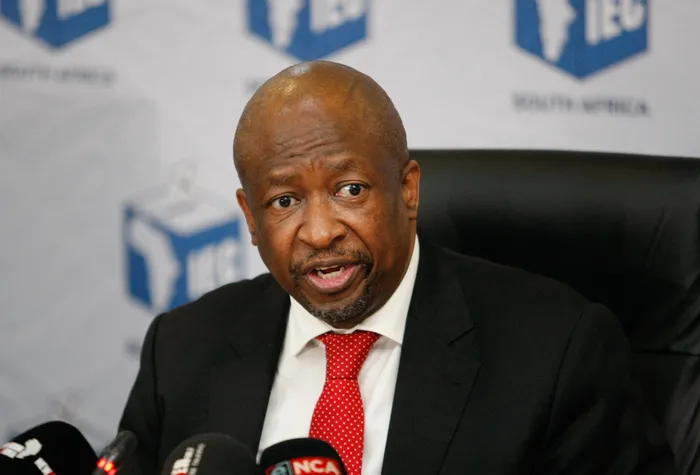
IEC Chief Electoral Officer Sy Mamabolo said the commission has a R2.6 billion budget to run the elections.
Image: Jacques Naude / Independent Newspapers
Sy Mamabolo, the IEC's chief electoral officer, stated during a recent media briefing that the commission is proactively using technology to safeguard election integrity.
He stated that the commission’s framework for collating results is one of the most transparent in electoral administration, ensuring the integrity of results.
“To ensure transparency, the results system, once coded and ready, will be subjected to an external audit process so that there is independent confirmation of its functional characteristics, ensuring that it does the same for all contestants,” Mamabolo said.
He added that the audit outcome will then be presented to political parties and the nation, as confidence that the results system functions optimally and does what it ought to do must ultimately be directed to the broader South African population.
“At the appropriate moment, once the audits are done, the report will be made available to the country. Political parties will be allowed to bring their own Information Communication Technology (ICT) audit experts to review the system and gain confidence in its integrity,” he stated.
Mamabolo said the IEC also runs an application programming interface (API) that transmits raw results once audited to political parties that have requested access and to some media houses that have requested the same.
The Voter Management Devices (VDM), he said, will also be subjected to an independent audit, and the outcomes will be shared with political parties and the country, so that early on, every stakeholder can be confident that the IEC has done all it ought to do to ensure a hassle-free registration drive and election process.
Mamabolo stated that the commission anticipates that the growth of generative AI will create fertile ground for increased disinformation attempts and is building its own internal capacity for social media responses.
“One of the key strategies is to give people who communicate via social media credible information upfront and limit the scope for disinformation.”
Other strategies being implemented include expeditious responses to instances of disinformation happening and a partnership with social media platforms, so that these are not used in a manner that negates the credibility of the electoral process, he said.
“We are also evaluating the possibility of a social media code of conduct; we are verifying its constitutionality. At an appropriate moment, we will be indicating whether such will be constitutionally permissible, and what framework will be to engage political parties, candidates, media, and everybody on the acceptable use of social media in the electoral process.”
He added that the electoral body has a fair budget to run the elections.
“If we exclude our administrative expenses, we are looking at a R2.6 billion budget to do the elections. We have really been engaging hard with the National Treasury, and they have tried to meet us and enable us to conduct a credible electoral process,” he said.
Mamabolo said currently, the total number of registered political parties is 508, as 20 new parties were registered between October 2025 and February 2026. Of these, 299 are registered on a national level, while the balance of 209 are either registered on a provincial, district, or metropolitan municipality level.
He stated that the commission’s electoral processes are unfolding.
Regarding four municipalities in KwaZulu-Natal (eThekwini Municipality, Mkhambathini Municipality, Inkosi Langalibalele Municipality, and Alfred Duma Municipality) whose ward delimitation process has commenced, as confirmed by the Municipal Demarcation Board (MDB), he said they will be revisited.
“We are revisiting all voting districts in conjunction with municipal party liaison committees. We are identifying suitable voting stations. In that process, we are training the trainers, and there will be a training rollout ahead of the election. We are doing platform upgrades to ensure our ICT platform has new technologies for security and related purposes.”
He said discussions with Cooperative Governance and Traditional Affairs Minister Velenkosini Hlabisa were at an advanced stage regarding the election date.
Mamabolo said the commission has gone back to its longstanding recruitment criteria.
“This is not because we want to exclude certain demographics, but to ensure that the voting stations are managed by persons with administrative acumen, who can respect the readers of the management and administration, a person who has managed people or processes. If you juniorise the management at the voting station, it shows in the quality of administration of that voting station, and in the quality of the voters roll.”
Mamabolo explained that the majority of electoral staff will always be young, unemployed persons, and the criteria apply only to the three key management roles at a voting station.
On election safety, he said, the National Joint Operational and Intelligence Structure (NATJOINTS) has established a priority committee co-chaired by the IEC to plan election security, and has begun its work.
There have been concerns that some people register to vote but stay away from the polls on election day.
Professor Siphamandla Zondi, a political analyst at the University of Johannesburg and a volunteer at the NGO Devoted Citizen, said that citizens have a duty to build a political system that serves the common good, including voting wisely.
He warned that passive citizens enable poor leadership to emerge and last long; if citizens do not stand up and address the issues facing the country, they will soon find themselves without a country to live in.
“By not voting, you delegate your power to others. You help the incompetent and unvarying to take over power and continue to destroy your communities. You cannot abandon your duty to future generations; the power is in your hands. Failure in the past does not mean giving up trying to build what you can live with,” Zondi stated.
He said when people are true citizens, they know power belongs to them, and that it is a myth that it belongs to politicians; power belongs to people who only cede it to politicians in a vote for a short time and cede it differently every election.
“We debunk the myth that citizens are helpless; they can certainly help themselves. The myth that there are leaders who must lord over citizens we reject; we contend that true citizens co-lead the country with those in leadership positions. They do not wait to be told the right things to do; they stand up for what is right. Such citizens do not let things fail before their eyes,” Zondi stated.
Professor William Gumede, a governance expert from Wits University, previously stated that citizens must vote for candidates based on competency, honesty, and experience.
He added that people must vote against their political party when it is failing or when their party puts up a candidate they disagree with; “voting against your party’s candidate is as important as voting for your party”.
Gumede said that sometimes people vote because they know the person. “You can’t vote just because the person is your friend, a family member, or is from your ethnic group, looks like you, and speaks like you. People must vote based on competency,” he said.
gcwalisile.khanyile@inl.co.za