

Transport Minister Barbara Creecy has warned that hundreds of thousands of minibuses, buses and trucks are not roadworthy.
Image: Supplied / Department of Transport
Minister of Transport Barbara Creecy has revealed that the National Traffic Information System (NATIS) shows 342,048 vehicles - mainly minibuses, buses and trucks - are not roadworthy, while 338,659 professional driving permits have expired.
She made the remarks on Friday, at the launch of the 2026 Road Safety Campaign, which runs from March 20 to May 1, in Vosloorus, Gauteng.
Creecy was joined by Deputy Minister of Transport Mkhuleko Hlengwa, Gauteng MEC for Transport Kedibone Diale-Tlabela, and the Chairperson of the Transport Portfolio Committee.
Creecy said the launch comes as the nation prepares for major religious festivals, including Eid al-Fitr, the Passover Seder, and Easter.
“This season is a time of spiritual reflection and family reunion, yet it remains one of the most hazardous periods on our national road network. Our mandate is clear: to ensure that every South African who sets out on a journey returns home safely."
She highlighted progress in reducing road fatalities this year, noting encouraging trends.
“Preliminary data from January 1 to March 15 indicates the lowest number of fatalities in six years, with the number of crashes down 11% compared to the same period in 2025.”
Every province has recorded a decrease in crashes, she added.
She said fatalities fell by 10% compared with last year, with six provinces showing reductions - Gauteng, Western Cape, KwaZulu-Natal, Mpumalanga, North West, and Eastern Cape.
“This progress is not accidental. It is the result of coordinated law enforcement, strategic partnerships with civil society, and a shift in the collective behaviour of road users.”
Creecy reaffirmed the campaign’s theme, “It Begins With Me,” calling for personal accountability.
“Over 80% of road crashes result directly from human behaviour. We are calling on every driver, passenger, and pedestrian to take responsibility for their actions on our shared roads.”
Law enforcement will be strict during the campaign.
“I have instructed all agencies to prioritise public and freight transport safety, as well as pedestrian protection. Vehicles found with defective brakes, worn tyres, or steering faults will be impounded immediately to safeguard passengers.
“Current information on the NATIS system indicates that 342 048 vehicles -mainly minibuses, buses and trucks – are not roadworthy, while 338 659 professional driving permits have expired.”
She said the government is engaging with the taxi and bus industries to address the worrying figures on vehicle roadworthiness and professional driving permits.

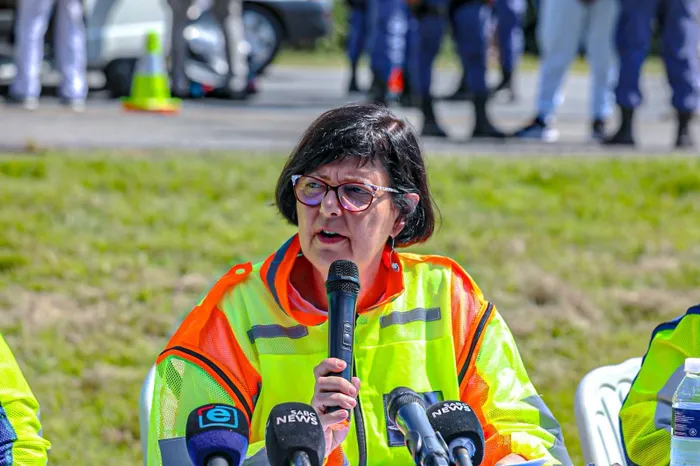
Transport Minister Barbara Creecy has called for personal accountability on South Africa’s roads, warning that nearly half of all road deaths involve pedestrians.
Image: Ayanda Ndamane
“We are also concerned about the number of Vehicle Testing Stations that are non-operational across provinces. The RTMC, working with the Department’s Vehicle Testing Inspectorate, has been instructed to implement a strategy to restore these facilities ahead of high-traffic periods.”
Creecy emphasised pedestrian safety as a priority.
“Pedestrians currently account for almost half of all road deaths. Traffic authorities have been instructed to deploy students to patrol critical pedestrian areas and remain on duty, rather than being sent home.”
She added that visibility in accident-prone areas, supported by communities and SAPS, will help maintain momentum in reducing road accidents and achieving the Road Safety Decade targets.
Drunk driving remains a key focus. Legislative amendments to Section 65 of the National Road Traffic Act are being pursued to tighten restrictions.
“High-risk routes, including the N1, N2, N3, and N4, will see an unprecedented saturation of mobile and static checkpoints. We will intensify policing on critical corridors with support from the National Traffic Police.”
Creecy also called on the Cross-Border Road Transport Agency to monitor key corridors and enforce permit compliance, vehicle roadworthiness, and fatigue management.
“We will clamp down decisively on illegal operations and non-compliance. Some road users may attempt to avoid checkpoints by using secondary roads, but our officers, educators, and communicators are prepared to respond.”
simon.majadibodu@iol.co.za
IOL News