

KwaZulu-Natal has been identified as a key province facing food security concerns.
Image: Independent Newspapers
* This is the final part of a four-part series on the devastating impact of malnutrition in South Africa.
In South Africa, food insecurity is a significant challenge, affecting 63.5% of households in some capacity. This leaves just 36.5% of households classified as food secure. A concerning 17.5% of the population experiences the most extreme form of food insecurity, defined as severe.
However, in a bid to tackle the multifaceted food and nutrition security challenges that plague South Africa, the National Food and Nutrition Security Plan (NFNSP) 2018-2023 emerges as a critical framework mandated by the Cabinet. However, a recent implementation report reveals that while the NFNSP has set ambitious targets to curb malnutrition across the country, significant gaps in its achievements remain evident.
The NFNSP aims to address the dire statistics surrounding malnutrition—ranging from undernutrition and micronutrient deficiencies to the rising tide of obesity—through 17 impact-level targets. Unfortunately, data limitations have allowed for the tracking of progress on only five of these targets, which reflect modest advancements but expose glaring discrepancies in reaching the 2023 goals.
Seven strategic objectives guide implementation, with varying progress. While some objectives, particularly those led by the Departments of Agriculture, Land Reform and Rural Development (DALRRD), Social Development (DSD), and Health (DOH), show some success due to alignment with existing departmental mandates and annual performance plans (APPs), others lag significantly.
Key inhibiting factors include the non-establishment of the National Food and Nutrition Security Council, hindering coordination; insufficient funding, especially for establishing inclusive local food value chains; limited awareness of the plan among stakeholders; and the impact of the Covid-19 pandemic. The evaluation highlights the need for a more holistic systems approach, incorporating urban food security and the informal sector, and emphasises the importance of strong leadership, multi-stakeholder collaboration, and a robust monitoring and evaluation system for future iterations of the NFNSP.
Recommendations include revising the plan with an updated theory of change, securing long-term funding, leveraging existing planning tools, and strengthening coordination mechanisms.

Families across South Africa face the daily challenge of food insecurity, with over 63% of households affected.
Image: IOL/ RON AI
Department of Agriculture media and external communication director Moses Rannditsheni said the plan was implemented over the said period. During the evaluation, it highlighted the challenges of not achieving some of the indicators.
He said that to overcome the challenges, the department has embarked on a Theory of Change process.
“The Theory of Change process includes inputs of academia, civil society, the informal sector, farmer organisations and farmers,” Rannditsheni said.
“The most successful approach will be for a coordinated effort with all stakeholders. The Theory of Change process is outlining a methodology and will be implemented.”
Rannditsheni said the difference in the 2024-2029 plan is that a wider range of inputs is part of the document. Non-government actors will be part of the implementation and reporting.
“Provinces are developing provincial plans based on the national plan, but customised as per province. KZN is engaging provincially to develop a Provincial Food and Nutrition Security Plan,” Rannditsheni said about the provincial implementation of the plan.
He said the Department of Health, which is part of the plan, has developed Malnutrition Indicators, which are integrated into the overall plan.
The DA’s Willie Aucamp posed a parliamentary question to Agriculture Minister John Steenhuisen regarding the NFNSP. Specifically, Aucamp sought details on the total funding secured for the NFNSP’s subsequent phase and the progress made on each of the recommendations outlined in the 2023 Implementation Evaluation of the NFNSP report.
Steenhuisen’s response indicated that the NFNSP currently lacks a dedicated budget. Instead, departments are funding the plan’s activities through their existing departmental budgets. A revised costing exercise, reflecting the activities of the current iteration, is being prepared and will be submitted to Cabinet as part of the approval process.
“Currently, the Theory of Change is underway, and a draft iteration of the plan is under development, encompassing the evaluation recommendations.”
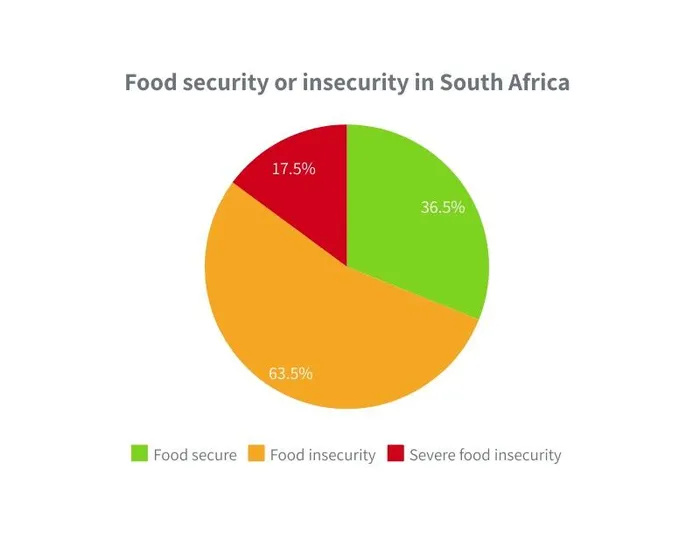
Households classified as food secure, some form of food insecurity and those experiencing severe food insecurity.
Image: Thobeka Ngema
Professor Thokozani Simelane, Professor of Practice at the Human Sciences Research Council (HSRC), said his comments are not exhaustive, as there are a handful of institutions that research child malnutrition. His responses are guided by what they uncovered during the National Food and Nutrition Security Survey (NFNSS) he led.
Simelane said the NFNSS conducted by the HSRC and published in 2023 by the HSRC and the Department of Agriculture, Land Reform and Rural Development, “has revealed that only 36.5% of South African households are food secure. The remaining 63.5% face some form of food insecurity, with 17.5% experiencing severe food insecurity.”
Simelane said that although the Household Hunger Score (HHS) suggests that 79.2% of households experience little to no hunger, this masks widespread dietary inadequacy. Nearly one in five households consumes nutritionally poor diets, and almost a quarter survives on borderline diets, as shown by the Food Consumption Score.
Additionally, the Household Dietary Diversity Score further highlights that over 80% of households lack diversity in the foods they consume.
“Geographically, food insecurity is not evenly distributed. Provinces such as North West, Free State, and Northern Cape show significantly higher rates of hunger and poor dietary outcomes,” Simelane explained.
“Within provinces, some districts, including uMkhanyakude and Zululand in KwaZulu-Natal, report critically low dietary diversity and food consumption scores. These spatial disparities are shaped by the uneven distribution of infrastructure, markets, and employment opportunities.”
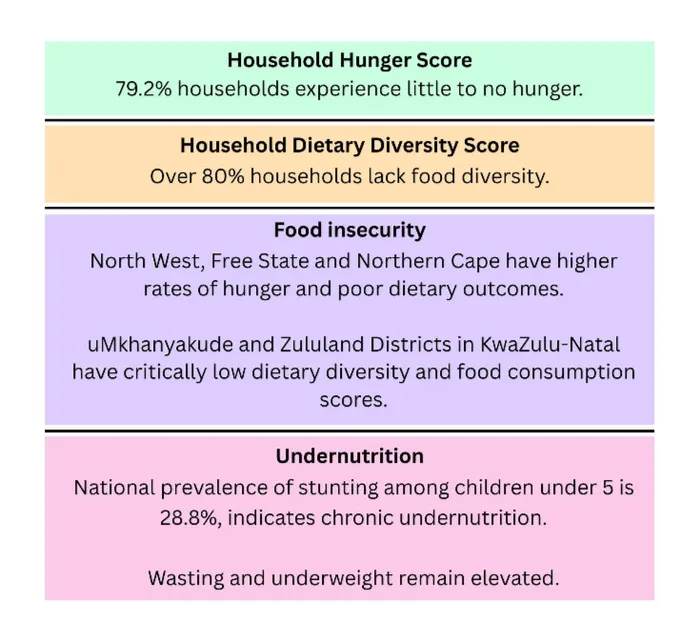
A glimpse into the Household Hunger Score, Household Dietary Diversity Score, food insecurity and undernutrition.
Image: Thobeka Ngema
Simelane said that nutritional outcomes are equally alarming.
“The national prevalence of stunting among children under five is 28.8%, indicating chronic undernutrition. Wasting and underweight also remain elevated, with significant increases in some provinces compared to 2016. At the same time, overweight and obesity have risen among adults, especially women, reflecting a double burden of malnutrition driven by reliance on calorie-dense but nutrient-poor diets,” Simelane explained.
Simelane said the food and nutrition security plan is under review. The Department of Agriculture, however, holds a strong view that the food system must be inclusive. The department is currently reviewing the indicators.
“The basic consideration, which the department is implementing, is the review of the dynamics and the effectiveness of South Africa’s food system. For this, the department has established committees that are working on various components of South Africa’s food system transformation. This includes a review of indicators,” Simelane said.
Regarding KZN, Simelane added that, according to the NFNSS, the province emerged as one of the areas where food security is a concern. This is also because the province is the largest among the other provinces.
thobeka.ngema@inl.co.za