

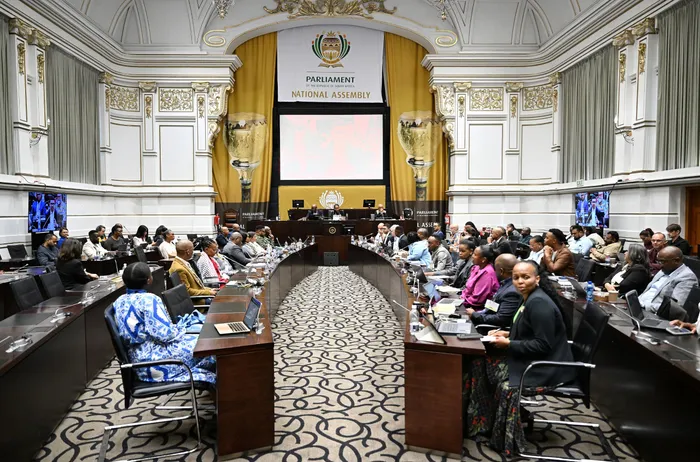
The Portfolio Committee on Communications and Digital Technologies held a roundtable with podcasters and key stakeholders.
Image: Phando Jikel/ParliamentRSA/Supplied
The Portfolio Committee on Communications and Digital Technologies’ roundtable on podcasting spurred a wide-ranging discussion, which is intended to be a starting point on how to regulate the sector.
The roundtable on Tuesday was held under the theme: “A Multi-Stakeholder Dialogue on Podcasting: Legislators, Policymakers, Regulators, Podcasters, and Industry Stakeholders Charting Balanced Regulation for Sustainable Growth, and Strong Accountability”.
The roundtable comes amid the rapid growth of podcasting in South Africa, driven by increased smartphone usage, wider internet access and a dynamic creator economy.
The committee Chairperson, Khusela Sangoni-Diko, said that the engagement is intended to provide a constructive platform for dialogue between Parliament, regulators, creators, platforms and civil society.
She said that the meeting is not to discuss the regulations of podcasting, but to get South Africans in conversation about a multi-billion rand industry.
“I was going through the statistics the other day, in the ICASA State of ICT report, it said in the last year we had more than R156 billion, which went to data costs - linked to social media, and access to the platforms we are discussing today.”
Sangoni-Diko said that it is a sector they should actively support. She had explained that podcasting represents one of the most exciting developments in South Africa’s digital content ecosystem.
“It has opened space for diverse voices, languages and perspectives, while creating new opportunities for innovation and economic participation,” Sangoni-Diko said.

The Portfolio Committee on Communications and Digital Technologies held a roundtable with podcasters and key stakeholders. Pictured in the middle is Sizwe Mpofu-Walsh, who is one of South Africa's well-known podcasters.
Image: Phando Jikelo/independent Newspapers
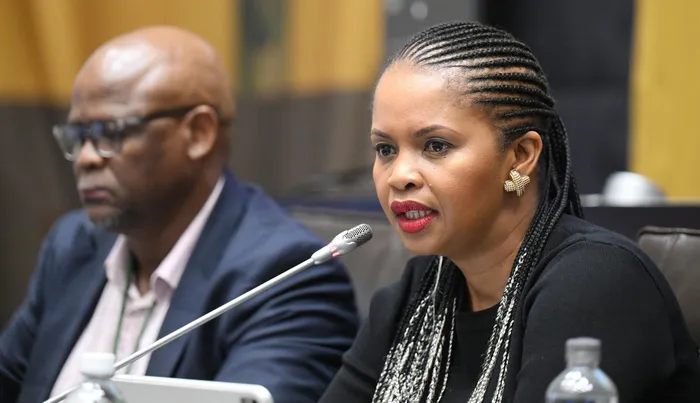
The Portfolio Committee on Communications and Digital Technologies held a roundtable with podcasters and key stakeholders. Chairperson of the committee, Khusela Sangoni-Diko.
Image: Phando Jikelo/ParliamentRSA/Supplied
Voices represented included Meta, TikTok, Google, ICASA, the Department of Communications and Digital Technologies, the Press Council, the Film and Publication Board, as well as producers of several local podcasts.
The roundtable sought to produce a report outlining consensus points, areas for further work and include recommendations of the next steps for policymakers, regulators and industry stakeholders.
After a full day of discussions, the committee heard that while guardrails are key, self-regulation of those within the podcast sector might be the preferred way to go.
A few other recommendations included how efforts should be made to support the digital creation market and ensure that innovation and creativity should not be stifled.
The committee heard that podcasting isn’t an elitist function, and there should be an opportunity for ordinary citizens to engage and have skills development.
Other key issues included: data sovereignty, the impact of artificial intelligence (AI), future regulations, which are rights-based, there should be more research done, and having data points available to understand what is happening in the sector, and how the revenue models are operating.
The committee was encouraged to implement minimum spends to help support the platforms and invest in them, as the next media conglomerate could emerge from the podcast sector.
Social media platform present already shared they already have content platform rules, but not enough consumer awareness surrounding how to access the rules and raise complaints.
Director-General of the Department of Communications and Digital Technologies, Nonkqubela Thathakahle Jordan-Dyani, said they have published a data and cloud policy to enable SMMEs to help avoid misinformation and disinformation.
“We are making other interventions, working with the regulator (ICASA), in terms of addressing the issue of data cost. If we’re going to talk about zero-rating (data), these are issues we have to put in some type of regulations.
“I hear that people are talking about how they don't want over-regulation… A regulation is not trying to stifle. It is not policing. Certainly, there are going to be guardrails.”
Jordan-Dyani said that they have addressed the issue of misinformation and disinformation in the AI draft policy, which is intended to be released for public comment, but the department is aware that they need to come up with stronger legislation.
She said that they want to learn from the lessons of the past, as what had occurred with over-the-top (OTT) streaming platforms, and not make the same mistakes that they had made when legislating that sector.
Sangoni-Diko said that the committee will be finalising a report after Tuesday's roundtable, while taking into account recommendations from the industry.
theolin.tembo@inl.co.za