

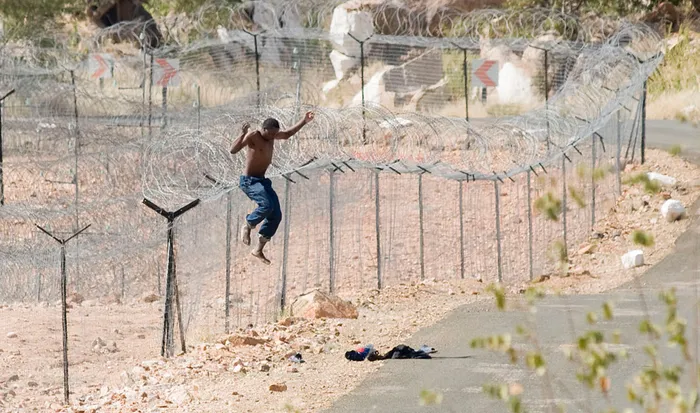
Border Management Authority introduces traceable stamps and boosts staff at ports of entry to manage peak holiday movement.
Image: HENK KRUGER Independent Newspapers
Border Management Authority (BMA) Commissioner Dr Michael Masiapato says the agency has introduced highly secure new passport stamps with unique numbers allocated to specific immigration officers, which will allow authorities to trace any illegally stamped passport back to the responsible official.
Masiapato made the announcement on Saturday during a media briefing where he was presenting the BMA’s Easter Festive Season Plan, aimed at ensuring the efficient, secure and seamless movement of people and goods across South Africa’s 71 ports of entry during the Easter period.
He said the operational plan is structured into four key phases: planning, execution, demobilisation, and sustenance.
Masiapato said the planning phase began on February 5, 2026, at the tail end of the December 2025–January 2026 festive season, and is scheduled to conclude on March 30, 2026.
“Given the existing BMA resource constraints, this phase has focused on integrated stakeholder engagements to identify partnerships that would assist in augmenting our resources,” he said.
He highlighted continued support from provincial governments.
The Western Cape has allocated 50 officials to assist as immigration officers at Cape Town International Airport, while Gauteng has deployed 80 officers to OR Tambo International Airport.
“To tackle cross-border social protection challenges, particularly safeguarding minors and vulnerable travellers including those without proper documentation and victims of trafficking, we partnered with the Department of Social Development to deploy social workers to various ports of entry,” he said.
He added that the Department of Tourism contributed more than 160 tourism safety officers to enhance the flow of travellers within port premises, and the Department of Public Works and Infrastructure (DPWI) provided temporary lighting, ablution facilities, barricades and Jojo water tankers to improve conditions at the ports and transit corridors.
Masiapato said the BMA also engaged in extensive regional discussions with its six neighbouring countries – Lesotho, Mozambique, Zimbabwe, Namibia, eSwatini and Botswana – to streamline border processes and operational coordination.
As a result, operating hours were adjusted at some key ports that do not operate 24 hours.
He said the execution phase will run for 10 days, from March 31 to April 9, 2026, divided into a departure leg (March 31 –April 4) and an arrival leg (April 5-9).
“Based on historical trends, peak travel volumes for the departure leg are expected on Thursday, 2 April, while the peak for arrivals is expected on Easter Monday, April 6,” Masiapato said.
He urged travellers to plan ahead.
“During these peak periods we expect significant traveller and traffic volumes, potentially double the baseline, exceeding 25,000 travellers per day at the busiest ports of entry.”
He said during the 2025 Easter period, more than 1,057,000 traveller movements were recorded in just 10 days.
The top three ports by volume were OR Tambo International Airport (220,339), Lebombo (161,457), and Beit Bridge (122,228), collectively handling over 50% of total movements.
He said an increase is expected for 2026.
Masiapato listed peak operating hours at key border posts, including Caledonspoort, Van Rooyensgate, Monontsa Pass and Qasha’s Nek.
He acknowledged that Easter travel is more concentrated than the December–January period, making operations more complex.
“Notwithstanding these facts, the BMA remains resolute to ensure heightened deployments and intensified border operations at the 71 ports of entry, key transit corridors, and vulnerable segments along the borderline,” he said.
He added that enhanced deployment will include high-visibility personnel and rapid response teams, with priority given to the elderly, people with special needs, and adults travelling with children.
Masiapato said the demobilisation phase begins on April 10, focusing on scaling down operations, reallocating resources, and consolidating deployed capabilities.
Post-operational assessments will evaluate effectiveness, identify gaps, and capture lessons for future operations.

Border Management Authority Commissioner Michael Masiapato warns of heavy traffic at South Africa’s busiest ports, with special measures for vulnerable travellers and stricter passport controls.
Image: File
He said the sustenance phase will maintain heightened operational awareness through continuous monitoring, evaluation and adaptive planning.
This, he said, also aims to ensure readiness for the 46th SADC Ordinary Summit of Heads of State and Government later this year.
“During this phase, operational teams will integrate lessons learned into standard operating procedures and encourage feedback from travellers and traders to refine our service delivery mandate,” Masiapato said.
The BMA will intensify the detection and processing of undocumented travellers, strengthen access control at all ports, and take firm action against corruption.
“Immigration requirements remain strict. All travellers must present a valid machine-readable passport with at least two blank pages,” he said.
He said visa conditions must also be adhered to, and parents travelling with minors must present unabridged birth certificates or authorised affidavits.
“New passport stamps with advanced security features were introduced on August 1, 2025. All travellers are expected to present themselves at designated ports of entry and not use vulnerable border segments,” he added.
Masiapato said ICT teams from the BMA, SARS and DHA will support the smooth operation of movement control systems.
High-risk areas will be monitored through coordinated law enforcement operations, intelligence-led targeting, and increased inspection of persons, vehicles and goods.
“The authority will also strengthen collaboration with neighbouring counterparts to ensure a coordinated response on both sides of the border,” Masiapato said.
He issued a warning, “Any individual attempting to enter or exit the Republic illegally, or to facilitate such activities, will face immediate arrest and prosecution in line with the Immigration Act.”
IOL News