

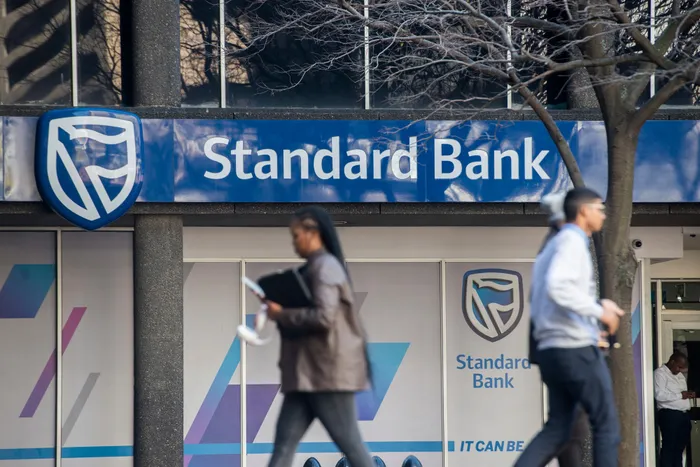
A customer is demanding over R60,000 from Standard Bank after transactions she said she did not authorise went off on her account.
Image: Armand Hough / Independent Newspapers
A Harrismith, Free State, woman is demanding a full refund from Standard Bank after nearly R60,000 was allegedly siphoned from her account, rejecting what she describes as an inadequate R16,000 “goodwill” offer from the bank.
Anastatia Radebe says the funds disappeared in January after a string of transactions was processed on her account without her knowledge. When she sought answers, the bank told her the payments had been authorised using one-time PINs (OTPs) linked to her profile, a claim she strongly disputes.
“The bank said I received an OTP authorising the payments, but that is not true. I did not receive anything,” Radebe said.
She told Independent Media that she acted quickly after discovering the alleged fraud, contacting her bank on January 26 and opening a case with the police. She submitted an affidavit and completed the required bank documentation, expecting a swift resolution.
Instead, she said there was no communication for two months. It was only on March 26 that the bank responded with the outcome of its investigation.
“They said their investigation found that I received an OTP authorising the transactions. But because I have been banking with them for so long, they are offering me R16,000 as a sign of goodwill. I refused the offer,” she said.
In its formal response, Standard Bank said it had followed all internal processes and found no fault on its side. The bank concluded that the fraud occurred after a third-party device accessed Radebe’s digital banking profile using valid login credentials and successfully verified OTPs.
The disputed transactions included multiple payments to Vodacom, Zapper, and EasyPay, with amounts ranging between R1,000 and R4,000.
According to the bank, the activity took place before the fraud was reported and before any cards were blocked, a factor it says is central to its decision.
“This occurs if your digital banking credentials and the associated system-generated OTPs were compromised through phishing, smishing, or vishing,” the bank said, adding that it does not store customer passwords or OTPs.
Despite denying liability, the bank offered R16,725 as a goodwill settlement, on condition that it be accepted as full and final resolution of the matter.
Radebe has also raised concerns about the method used in the transactions, saying the bank indicated her virtual card was used, something she insists she never activated.
“I don’t have a virtual card and my phone was not hacked. So how did this happen?” she asked.
She said the financial impact has been severe, forcing her to take out a R40,000 overdraft to cover living expenses.
“I need my money back with interest because I’m still repaying that overdraft,” she said.
The case comes amid growing concern over digital banking fraud in South Africa, where criminals are increasingly using social engineering tactics to gain access to customer accounts. Techniques such as phishing emails, SMS scams ,and fraudulent calls are commonly used to trick users into revealing sensitive information.
Data from the South African Banking Risk Information Centre shows that digital banking fraud remains one of the fastest-growing forms of financial crime, with mobile banking platforms a key target.
Banks have consistently maintained that customers play a critical role in safeguarding their credentials, while consumer advocates argue that institutions should do more to protect clients from increasingly sophisticated scams.
At the centre of disputes like Radebe’s is a persistent tension: when credentials are used, banks often treat transactions as authorised, even where customers insist they were deceived or compromised.
For Radebe, the issue is straightforward.
“I did not authorise those payments,” she said. “I just want my money back.”
The case underscores the challenges many South Africans face in recovering losses linked to digital fraud and the difficult balance between user responsibility and institutional accountability in an increasingly digital banking environment.
Standard Bank maintains that the transactions were approved using an OTP that was sent to her number.
Image: File
Standard Bank spokesperson Ross Linstrom this week said the bank conducted a detailed investigation into the transactions reported by Radebe.
He said the investigation found that the transactions were carried out using the customer’s own Standard Bank banking app on her registered mobile device, and were authorised using security details that are meant to be known only to the customer.
“These included her banking username, card details, and personal identification number (PIN). In addition, the transactions and the creation of virtual cards were approved using One Time PINs (OTPs) that were sent to the customer’s registered cellphone number,” he said.
Linstrom further added that their records confirmed that two virtual cards were created on Radebe’s banking profile.
“While the customer indicates that she was not aware of having a virtual card, the investigation confirms that the customer’s username, card, and PIN details were used to gain access to the profile to create the virtual card. For additional security, second-level authentication was applied during login by sending an OTP, which was required to complete the login process.
“OTP system logs show that the required OTP was delivered to the mobile number on record, and further checks confirmed that no SIM swap took place on that number, giving us confidence that the OTP was delivered to the registered number,” he said.
Linstrom maintained that the transactions were approved using Radebe’s specific security measures, and there is no evidence of a system failure or breach on the bank’s side.
“Although the investigation found no fault by the bank, Standard Bank offered the customer a goodwill payment. This was done as a gesture of goodwill in recognition of the customer’s long-standing relationship with the bank. The customer can accept or decline this offer of goodwill.
“Where there are concerns with an outcome of a fraud case, clients can refer the matter to the National Financial Ombudsman for an independent review. Standard Bank has completed its internal investigation, shared the outcome with the customer, and remains fully committed to cooperating with any external review process,” he said.
Standard Bank has been in the news in recent weeks for all the wrong reasons. Two weeks ago, distressed bank users expressed concern about Standard Bank allegedly exposing their confidential and private information to scammers, who allegedly wiped out their bank accounts.
karabo.ngoepe@inl.co.za