

FMD vaccines – 21 February 2026.
Image: Timothy Bernard / Independent Newspapers
Parliament’s Portfolio Committee on Agriculture heard that while there are enough vaccines to manage the outbreaks of Foot and Mouth Disease (FMD) in the country, the Department of Agriculture is still unhappy with the progress being made to vaccinate cattle in the country.
Deputy director general: Agricultural Production, Biosecurity and Natural Resources, Dipepeneneng Serage, and chief director for Animal Production and Health, Dr Botlhe Modisane, gave the committee an update on where things currently stand with FMD in the country.
Modisane shared that outbreaks have been reported in all provinces, but that the Northern Cape province has reported the least number of outbreaks.
The North-West has reported a continuation of the Swartkopfontein outbreak, but also reported an outbreak in Ramatlabama, and there are possible suspected outbreaks in Lobatla village, Driefontein, Borakalalo, and Dinokana.
Limpopo reported outbreaks in the greater Letaba area, while there have not been any new outbreak reports in the Western Cape. Modisane explained that vaccinations are proceeding well to date, with the private sector also assisting.
The department is also considering changes to regulations relating to movement control.
The Routine Vaccination Scheme for Foot and Mouth Disease (RVS-FMD) under Section 10 of the Animal Diseases Act, 1984 (Act No. 35 of 1984) has been published for comment already, and thus far, more than 200 comments have been received and are being evaluated.
As of 17 April, there are 1502 cases in the country, with the provincial breakdown as follows:
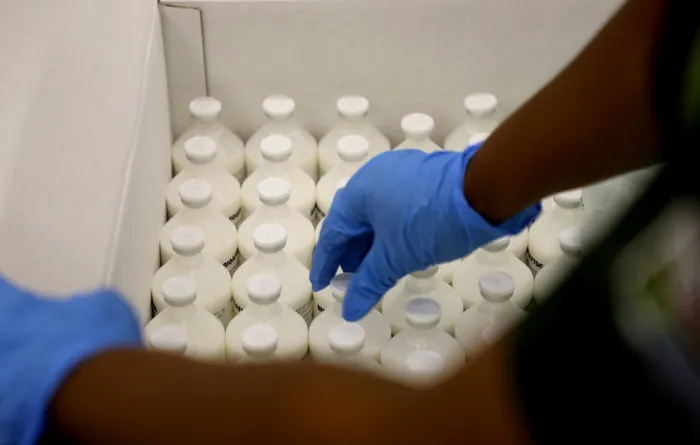
To date, 4 million doses of FMD vaccines have been received (2.5 million doses from Biogenesis Bago, Argentina and 1.5 millon doses from Dollvet, Turkey). An order for 2 million doses of Dollvet has already been placed, and the order will arrive on Monday (April 20, 2026) if all goes according to plan.
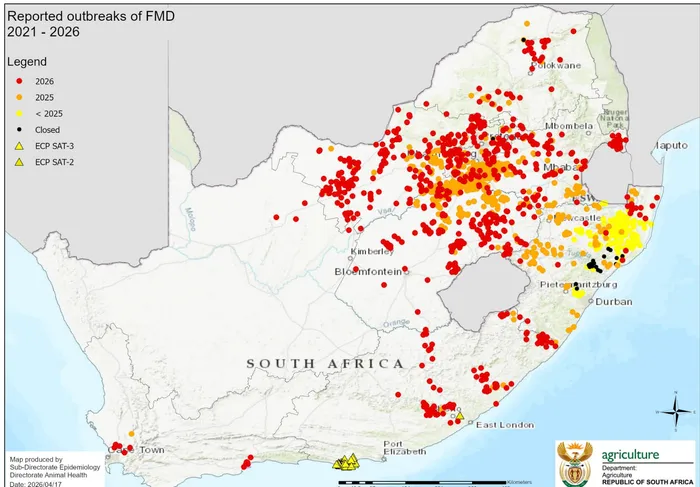
A map of the recorded outbreaks in the country.
Image: Supplied
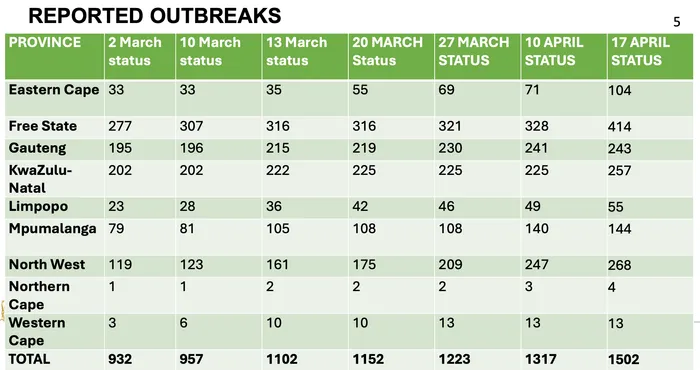
A look at the recorded outbreaks this year
Image: Supplied
Modisane added that the department has also requested to order 5 million doses from Biogenesis Bago.
He explained that to date, they cannot even say South Africa got the outbreak from its wildlife reserves, because the virus of concern was last isolated in Zimbabwe in 2003, and that these cases being recorded in the country are being reported to the WOAH (World Organisation for Animal Health).
Serage said that the reason why there has been an increase in officially reported outbreaks is because of previous under-reporting, and that there is now a central system being used to report outbreaks.
In terms of vaccination rollout, there have been 2,134,609 vaccines administered, with the provincial breakdown as follows:
Modisane also explained that the reason why there is a residual balance of 323,231 vaccines left over is that some private vets and industries still have to report their usage.
Other reasons also include about 6-8% of the bottles either leaking or broken, issues related to bottles being opened, the number of animals in a herd being fewer than the available doses, issues related to syringe glasses breaking, and the impact of heavy rainfalls in some areas
“This strategy that we have, and it has been sent and presented to Cabinet, and has been accepted, is a 10-year strategy. It's not something that is going to finish now, but it is something we’re starting now. We’re dealing with positive cases, and then later on will go out and vaccinate prophylactically (for preventive purposes),” Serage said.
In terms of compensation for farmers who have lost income, Serage said that they unfortunately do not have the funds.
“The funds that we have now are dedicated towards controlling the outbreak and getting the country to normalcy. But of course, we do sympathise with farmers who have lost production as a result of these outbreaks, and unfortunately, we do not have the means at the moment,” he said.
“Are we happy with the progress? No, we are not. What is causing this delay or this somewhat sluggish process? It's because we rely on imported vaccines. Vaccine registration is a long process, and we have not had the appetite, with the private sector in the country… and unfortunately, we have to rely on the importation of vaccines.
“At the same time, our resources on the ground to be able to vaccinate quicker, we are still ramping that up, and we hope for the vaccination rate to improve.”
theolin.tembo@inl.co.za