

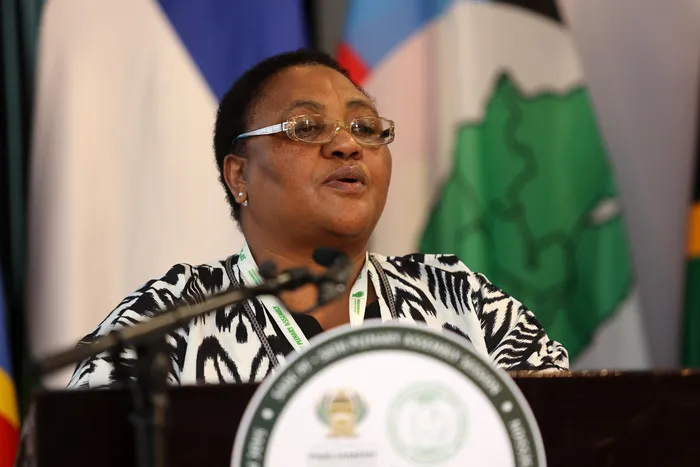
Parliament Speaker Thoko Didiza has announced the process that the National Assembly will follow in response to the judgment handed down by the Constitutional Court regarding Phala Phala farm scandal.
Image: Tumi Pakkies/ Independent Newspapers
Parliament Speaker Thoko Didiza, has announced she will report the Section 89 Independent Panel's findings to the National Assembly by publishing them in the official Parliamentary records.
This after the Constitutional Court (ConCourt) on Friday ruled that Parliament acted unlawfully in 2022 when it voted to block an impeachment inquiry into President Cyril Ramaphosa over the Phala Phala farm theft scandal.
The ConCourt invalidated the National Assembly’s vote that used the ANC majority to reject the Section 89 Independent Panel report.
The court ordered that the Independent Panel's report be referred immediately to an Impeachment Committee.
The judgment was a direct result of a legal application brought by the EFF and the African Transformation Movement (ATM), which submitted that Parliament failed to fulfill its constitutional obligations.
Following the judgment, the EFF demanded an immediate impeachment committee, while the MK Party and ATM have submitted motions of no confidence against Ramaphosa.
The EFF requested that Parliament provide explicit timelines detailing exactly how and when the court's directive will be executed without delay.
The MK Party, on the other hand, requested that the motion of no confidence vote be conducted via secret ballot to protect MPs from internal intimidation.
The party has also requested that the motion be prioritised, scheduled, and debated without any undue delay, while the ATM filed an accompanying Motion of No Confidence targeting both Ramaphosa and his entire Cabinet.
The ATM stated that Ramaphosa's continued tenure severely undermines the integrity of the Office of the President.
The three parties have publicly demanded his immediate resignation, arguing that he cannot govern effectively while preparing for impeachment proceedings.
Some factions within the ANC also believe keeping Ramaphosa in office is politically risky, adding that this will damage the party's prospects ahead of the upcoming local government elections.
Didiza on Monday said Parliament reaffirms its respect for the judgment of the Constitutional Court and will act in full compliance with the order and directions of the Court.
Announcing seven steps to effect the judgment, Didiza said she will initiate the process to constitute the Impeachment Committee in terms of Rules 129J to 129O of the Rules of the National Assembly to consider the section 89 inquiry process contemplated in the Constitution and the Rules of the Assembly.
She added that she will formally refer the Independent Panel Report to the Impeachment Committee as directed by the Constitutional Court.
“The Speaker will refer the Constitutional Court judgment to the National Assembly Subcommittee on the Review of Rules to consider and process the amendments required to the Rules of the National Assembly pursuant to the findings, reading-in, and directions of the Court. The Subcommittee will report on its work to the Rules Committee, which will in turn submit its recommendations to the National Assembly for consideration.
“The Speaker will determine the appropriate programme, procedural arrangements, timeframes and institutional support measures necessary to enable the Impeachment Committee to undertake and finalise its work effectively, fairly and within the framework of the Constitution and the Rules of the National Assembly,” read the statement published on Monday.
Director and head of Accountability Now, Paul Hoffman, said the committee, once appointed, will consist of a mix of parliamentarians that approximates party representation in the National Assembly.
“For example, if the panel is ten members strong, it will likely have 4 members from the ANC, two from the DA, and one each from the EFF and MK parties. The remaining three members will be drawn from the smaller parties, with the ATM a strong contender for a place on the panel, having initiated the whole process,’ he said.
Governance expert and political analyst Sandile Swana said that the as much as the ANC would not want the hearings to continue, 'they also know that what they did was not rational'.
“They represented their careers and their party, not the voters,” said Swana.
Professor Andre Duvenahage said this is likely to bolster the anti-Ramaphosa group within the ANC, adding that this would be a golden opportunity for some to claim ground in the succession battle involving people such as deputy president Paul Mashatile, Fikile Mbalula, and others.
‘But we must also take into consideration that the ANC can decide to force Ramaphosa to step down. That is not impossible,” he said.
According to the SABC, some ANC veterans have dismissed calls for Ramaphosa's resignation, arguing the ruling focuses on parliamentary procedure rather than a direct finding of guilt against the President.
Meanwhile, Ramaphosa has stated that he respects the Constitutional Court's judgment and reaffirms his commitment to the rule of law.
manyane.manyane@inl.coza