

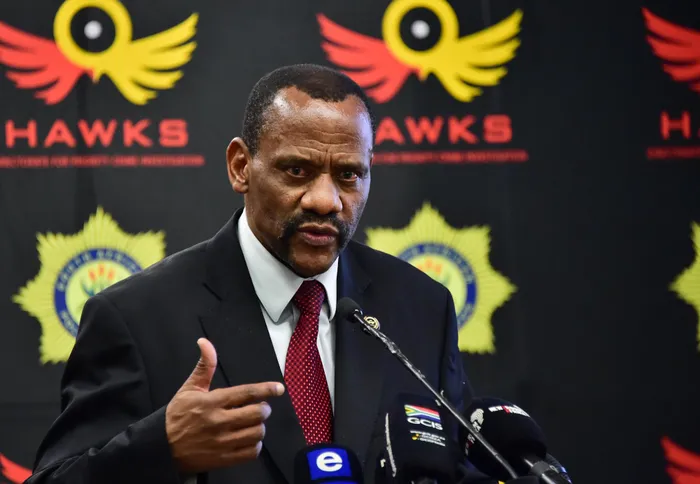
Former Hawks boss Lieutenant-General Godfrey Lebeya has denied any form of interference in any of the TRC cases, as alleged by the family of the Cradock Four victims.
Image: GCIS
The former head of the Directorate for the Priority Crimes Investigations (DPCI), also known as the Hawks, Dr Godfrey Lebeya, has denied interference with Truth and Reconciliation (TRC) cases during his term as Hawks head.
Lebeya, who served from 2018 to 2025, has been accused by the Calata family of having interfered with investigations in the TRC cases.
However, during his testimony on Tuesday, he told the TRC Commission, chaired by retired Constitutional Court Justice Sisi Khampempe, that instead, he tried to mobilise resources to ensure some of the cases were resolved with speed.
"Working closely with the National Director of Public Prosecution (NDPP), we increased the capacity of DPCI, as we were operating at 50% capacity, on cases classified under national offences against the state, as we had fewer than 3,000 personnel across nine provinces," he said.
On having directly or indirectly interfered or given unlawful instruction to his members, Lebeya stated: "When I joined the police force in 1984, I took an oath, and I renewed this oath when I took over as the head of DPCI... I have never given nor received any unlawful instruction."
Lebeya noted the challenges that arose from significant events, such as the July unrest and various cases emerging from the Zondo Commission, which added a layer of complexity to their responsibilities.
In response, the former Hawks head announced the recruitment of additional personnel, saying: "We had the July unrest, cases emanating from the Zondo Commission, to deal with the TRC cases, we recruited 200 personnel. We advertised 200 posts to recruit retired detectives to deal with these cases. We managed to get 104 retired detectives and allocated 40 of them to focus on TRC cases.''
Lebeya added that, for his efforts in mobilising resources for crimes against the state, which all the TRC cases were categorised as, he received commendation from his seniors.
He also used the opportunity to detail his early days as a new police recruit after being deployed to Cradock in 1984 and to Port Elizabeth.
"I became one of the members who were taken for deployment at Cradock in July 1985, to guard houses of police officials and councillors when the funerals of Matthew Goniwe, Fort Calata, Sicelo Mhlauli, and Sparrow Mkhonto (Cradock Four) were held. I was not aware at that time that the then-Security Forces were behind the murders of the Cradock Four until the revelations were made during the amnesty process held by the Truth and Reconciliation Commission."
Lebeya has concluded his evidence-in-chief, with the commission only engaging in clarity-seeking questions following the morning tea adjournment.
siyabonga.sithole@inl.co.za