

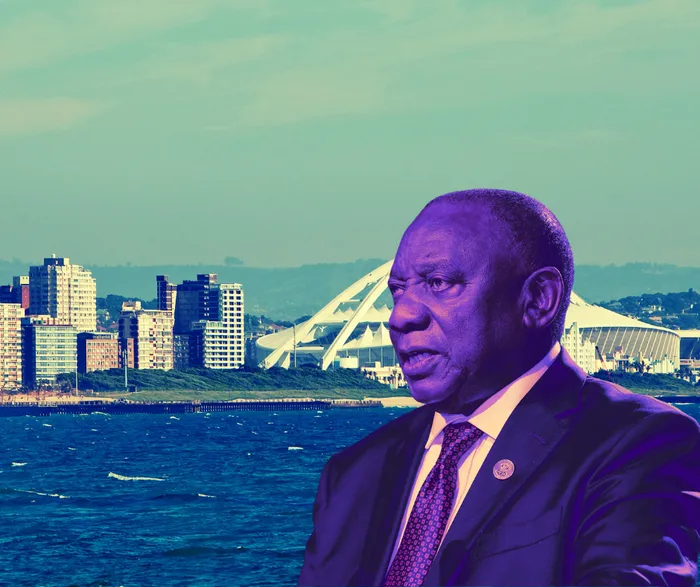
President Cyril Ramaphosa says the next phase of the Presidential eThekwini Working Group will focus on boosting economic growth and investment as Durban shows signs of recovery after years of service delivery challenges.
Image: IOL Graphics
President Cyril Ramaphosa says the next phase of the Presidential eThekwini Working Group will shift its focus towards economic growth as Durban seeks to strengthen its position as a leading business and tourism destination, The Mercury has reported.
Speaking during a meeting this week, Ramaphosa said the partnership between government, the municipality and the private sector had already produced visible improvements in stabilising service delivery in the city.
The intervention was launched two years ago following mounting concerns from the business community about deteriorating municipal services and governance challenges in eThekwini.
At the time, several companies warned that failing infrastructure, unreliable services and administrative delays were undermining investment confidence in the metro.
Ramaphosa said recent assessments now show a significant shift in sentiment among businesses operating in Durban.
A study examining business confidence in the city found that optimism within the local business sector has risen to its highest level in years.
The president credited the collaborative approach adopted through the Presidential eThekwini Working Group for helping to reverse the city’s decline.
“When I came here two years ago, business leaders outlined the serious challenges the city faced,” Ramaphosa said. “The model of cooperation that has emerged here has proven to be one of the most effective partnerships we have seen.”
He added that the working group had created a platform where municipal officials, national government representatives and the private sector could jointly address the city’s challenges.
According to Ramaphosa, early signs suggest that the intervention has succeeded in stabilising conditions in the metro.
“There are tangible signs that the decline has been halted. Stability has begun to take hold and recovery is now underway,” he said.
Despite the progress, the president cautioned that stabilisation alone is not enough to secure the city’s long-term future.
He said significant structural issues still need urgent attention, particularly in areas affecting service delivery and infrastructure.
Surveys indicate that nearly two-thirds of businesses remain concerned that service delivery complaints may not be addressed within reasonable timeframes.
Environmental management and the condition of roads also remain major concerns raised by companies operating in the city.
Another critical challenge highlighted by Ramaphosa is the municipality’s high level of non-revenue water, which currently stands at about 55%.
He said the figure is well above acceptable benchmarks and represents both financial losses for the municipality and missed economic opportunities.
The second phase of the Presidential eThekwini Working Group will therefore concentrate on initiatives that stimulate economic development and unlock investment.
Part of this strategy will involve accelerating large-scale infrastructure development projects across the city.
Ramaphosa said the Department of Trade, Industry and Competition will play a larger role in the next phase of the programme, particularly in tackling issues such as illicit trade.
He also emphasised the need to simplify administrative processes that slow down development.
“If eThekwini is to compete with other metropolitan areas, we must reduce the friction in development planning, speed up approvals and reform cost structures that discourage investment,” he said.
The president encouraged businesses to highlight regulations that unnecessarily hinder economic activity.
Government, he said, must work to eliminate excessive bureaucracy and create a more investor-friendly environment.
“You must tell us where there are rules that stand in the way of your operations. Our responsibility is to remove those barriers and ensure the red carpet is rolled out for investment,” Ramaphosa told business leaders.
In recognition of the city’s progress, Ramaphosa also announced that Durban will host the Southern African Development Community (SADC) Heads of State summit in August.
The gathering is expected to bring approximately 14 regional leaders to the city.
The president noted that such events carry economic benefits, as visiting delegations often travel with large teams and contribute to tourism and hospitality spending.
Minister of Cooperative Governance and Traditional Affairs Velenkosini Hlabisa said the improvements in eThekwini demonstrate the potential of collaborative governance.
He told business leaders that their continued engagement with government has been vital in driving progress.
“Thank you to the business community for remaining involved in this process and not only criticising from the sidelines,” Hlabisa said.
He added that the ultimate measure of success will be whether residents begin to experience reliable municipal services.
KwaZulu-Natal Premier Thami Ntuli also acknowledged the role of the private sector in supporting the intervention.
Ntuli said government’s responsibility is to create a stable environment in which businesses can invest and grow.
“When local government fails, it is the people who feel the consequences first and most severely,” he said.
He added that the intervention has already helped stimulate investment in the province, with around R100 billion in pledges linked to ongoing development initiatives.
Moses Tembe of the KZN Growth Coalition said the progress made in eThekwini should be recognised.
He urged stakeholders to acknowledge the positive impact of the partnership between government and business in stabilising the city.
“We must appreciate the work that has been done so far,” Tembe said, adding that continued collaboration will be key to sustaining Durban’s recovery.
IOL News