

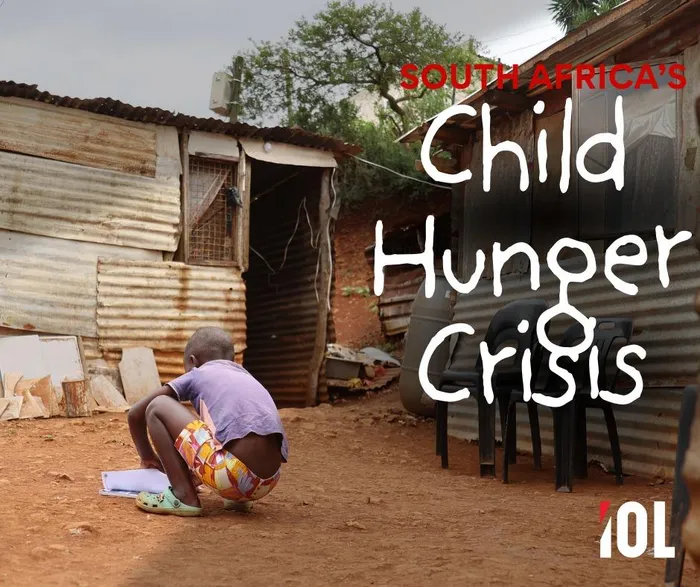
Hunger and a lack of documentation presents a significant hurdle for Zanele Maphisa’s grandchild, who dreams of attending school.
Image: Tumi Pakkies/ Independent Newspapers
* This is part one of a four-part series on the devastating impact of malnutrition in South Africa.
On the outskirts of Inanda township, 55-year-old Zanele Maphisa (*name changed to protect the identities of the minor children) finds herself the sole guardian of her three grandchildren.
On a daily basis she battles against the tides of poverty and neglect.
Each day is a struggle to provide basic necessities, as her home, constructed from makeshift corrugated iron, bears witness to both the resilience and desperation of a family facing overwhelming obstacles.
Maphisa’s household is divided into two cramped rooms: one part serves as her bedroom, while the other is shared between her three grandchildren, aged 2, 5 and 18.
Recently, her middle grandchild sustained an injury to his hand caused by the very materials that form their home.
Her sons fathered her grandchildren.
“I would cry out to them (my sons) for help, and it just falls on deaf ears. The eldest’s father died,” Maphisa said.
She said her eldest and youngest grandchildren have the same mother.
When asked about other family members, Maphisa stated she had none, as the others had passed away.
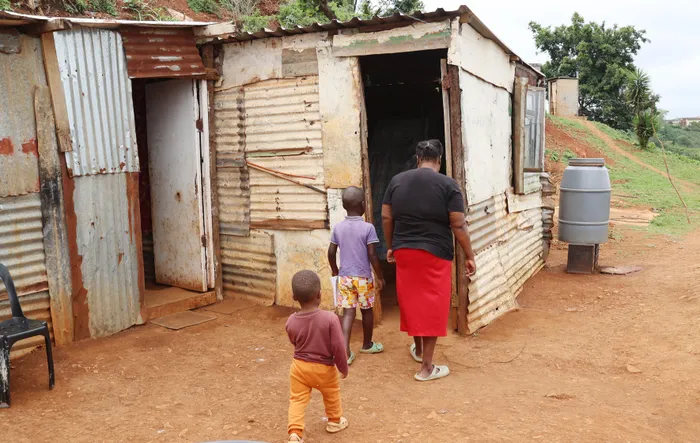
Zanele Maphisa*, a devoted grandmother, navigates the challenges of poverty while caring for her three grandchildren.
Image: Tumi Pakkies/ Independent Newspapers
Since Maphisa has not reached pension age, she is not getting the government’s older persons’ grant, a lifeline they desperately needed. However, she is getting what she called “Ramaphosa’s grant”, formally known as the Social Relief of Distress Grant.
Her eldest grandchild was getting the child support grant (R560), but that has been stopped because of his age.
“We lived off his grant,” Maphisa said.
They try to live through her sporadic employment (domestic worker or some small business initiative), but it is insufficient to sustain them.
“When I get money from those 'piece jobs', I buy what I can sell like soap. I sell soap, which gets me some sales now and then,” Maphisa said.
Further highlighting their plight, she said they never have enough food for the whole month.
“The food runs out before the month ends,” Maphisa said. “By the 15th, food starts to run out.”
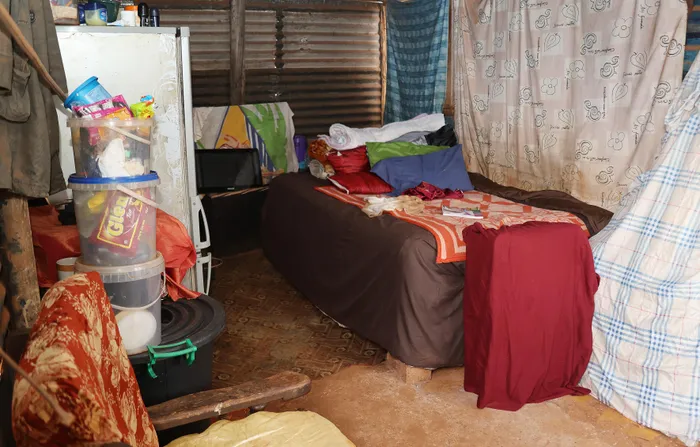
Inside Zanele’s room. She also shares the limited groceries that sustain her family, highlighting the reality of hunger.
Image: Tumi Pakkies/ Independent Newspapers
During the interview, Maphisa said they only had maize meal and potatoes, which are what she usually buys, so they can eat and survive.
She said they have never gone to bed without a meal, thanks to a helpful community member who comes to their aid when times get hard.
“If she weren’t there, we would go to bed hungry. It helps that there is someone like her in the community,” Maphisa said.
The National School Nutrition Programme (NSNP) is designed to provide one nutritious meal to quintile 1-3 schools daily, but it sometimes falls short. That was evident at her eldest grandchild’s school.
Food is served at his school, and although it helps fill his tummy, it is not always the case.
“Sometimes he will come home hungry, and there will be no food here. He says that when he goes to get food at school, sometimes he gets there and the food has run out because there is a fight for food,” Maphisa said.
If her middle grandchild were enrolled in school, he too, would have been eligible for the NSNP. But he does not have a birth certificate, unlike his elder cousin, which allowed him to go to school and receive the child support grant.
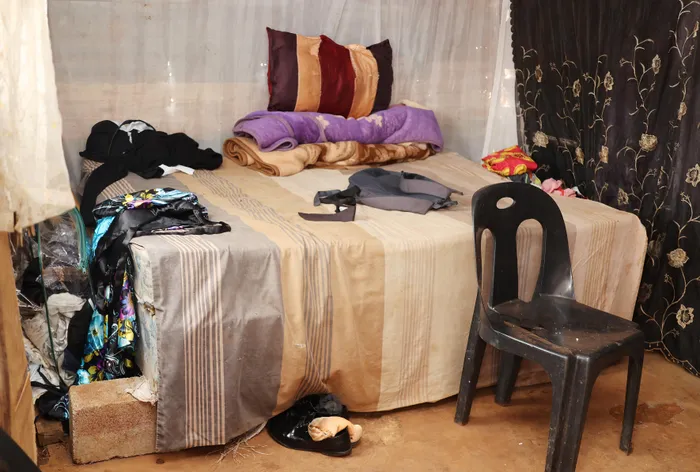
The bedroom where the boys sleep also doubles as the kitchen.
Image: Tumi Pakkies/ Independent Newspapers
The youngest grandchild is also without a birth certificate.
Maphisa explained that when she looks for the middle grandchild’s mother, she runs away from her “to spite her child’s father”.
Obtaining the birth certificates for her grandchildren is complicated because their surnames differ from hers, as they use their mothers’ surnames. She noted that the process requires the involvement of the parents, an obstacle she has faced previously with her middle grandchild.
“He (middle grandchild) wants to go to school. He would be in Grade R if he had a birth certificate,” Maphisa said.
“I tried in February, but I failed. He had told everyone he was going to school. When I send him to the shop, people ask why he isn’t going to school. He says he does not have a birth certificate.”
Shifting her focus to their living conditions, she said she has lived in Inanda for 20 years and had registered for government housing, but she has not received a state house.
In 2022, their house was washed away during the floods, and she had no choice but to rebuild nearby. Their new house leaks when it rains.
“I just put my faith in the Lord because He knows,” Maphisa said about their situation.
“My primary concern is securing assistance for food and obtaining adequate housing. The immediate priority is getting help and food; the house can follow, though it is also important.”
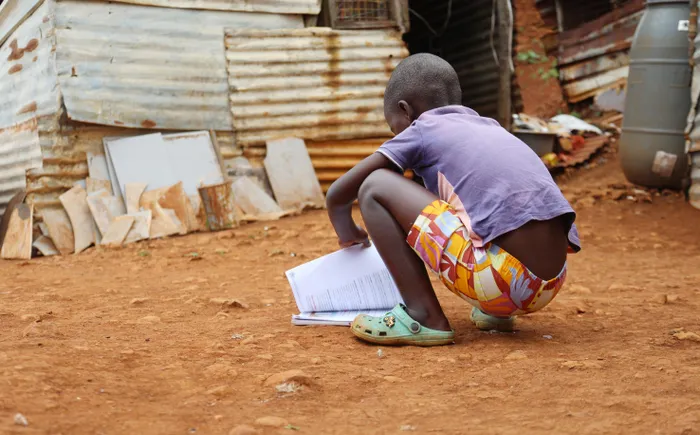
Education barriers: Zanele’s middle grandchild dreams of attending school but faces challenges due to missing documentation.
Image: Tumi Pakkies/ Independent Newspapers
According to the South African Child Gauge 2025, 14% of children in South Africa (approximately 2.9 million) lived in households that reported child hunger in 2024.
However, the long-term trend is that reported child hunger has declined substantially since 2002, when 30% of children (5.5 million) lived in households that reported child hunger. The largest declines have been in the Eastern Cape and Limpopo, followed by Free State, Mpumalanga and KwaZulu-Natal.
The publication said that one of the main contributors to the long-term decline is the expansion of the Child Support Grant, which steadily increased its coverage, reaching over 13 million children in 2024.
Another contributor could be the National School Nutrition Programme (NSNP), which reaches an estimated nine million learners in approximately 20,000 schools. However, the NSNP only operates during the school term and does not include children who are too young to attend.
“Despite having the smallest child population, the Northern Cape appears to have the highest rates of hunger, with 22% of children living in households that report children going hungry. KwaZulu-Natal households report slightly lower rates of child hunger (19% of children), but because of its large child population, it accounts for nearly a third (29%) of children reported to suffer hunger.
"The Western Cape has relatively low rates of child hunger (15%), but is also the only province where child hunger rates have not reduced in the past two decades. Given population growth, the estimated number of children reported to be hungry in that province has increased from 275,000 in 2002 to around 330,000 in 2024,” according to the publication.
“The lowest reported hunger rates were in Limpopo (4%). Despite high poverty rates, Limpopo has always reported child hunger rates well below the national average, perhaps because of the relatively fertile and productive land in rural areas where most of the population lives. However, there is no clear explanation for the dramatic decline in reported hunger in the Eastern Cape.
"Over the period 2002 to 2024, reported child hunger rates in that province fell from 48% (higher than any other province) to 14%, despite the Eastern Cape having the highest poverty rates in the country, with half of the children in that province living below the food poverty line.”
The the South African Child Gauge 2025 said that children who suffer from hunger are at risk of various forms of malnutrition, including wasting, stunting, overweight and micronutrient deficiencies.
It explained that the 2016 Demographic and Health Survey recorded the stunting rate among children under five years at 27% – a figure that has remained persistently high since the 1990s and indicates high rates of chronic undernutrition.
The more recent National Food and Nutrition Security Survey conducted by the Human Sciences Research Council between 2021 and 2023 found similarly high levels of malnutrition, with under-five stunting estimated at 29% nationally. This suggests that chronic malnutrition has remained persistently high and may even have worsened in the last decade.
It further explained that child hunger is a subjective indicator and does not capture other important aspects of food security, such as dietary diversity and consumption of nutrient-rich foods, both of which are important for children’s healthy growth, especially in early childhood.
“Children living in households that do not report hunger may still not have access to sufficient nutritious food and be at risk of malnutrition,” the publication read.
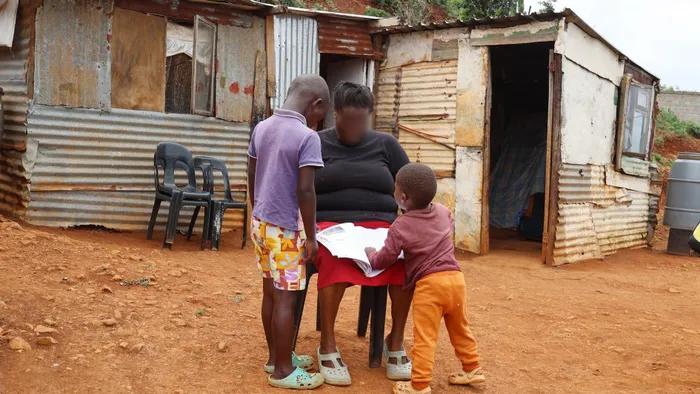
A glimpse into Zanele’s home: a small, makeshift structure that reflects both resilience and hardship.
Image: Tumi Pakkies/ Independent Newspapers
In 2025, Health Minister Dr Aaron Motsoaledi, in parliamentary responses, revealed the face of malnutrition in children under age 5 in South Africa.
In 2024, 5,146 children under age 5 were admitted to public health facilities with moderate acute malnutrition. The number of children admitted with severe acute malnutrition was 9,143.
In 2024, 192 children under age 5 with moderate acute malnutrition died in public health facilities. The number of children with severe acute malnutrition who died in public health facilities was 574.
UNICEF South Africa nutrition manager Gilbert Tshitaudzi said a UNICEF report in 2024 showed that 181 million children under the age of 5 globally – or 1 in 4 – live in severe child food poverty. This means they are fed two or fewer food groups per day.
He explained that children experiencing severe child food poverty consume nowhere near the required balance of nutrients for healthy physical growth and cognitive development.
“This is particularly alarming as our data tells us that children in severe child food poverty face 50% increased odds of wasting, which is a life-threatening form of malnutrition,” Tshitaudzi said.
He said there are three main drivers of severe child food poverty:
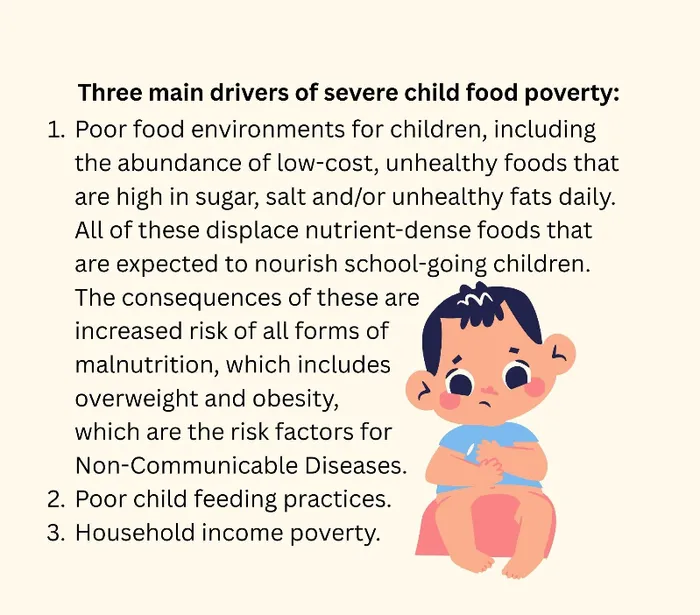
Three main drivers of severe child food poverty.
Image: Thobeka Ngema
Tshitaudzi said the effects of malnutrition in school-going children may manifest in several ways, including micronutrient deficiencies such as iron deficiency (particularly among girls), and overweight and obesity, which increase the risk of non-communicable diseases.
“Malnutrition during this period can also negatively affect school performance, impair cognitive abilities, compromise cognitive development, delay sexual maturation, and slow linear growth,” Tshitaudzi said.
“Later in life, stunting (i.e children who are short for their age) may increase the risk of excessive weight gain and this, in turn, increases their risk of chronic diseases related to nutrition, such as hypertension and diabetes. Moreover, stunting reduces children’s future productivity, leading to wages up to 20% below average and fewer assets in adulthood.”
Tshitaudzi said UNICEF believes that the following evidence-based key interventions should be scaled up by the government at the national level to improve the school food environment for school-going children:
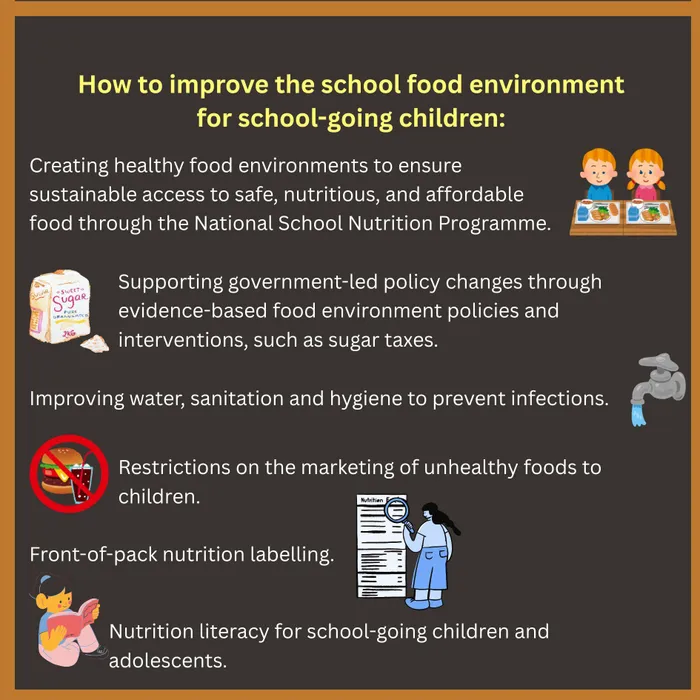
How to improve the school food environment for school-going children.
Image: Thobeka Ngema
Tshitaudzi explained that the Child Support Grant (CSG) has the potential to be a game changer in addressing child food poverty in South Africa by helping households access healthy, nutritious foods that meet children’s daily nutritional requirements.
“It plays a critical role in reducing child poverty, enhancing food access, and strengthening household resilience across the country. UNICEF supports the increase of the child support grant above the poverty line to assist poor families in covering the basic food items,” Tshitaudzi explained.
“The current value of the CSG (R560) is insufficient to shield the poorest children from hunger, malnutrition, and stunting. The grant can lift children out of poverty only if they are not already deeply below the poverty line. For households facing severe poverty, even an increased CSG may not be enough to move them above the poverty threshold. All of which illustrates that the CSG alone cannot keep pace with the broader socio-economic challenges faced by many households.
“To be fully effective, the CSG should be complemented by broader structural multisectoral interventions across social protection, health, education and agriculture. This includes improved early access to CSG, health and nutrition services, education and employment opportunities for caregivers.”
The CSG’s primary objective was to ensure that the primary caregivers of children, up to 18 years, living in extreme poverty could access financial assistance to supplement household income. Over 13 million poor children were in receipt of the grant.
* The grandmother’s name has been changed to protect the identity of the minor children.
thobeka.ngema@inl.co.za