

Healthy eating guidelines for pregnant women and young children: A roadmap to better health.
Image: Sibonelo Ngcobo/ Independent Newspapers
* This is part two of a four-part series on the devastating impact of malnutrition in South Africa.
A nutrition expert has explained that inadequate nutrition during pregnancy and during early childhood has long-term detrimental effects on children.
University of the Western Cape (UWC) nutrition lead Professor Rina Swart said: “Some specific effects are linked to specific nutrients, but in general, the growth and development of the child can be delayed, leading to eventual challenges in the educability of the child and limiting the opportunities for reaching his/her full potential as an adult.”
Swart said severe food shortages cause wasting (thinness) or underweight. Moderate, long-term undernutrition can lead to stunting (shortness), the most common undernutrition in South Africa. Stunting is challenging to identify without regular monitoring and is associated with lower scholastic performance and adult income.
She said if children eat unhealthy food items frequently, it often replaces the healthy foods in their diet, and they are at risk of micronutrient deficiencies, whilst they may gain too much weight (given the “empty” calories they consume), resulting in overweight.
“Children who are overweight have a very high risk of becoming obese adults. South Africa currently has one of the highest prevalences of adult overweight and obesity in the world, especially in women,” Swart said.
She said different guidelines for maternal feeding practices may achieve the same purpose, so her recommendations are not the only solution.
Swart said the World Health Organisation (WHO) published healthy diet guidelines, but because their energy percentage calculations are not easily understood by ordinary people, more general recommendations, like the dietary diversity score, are used instead.
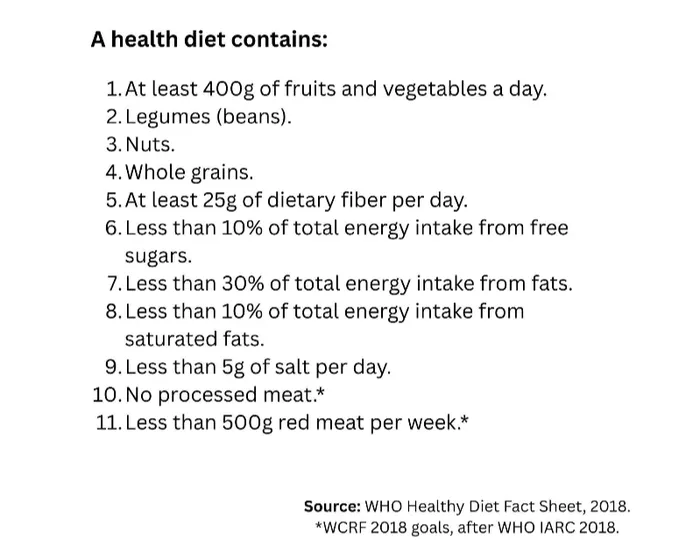
What a healthy diet contains.
Image: Supplied
Swart noted that validation of the minimum dietary diversity score for women (MDD_W) suggests that consuming more food groups from the list increases the likelihood of meeting micronutrient needs. The MDD-W has 10 groups, and the minimum acceptable diversity is 5, though more is better.
She said dietary diversity classifies foods with similar nutrient composition into one group. Eating more of the same type of food (e.g., bread, rice, and maize pap) still counts as only one food group.
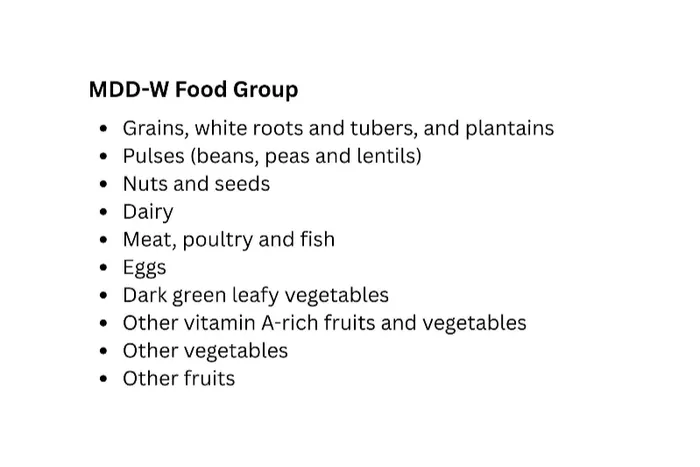
The MDD-W Food Group.
Image: Supplied
“The latest recommendations have now also gone beyond foods that are health-promoting, but also make recommendations of foods that should not be consumed regularly. Some refer to these foods as discretionary foods. If you consume any of these groups daily, your consumption of sugar, salt and unhealthy fat is definitely going to be excessive, which can lead to overweight and obesity and diseases such as Diabetes (type 2), hypertension or cardiovascular disease,” Swart said.
Swart said foods associated with non-communicable disease risk should NOT be eaten daily.
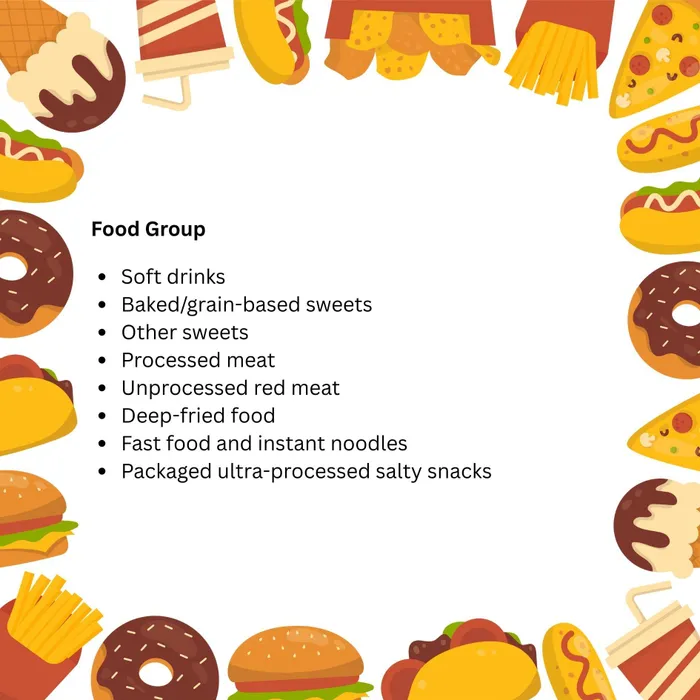
Foods which should not be eaten daily.
Image: Supplied
Swart said these guidelines are for a minimum adequate diet for young children. Additionally, it should be noted that for young children, the guidelines are very specific based on age brackets:
Birth to six months: Exclusive breastfeeding is best. If not breastfeeding, use commercial formula ONLY if it is hygienically prepared and sufficient resources are available to ensure it is prepared according to the correct dilution guidelines. Incorrect dilution (over- or under-diluting) can cause malnutrition in children. Infants 0-6 months need at least four formula milk feeds daily.
Six to eight months: Continue breastfeeding. Slowly introduce new tastes by adding soft foods (mashed cooked vegetables) or porridge (consistency suitable for the baby). At this age, the minimum frequency of additional feeds should be two per day. If a child is not breastfed, then the child should receive at least two milk feeds per day and two feeds of soft foods.
Nine to 23 months: To achieve a minimum adequate diet, a child should consume foods from at least 5 of the 8 food groups, served at least three times daily, with appropriate consistency for their age. Young children should not eat the listed unhealthy foods every day:
“Children older than two years can follow the same minimum guidelines as for women of childbearing age, noting that they may require more frequent eating opportunities (at least four during the day) as their stomach capacity is small,” Swart said.
She said the same dietary guidelines apply to pregnant women. It is not true that a pregnant woman needs to eat for two.
“Yes, their appetite will increase proportionately as the fetus develops, and they will gain weight as the fetus develops (little in the first three months, but thereafter about 1/2kg/month). Pregnancy does put a premium on certain micronutrients - specifically iron and folate. These micronutrients are needed during the very first stages of the development of the embryo (for example, folate is needed for neural tube development). This is why meeting the minimum dietary diversity is so important for all women of childbearing age, in case of an unplanned pregnancy,” Swart explained.
She said a few other critical guidelines for pregnant women to improve the development of the fetus and avoid any potential damage to the infant:
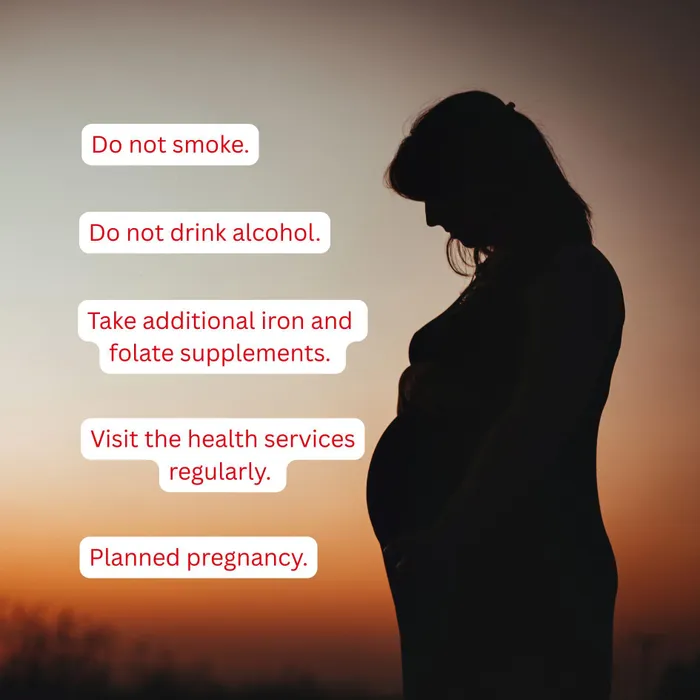
Critical guidelines for pregnant women.
Image: Thobeka Ngema
Swart explained that the purpose of growth monitoring is to identify growth faltering early. Regular visits to a health practitioner are beneficial, as one measurement is insufficient. Ideally, a child’s height should also be monitored at least every six months in the first two years to identify stunting early.
Growth monitoring and promotion (GM&P) provides encouragement and support to caregivers to ensure children achieve their potential, as not doing so has significant negative implications for their future, including scholastic and income-earning achievements.
Meanwhile, in a parliamentary question, Social Development Minister Nokuzola Tolashe was asked why the department has not introduced a maternal support grant for malnourished, at-risk pregnant women, despite the documented impact of maternal malnutrition on infant health, birth outcomes, and early childhood development.
Tolashe clarified that the department has not reached any conclusion or made a decision to cancel the introduction of the maternal support grant.
“The department presented a draft policy to Cabinet to obtain approval to consult on it before it could be approved for implementation. However, Cabinet directed that the policy should rather be revised as part of a broader agenda to consider the consolidation of the social security system. As a result, the policy will no longer be addressed as the department had originally envisaged,” Tolashe said.
thobeka.ngema@inl.co.za