

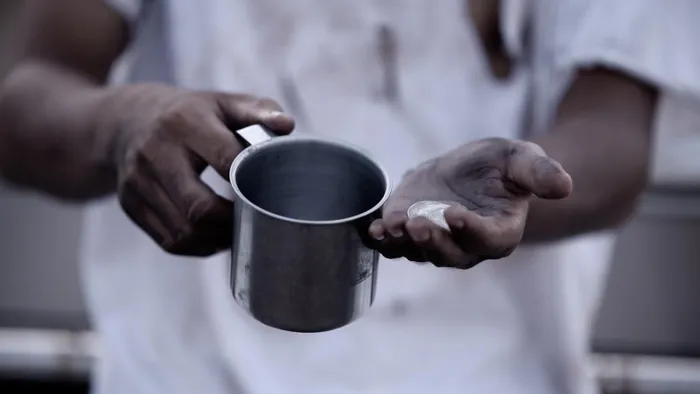
A stark reminder: 23.2 million South Africans live below the lower-bound poverty line, with KwaZulu-Natal ranking the highest.
Image: Freepik
Provincially, KwaZulu-Natal now ranks number one in terms of lower-bound poverty levels (the poverty threshold forces difficult trade-offs between food and other necessities) at 49.6%. This is in the context of 23.2 million people in South Africa, representing 37.9% of the population, living below the lower-bound poverty line, according to the latest figures from Statistics South Africa’s Income and Expenditure Survey (IES) conducted in 2023.
During KwaZulu-Natal Premier Thamsanqa Ntuli’s Premier’s Coordinating Forum (PCF) on Friday, Bongani Radebe of Statistics SA noted that in terms of poverty, the IES of 2023 indicated that 68.8% of South Africa’s income is derived from work. In KZN, it is 63.8% while 12.5% is derived from pension and social insurance, which includes grants and others.
Radebe highlighted that the IES of 2023 has allowed them to review national poverty lines.
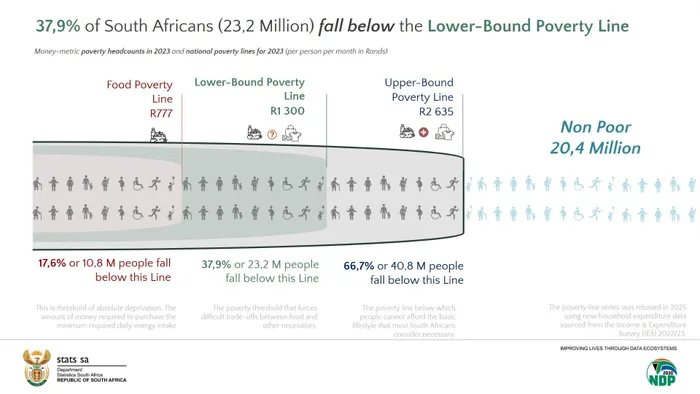
According to the 2023 Income and Expenditure Survey, 23.2 million South Africans, representing 37.9% of the population, live below the lower-bound poverty line.
Image: Stats SA
“With food poverty lines, we’re at R777, which is the threshold of absolute deprivation where a household will have no choice but to buy food. And those who are at the lower-bound poverty line, where the poverty threshold forces difficult trade-offs between food and other necessities, are now adjusted to R1,300. The upper-bound of the line is at R2,635 (the poverty line below which people cannot afford the basic lifestyle that most South Africans consider necessary),” Radebe said.
He said these figures translate to 23.2m (37.9%) of people in South Africa falling below the lower-bound poverty line. Moreover, 17.6% or 10.8m people fall below the food poverty line while 66.7% or 40.8m people fall below the upper-bound poverty line.
“The IES 2023 says KwaZulu-Natal ranks number one (provincially) in terms of lower-bound poverty levels at 49.6%. Over time, it has not been number one, but recently, it has actually taken that spot,” Radebe said.
The North West now ranks as the second-highest province in terms of the lower-bound poverty levels.
Radebe said that in terms of the share of poverty (shift in share of all persons under the lower-bound poverty level), KZN contributes 24.8%. Gauteng had the second-highest number of those in poverty after KZN, but had increased the most between 2015 and 2023, gaining a 4.8% point share from 13.9% to 18.7%.
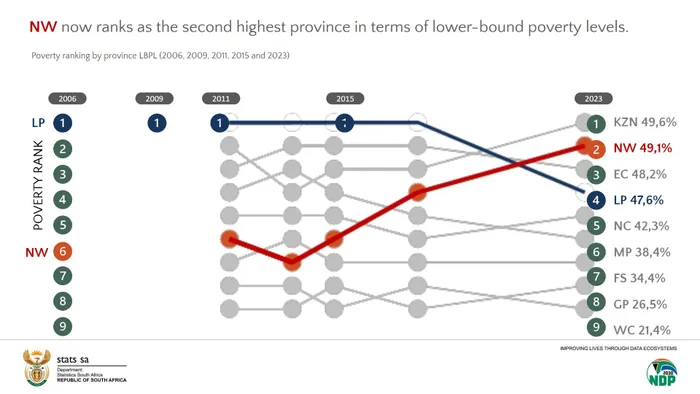
Statistics reveal KwaZulu-Natal’s alarming 49.6% lower-bound poverty rate in 2023.
Image: Stats SA
He further said that the South African Multidimensional Poverty Index (Sampi), which measures poverty in these dimensions (health, education, living standards and economic activity), the national headcount poverty decreased from 17.9% in 2001 to 7.0% in 2016.
Radebe said this also speaks to the issue of social grants that have increased in terms of provision from 12.8% (2003) for individuals to 40.1% in 2024. However, for households, it has increased from 30.8% (2003) to 50.4% (2004).
“In KZN, grants hold a share of 27% in terms of our households.”
Radebe noted that about half, which is 49.3% of youth-headed households in KZN, received remittances (money coming from outside the household, money sent home), as their main source of income. Salaries were the highest share of the main source of income for youth-headed (25-34 years) and adult-headed (35-59 years) households. Elderly-headed households mainly had grants as their main source of income.
He also noted that those with higher education are most likely to receive social grants. In 2014, they were at almost 5.3% (National Senior Certificate (NSC)/ Grade 12) and 10.4% (upper secondary) in terms of level of education, while in 2024, the picture changed to almost 50% (22.6% - NSC/ Grade 12 and 27.2% - upper secondary) when combined and compared to 2014.
thobeka.ngema@inl.co.za