

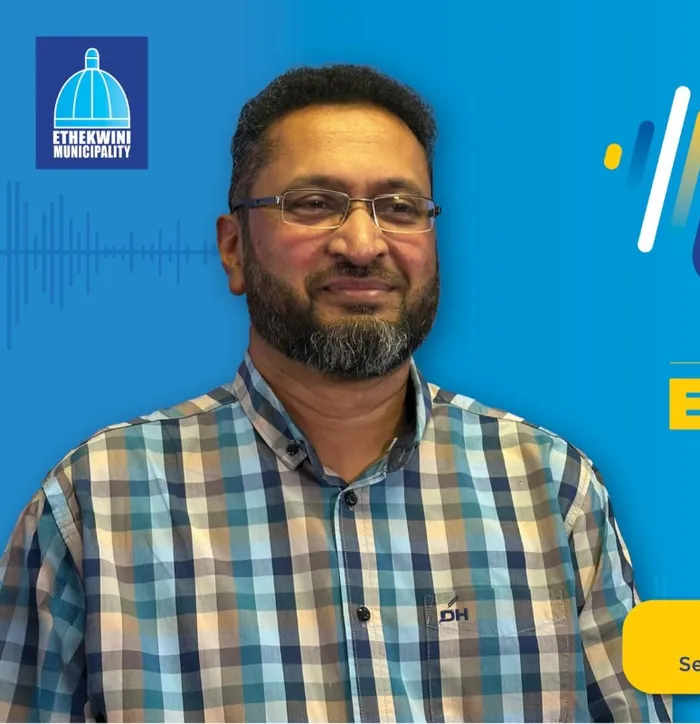
Puven Akkiah, Senior Manager: Integrated Planning, breaks down eThekwini’s 2026/2027 Integrated Development Plan (IDP).
Image: eThekwini Municipality
Residents of eThekwini must acquaint themselves with the targets of the Integrated Development Plan (IDP) so that they can hold the city accountable if those targets are not met.
Zimbili Mazibuko, a spokesperson on eThekwini Matters Podcast, said the municipality has tabled its draft IDP plan as part of the 2026/2027 budget which outlines investment in jobs, reliable basic services, safety and social development, good governance and long-term financial sustainability.
“The IDP is our five-year road map for inclusive economic growth and sustainable development,” she added.
The IDP plan consists of the following strategic pillars: the natural and built environments; economic development and job creation; quality living, safe, healthy and secure environment; empowering citizens; celebrating cultural diversity; good governance; and lastly, financial viability and sustainability.
Puven Akkiah, the municipality’s senior manager for Integrated Planning, explains the processes behind the 2026/27 IDP and why resident input was important.
“Residents can hold us accountable. We actually set the strategy, and we have to deliver. Residents must become aware of what the targets are. That is why we ask residents to comment on the IDP.
He said that on a quarterly basis, the municipality reports on the Municipal Spatial Development Framework (SDF), which is made available to the public.
Akkiah said that the IDP is a very technical document, which he went on to describe as the “game plan” for the municipality, outlining how the IDP will develop in the next financial year, which begins on July 1.
“It is reviewed in terms of the Municipal Systems Act, and the IDP is enforced during the term of office, so that when the new councillors come in, they effectively develop a five-year plan. After that, every year we review that five-year plan in terms of the development potential within that financial year,” he said.
Akkiah said it was important to understand that the IDP, the budget, and the SDF are strategic documents in the municipality. He said they contain all of the strategic thrusts and advised that if you want to look at one single document to find out what is happening in the municipality, the IDP was best suited.
“The IDP gives you the strategy, the budget gives you the resources from a financial perspective, but the SDF tells you exactly where those projects are going to be specialised,” he said.
Akkiah said the IDP tells stakeholders exactly what is going to happen with the municipality itself.
“It goes down to the ward level as well. It tells you the delivery targets for the municipality, for example, how many houses will be built or roads that will be rehabilitated. That information arms the residents, who are the stakeholders, to hold the municipality accountable in terms of delivery against the strategy contained in the IDP,” she said.
Akkiah said the community voices and community needs are actually heard. He said the process of engaging the municipality as well as stakeholders is through the Community-Based Planning (CBP) process, which happens prior to the development of the IDP.
He explained that once the CBP is completed, the municipality then circulates that list of needs to the sector department, the line department, and they use that in their preplanning for the budget and IDP.
“We create a framework. The line departments come through and say under this program, they are implementing certain projects aligned to the community needs in this manner. Effectively, it is localising community needs within the wider strategy of the city itself,” he said.
Akkiah said that community input influences the IDP in terms of achieving the strategy and influencing the budget. He said the Service Delivery Budget Implementation Plan ties the budget together with the performance indicators within the IDP itself.
"We have key performance indicators for each of the programmes. If targets are not met the municipality reviews the target in January or February," he said.
He said communities are aware and they are given the opportunity to participate in these processes.
"It is incumbent on the stakeholders to use those opportunities to engage with us on these matters,” he added.
Rose Cortes, deputy chairperson of the eThekwini Ratepayers Protest Movement (ERPM), said they have been analysing the IDP and budget for direct comment and will be providing analysis on it.
zainul.dawood@inl.co.za