

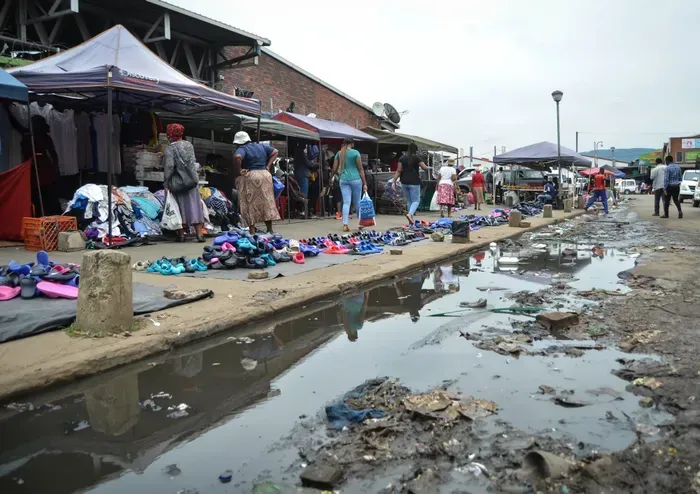
Parts of Pietermaritzburg CBS remain filthy despite Premier Thami Ntuli's efforts, including establishing Premier's Msunduzi Working Group to come up with solutions.
Image: Independent Media archives
Members of the public standing in a queue, waiting on the busy Pietermaritzburg Church Street to be assisted at the Home Affairs offices, are forced to endure the disgusting sight of sewage every day.
The eyesore sight, which is on a lane connecting Church and Pietermaritz streets behind the Home Affairs building, is evidence of Msunduzi Municipality’s decaying infrastructure.
Traffic congestion is still a huge problem in Pietermaritz Street, as taxis ranking at the Imbali Taxi Rank are left parked in the middle of the street.
Filth is still visible, especially in the area lying between Boshoff and East streets.
This is all despite the work that has been done by Premier Thami Ntuli’s appointed Premier's Msunduzi Working Group (PMWG), whose chairperson is former finance MEC Ravi Pillay.
During the 2025 State of the Province Address, Ntuli announced the establishment of PMWG to assist the struggling municipality to turn around the collapsing city’s infrastructure and service delivery , and longstanding governance challenges.
Msunduzi Association of Residents and Ratepayers (MARR) Chief Executive Officer, Anthony Waldhausen, said that since the PMWG was established in February 2025, nothing has changed the condition of the CBD and surrounding settlements, as residents continue to experience increasing water and electricity challenges.
“We have not seen any improvements, as the entire municipality is still dysfunctional. We last saw the members of the group (PMWG) when they met with us early last year to introduce themselves, and after that, they have not spoken to us at all,” said Waldhausen.
He said the filth that is visible in the CBD is evidence that the municipality’s service delivery system is still dysfunctional and that contacting the municipality and the Premier’s Office to get an update on the PMWG’s task “is a useless task”.
“We requested follow-ups, and we are trying to organise a meeting to get an update, because they should be updating the public about what is happening, but they are not doing that. I don’t know what the issue is because they are not explaining anything to us at all,” he said.
He described the state of the city as “completely dysfunctional and falling apart”.
“There is no turnaround plan and nothing whatsoever to turn the city around. All the streets in the suburbs and CBD are filthy,” Waldhausen said.
The Snathing, which is part of the city’s Greater Edendale area, has been without water for years and has been relying on tankers, which the residents alleged were not delivering consistently.
For years, three schools in the area had not only stopped the school nutrition programme, but they had also been forced to cut short the hours of learning and teaching so that teachers and pupils could go home to access ablution facilities and drink water.
These school governing bodies took the matters into their own hands by raising funds to build boreholes.
Waldhausen said the water infrastructure is still collapsing all over the city, including suburbs.
“We have continuous outages every day all over the city, as people go without water for two or three days,” Waldhausen said.
However, Pillay said the PMWG was functioning as it had done intensive work dealing with the city’s governance, financial sustainability, electricity, water and sanitation, roads, waste management and human settlements, safety and security, and economic development.
“There are short, medium, and long-term issues to be addressed. There have been obstacles to the work of the PMWG in relation to the interpretation of its legal mandate, but we expect the same to be resolved as we move forward.
“Sustainable success will require the good faith commitment of all stakeholders over a sustained period of time,” Pillay said.
Ntuli’s spokesperson, Lindelani Mbatha, said Ntuli was encouraged by the PMWG’s progress, which he said has been achieved since it was established.
“Under the leadership of the chairperson and former MEC Mr Ravi Pillay, the Working Group has been engaging extensively with municipal leadership, provincial departments, business formations, civil society, and community stakeholders to develop and coordinate practical turnaround interventions.
“Among the notable areas of progress are improved intergovernmental coordination, the strengthening of service delivery monitoring mechanisms, support towards infrastructure maintenance and rehabilitation, as well as enhanced engagements around waste management, water provision, and urban renewal initiatives within the city,” Mbatha said.
However, he also acknowledged challenges in certain areas, including water supply interruptions affecting communities such as Willowfountain, Snathing, and parts of Imbali, “as well as issues relating to cleanliness and infrastructure conditions within sections of the Pietermaritzburg CBD”.
“These challenges are largely linked to historical infrastructure backlogs, aging systems, financial constraints, and operational capacity pressures within the municipality.
“It is important to indicate that the intervention of the Working Group was never envisaged as an overnight solution, but rather as a structured and sustained process aimed at restoring stability, improving governance, and accelerating service delivery within Msunduzi Municipality.”
He said the group provides regular updates and reports to the premier on progress achieved, ongoing interventions, and existing challenges requiring further support.
“Premier Ntuli remains actively engaged and has consistently directed relevant provincial departments and entities to provide the necessary technical, governance, and infrastructure support to the municipality.
“Furthermore, the Provincial Government continues to work closely with Umgeni-uThukela Water and other strategic stakeholders to strengthen water supply interventions and implement longer-term solutions to improve reliability of water services in affected communities.
“Premier Ntuli remains committed to ensuring that Msunduzi Municipality is restored to a functional, responsive, and service-oriented institution capable of meeting the needs and expectations of its residents,” said Mbatha.
Msunduzi spokesperson, Ntobeko Ngcobo, referred questions related to the work of the PMWG to Ntuli's office.
bongani.hans@inl.co.za