

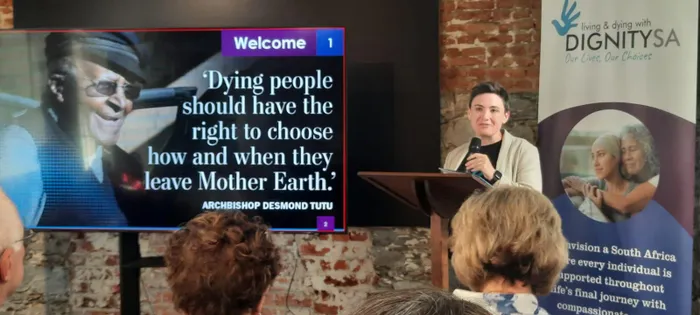
CEO of the Desmond & Leah Tutu Legacy Foundation, Janet Jobson, said it was fitting having the centre as the Arch had previously spoken in favour of MAiD with his famed quote being, ‘Dying people should have the right to choose how and when they leave Mother Earth’.
Image: Theolin Tembo/Independent Newspapers
Efforts to decriminalise and legalise medically assisted dying in SA got a major boost on Thursday as non-profit organisation, DignitySA, filed its court papers at the North Gauteng High Court to argue for the constitutionality of assisted dying.
The weight of DignitySA’s constitutional challenge was palpable in the room at the Desmond Tutu Centre, where attendees heard of the legal action being taken to make medical assistance in dying (MAiD) a reality in South Africa.
The legal bid is the culmination of 15 years of advocacy for the right of South Africans to choose a dignified end when facing intractable and unbearable suffering.
While DignitySA is the applicant, four state and professional respondents are named in DignitySA’s case: the Minister of Justice and Constitutional Development, the National Director of Public Prosecutions (NDPP), the Minister of Health, and the Health Professions Council of South Africa (HPCSA).
The application seeks to declare the current common-law prohibition of assisted dying unconstitutional and invalid. DignitySA defines 'assisted dying' as a medically assisted death that can be either self-administered or administered by a doctor, governed strictly by eligibility criteria and robust safeguards.
The case is built on the fundamental rights enshrined in the South African Constitution, specifically the rights to human dignity, bodily autonomy, life and freedom.
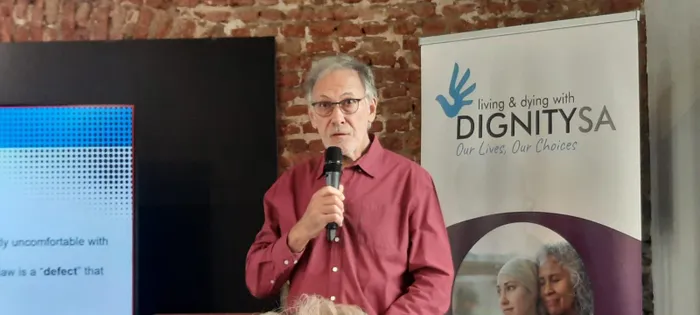
Chairperson and co-founder of DignitySA, Willem Landman, explained the processes and gave an overview of not only why but also what they hope to achieve in the process of having MAiD decriminalised and legalised.
Image: Theolin Tembo/Independent Newspapers
Chairperson and co-founder of DignitySA, Willem Landman, explained the processes and gave an overview of not only why but also what they hope to achieve in the process of having MAiD decriminalised and legalised.
Landman explained that there are four key constitutional rights that, individually and together, support MAiD, and that the reason they are going to court is to examine the contradictions that exist between the constitution and the common law.
The legal strategy involves requesting the High Court to: declare the blanket common-law prohibition of medically assisted dying unconstitutional and invalid, direct Parliament to remedy this constitutional defect by enacting appropriate legislation within 24 months, and to suspend the declaration of invalidity for 24 months to allow Parliament to implement an appropriate assisted-dying regime.
Landman said that he is aware that this constitutional challenge won’t be a quick fix and will not happen overnight. Landman explained that they will now have to wait for the respondents to file their responding papers.
Associate Professor Joseph V. Raimondo, a neuroscientist at the University of Cape Town (UCT), was one of the individuals who explained the arguments for how MAiD might work.
Raimondo explained that they have been guided by other countries where MAiD is legal in some form such as Canada, Belgium, Netherlands, Switzerland, Spain, Portugal, Austria, Germany, Luxembourg, Italy, 14 of the 56 jurisdictions within the USA, Colombia, Peru, Ecuador, and others, but that they have tailored their bid to the South African context.
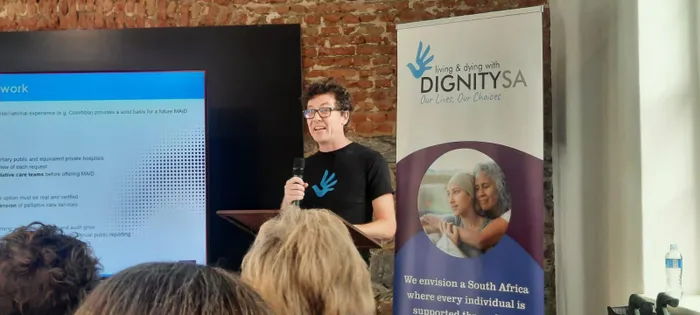
Associate Professor Joseph V. Raimondo is a neuroscientist at the University of Cape Town (UCT) who leads a research group focused on understanding the cellular mechanisms of epileptic seizures.
Image: Theolin Tembo
“So, to implement MAiD in a very unique South African context, we are fortunate to be able to draw on the South African Law Commission’s Project 86. This was put together during President Nelson Mandela’s presidency, over many years, drawing on a huge amount of public participation.
“The commission put together draft legislation with different options on how MAiD could be provided in South Africa,” Raimondo said. “Unfortunately, this draft legislation was not taken forward by the Mbeki presidency.”
Raimondo also explained the local case studies that they have not only been able to draw on, but also people involved in the case.
With DignitySA as the applicant acting in the public interest, rather than an individual applicant (patient) who seeks legal MAiD, they rely on 11 case studies, 10 of which are accounts of individuals who wished to access MAiD or would have requested it if it were legal.
The exception is Dieter Harck, who suffers from Motor Neurone Disease (MND). Harck was present and spoke about his experience with his terminal condition.
“I love life, and there are many choices I have in life; however, I don’t want to suffer in pain with the loss of dignity at the end of my life. MAiD would give me the choice of a dignified and peaceful exit from this world… the availability of this option would be reassuring and make living easier,” Harck said.
“I am sure many who have witnessed the ending of a loved one's life would feel the same, and this is what this case is all about. We are asking the court to decide whether the current law is constitutional.”
Attendees also heard from Craig Schonegevel’s mother, Patsy, who shared her experience of having her son in indescribable pain due to his Neurofibromatosis. She said their life became a “cycle of grief, happiness, followed by crisis”.
Landman was asked questions surrounding how children with terminal illnesses would be affected, and other grey areas, but he said: “Decisions on children would be discussed in the democratic process; all we are trying to do is to have the general Right addressed.”
He said that what would be appropriate for South Africa would depend on Parliament’s legislation, which would allow the public to weigh in on all the grey areas.
CEO of the Desmond & Leah Tutu Legacy Foundation, Janet Jobson, said it was fitting to have the briefing at the centre as the Arch had previously spoken in favour of MAiD, with him quoted saying, ‘Dying people should have the right to choose how and when they leave Mother Earth’.
“The Arch was such an extraordinary example of someone who had a consistency of principles, and the principle of dignity extended to every human being, and every situation that they might find themselves in.
“He wrote publicly about his support for MAiD, he corresponded with Sean Davison, and really came to a view even for himself, that this should be something that people had the right to access, and that this should be a constitutional right.”
DignitySA is pursuing this litigation in the public interest, seeking to secure “the last right” for all South Africans and calling on all who support this to sign their petition at amandla.mobi.
theolin.tembo@inl.co.za