

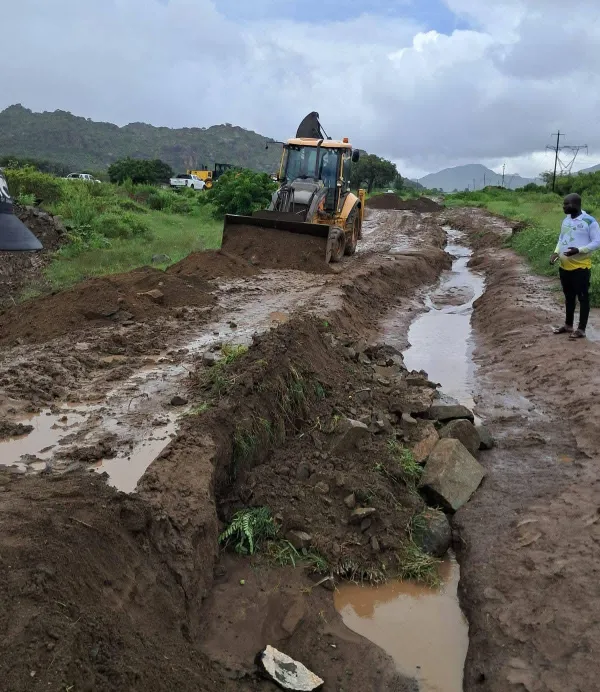
Authorities in Limpopo are working hard to rebuild and reconnect communities devastated by the recent floods. The death toll in Limpopo and Mpumalanga has risen to 39.
Image: Supplied
As South Africa grapples with the aftermath of devastating floods that have wreaked havoc across five provinces, leaving dozens dead, displacing thousands of families, and causing damage that authorities estimate will run into the tens of billions of rand, the National Disaster Management Centre has declared the situation a national disaster.
The recent classification of the floods as a national disaster was officially gazetted on Thursday by the National Disaster Management Centre (NDMC), effective immediately, in response to the severe weather that began in late December 2025.
This declaration covers Limpopo, Mpumalanga, KwaZulu-Natal, Eastern Cape, and North West, in response to the severe weather that began in late December 2025.
Dr Elias Sithole, head of the NDMC, signed the classification notice, stating the sheer scale of destruction necessitated this national declaration.
“After careful deliberations with various organs of state and a thorough assessment of the magnitude and severity, I regard this occurrence as a disaster,” Sithole said in the official notice.
The classification triggers Section 23 of the Disaster Management Act, placing the primary responsibility for coordinating the national response on the National Executive.
The Department of Cooperative Governance and Traditional Affairs in both provinces confirmed on Friday that the official death toll has climbed to 19 in Limpopo, with four people still missing, and that 20 people have died in Mpumalanga.
Limpopo has been one of the hardest-hit provinces, with the latest fatality figures coming after the recovery of a male body in the Ba-Phalaborwa area, believed to be one of two teenagers swept away earlier in the week.
Limpopo MEC for Co-operative Governance, Human Settlements and Traditional Affairs, Basikopo Makamu, said search and rescue operations were continuing in multiple districts for those who remain missing.
“We recognise the trauma that affected families are going through and assure them that with the additional teams deployed, their loved ones will be found so that there can be closure,” said Makamu.
In Limpopo alone, provincial authorities have confirmed that 439 roads were destroyed, with bridges collapsing and critical transport routes rendered impassable.
Limpopo Premier Dr Phophi Ramathuba said the damage estimate for the province exceeds R4 billion. Independent research suggests the final cost could be far higher.
Reports estimated that repairing the destroyed road network could cost between R16 billion and R66 billion, excluding indirect economic losses which could push the total damage to over R100 billion, based on global disaster-economics models.
The disruption to the economy is already being felt, from agriculture to tourism.
The floods have severely disrupted the start of the school year, with the Limpopo Department of Education reporting that access challenges have hindered the opening of hundreds of schools across its districts.
Department spokesperson Mike Maringa detailed the scale of the crisis.
“Flooding-related issues rendered 91 out of 305 schools in the Mopani East Education District inaccessible,” with 172 schools in Vhembe East also cut off by impassable roads, said Makamu.
In affected areas, Maringa said: “School nutrition service providers have not yet been able to deliver meals, as roads leading to schools remain inaccessible.”
In KwaZulu-Natal, the effects were particularly severe in the north.
KZN MEC for Cooperative Governance and Traditional Affairs, Thulasizwe Buthelezi, reported that approximately 158 families were affected by severe flooding in Jozini.
“We are grateful that no lives were lost and that no one was injured during the floods in this area,” he said, while referring to the plight of the Nhlengethwa family, whose home was completely submerged.
The Kruger National Park, which spans the Limpopo and Mpumalanga provinces, bordering Mozambique, one of the country’s most important tourism assets, sustained extensive damage.
Minister of Forestry, Fisheries, and the Environment Willie Aucamp announced the establishment of a dedicated recovery fund after an aerial assessment showed damage that could run into “hundreds of millions”.
“The Kruger National Park is not just a conservation landscape; it is an economic lifeline for the region, a symbol of our national heritage, and a globally recognised conservation asset,” Aucamp stated, appealing for national and international support for the SANParks Kruger Recovery Fund.
The South African Local Government Association (SALGA) has used the crisis to call for an overhaul of the country’s disaster management systems.
“These events highlight the rapidly increasing frequency and intensity of climate-related disasters and expose the limitations of the current disaster management system,” said Mluleki Nkosi, SALGA’s chairperson of the Emergency Services and Disaster Management Working Group.
He urged the government to modernise disaster policies and secure “sustainable funding for municipal preparedness and resilience”.
Rescue operations have extended beyond South Africa's borders. The South African National Defence Force (SANDF) has deployed air assets to neighbouring Mozambique, which is battling its own severe flooding.
The SANDF’s Operation CHARIOT has rescued nearly 500 people in Mozambique.
Tragically, the search continues there for Ekurhuleni Member of the Mayoral Committee, Andile Mngwevu, who remains missing after his vehicle was swept away by floodwaters.
While the rains have begun to subside in some areas, the emergency is far from over as mop-up operations continue.
The Presidential Climate Commission (PCC) has urged the country to move from a reactive stance to proactive climate risk governance.
“Without reform, the country risks repeating the same cycle of loss and reconstruction,” warned Dorah Modise, executive director of the PCC.
Relief efforts are being mobilised by government agencies and organisations like Gift of the Givers, which has expanded its operations to assist over 1,000 affected residents with immediate humanitarian aid, including bottled water due to the contamination of treatment plants.
karen.singh@inl.co.za