

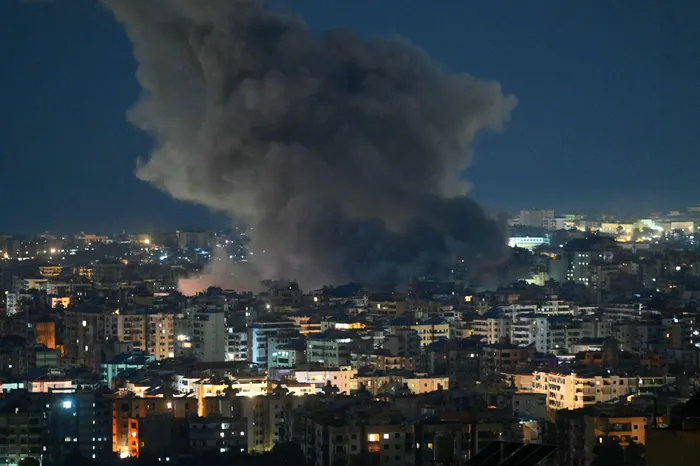
Smoke rises from the site of an Israeli airstrike that targeted the office of the Hezbollah affiliated Al-Manar TV station in Beirut’s southern suburb of Haret Hreik on March 3.
Image: Fadel Itani / AFP
US President Donald Trump warned that his attack on Iran could run longer than a month, as Tehran retaliated to ongoing strikes by targeting US allies in the Gulf, and drones hit the US embassy in Saudi Arabia on Tuesday.
Shortly after the United States urged Americans to flee all Middle Eastern nations from Egypt eastward, two drones hit the US embassy in Riyadh, sparking a quick vow by Trump to retaliate "soon", without elaborating how.
New powerful explosions shook windows in Tehran throughout the night as fighter jets flew over the Iranian capital, AFP journalists witnessed, and the Pentagon said it had achieved air superiority over the country, ruled since 1979 by Islamic clerics virulently opposed to the United States.
Beyond launching missile and drone attacks that forced Qatar's state-run energy firm to halt liquefied natural gas production, Tehran also vowed to choke one of the world's most vital shipping lanes.
"We will burn any ship that tries to pass through the Strait of Hormuz," Revolutionary Guards General Sardar Jabbari said of the strategic waterway to the Gulf through which about 20 percent of global seaborne oil travels.
Trump said that the war, which began Saturday with a strike that killed Iran's supreme leader, Ayatollah Ali Khamenei, was going "substantially" ahead of schedule but that the United States was equipped for a prolonged conflict.
"From the beginning, we projected four to five weeks, but we have capability to go far longer than that," Trump said at the White House.
The US president laid out for the first time the operation's objectives -- destroying Iran's missiles, navy and nuclear programme and stopping its support for armed groups across the region. The goals notably did not include toppling the Islamic Republic, even though on Saturday, Trump had urged the people of Iran to rise up and overthrow their government.
As Iran ramped up its retaliation, Saudi Arabia, home to one of the region's largest oil refineries, which has already been closed following an attack, said it intercepted eight more drones in two cities, including the capital, on Tuesday.
Just after midnight local time on Tuesday, Israel's military said it was working to intercept a large wave of missiles launched from Iran targeting multiple locations, including Jerusalem.
"A short while ago, the IDF identified missiles launched from Iran toward the territory of the State of Israel. Defensive systems are operating to intercept the threat," the military said.
Explosions were heard and clouds of smoke seen in Riyadh's diplomatic quarter, home to foreign embassies and diplomats' residences, four witnesses told AFP early Tuesday.
Two drones hit the US embassy in the Saudi Arabian capital and sparked a fire, a Saudi defence ministry spokesman said.
In Qatar, the military intercepted two ballistic missiles early Tuesday, the country's defence ministry said, after AFP reporters heard loud explosions across Doha.
Qatar downed two Iranian bombers and halted LNG production on Monday, as Tehran widened its attacks to hit oil facilities in Saudi Arabia and the UAE in the sharply escalating crisis that has sent prices soaring.
President Donald Trump suggested on Monday that the United States would retaliate "soon" after its embassy in the Saudi capital Riyadh was struck by two suspected Iranian drones.
Speaking to the NewsNation network, Trump said, "You'll find out soon" how the United States would respond, without providing further detail.
Israeli Prime Minister Benjamin Netanyahu said in a Fox News interview on Monday that the US-Israeli operation against Iran would be "a quick and decisive action," later adding: "It may take some time, but it's not going to take years.
Israel's military said Tuesday that it had launched strikes on Hezbollah targets, including "command centres and weapons storage facilities" in Lebanon's capital, Beirut, after warning it would press ahead with its campaign against the Iran-backed group.
The Lebanese militant group said just after midnight that its rocket and drone attack on Israel was a "defensive act" after more than a year of Israeli strikes despite a ceasefire.
The US State Department urged Americans to leave much of the Middle East, including Egypt and Gulf states, due to the US-Israeli war on Iran.
The State Department "urges Americans to DEPART NOW from the countries below using available commercial transportation, due to serious safety risks," wrote Mora Namdar, the assistant secretary of state for consular affairs, in a social media post.
The countries or territories included in the warning were Bahrain, Egypt, Iran, Iraq, Israel and the Palestinian territories, Jordan, Kuwait, Lebanon, Oman, Qatar, Saudi Arabia, Syria, the United Arab Emirates and Yemen.
Israel's military claimed it had "struck and dismantled" the headquarters of Iran's state radio and television broadcaster, the Islamic Republic of Iran Broadcasting (IRIB), saying it had "called for the destruction of the State of Israel and for the use of nuclear weapons."
The IRIB wrote on Telegram that there had been explosions near its headquarters in Tehran but that there was no disruption to its operations.
The US-based Human Rights Activists News Agency (HRANA) on Tuesday said there were 101 casualties inside Iran on the third day of the war, including "85 civilian deaths and 11 military personnel killed."
A general in Iran's Revolutionary Guards threatened to "burn any ship" seeking to navigate the Strait of Hormuz, a vital route for oil and gas shipments.
"We will also attack oil pipelines and will not allow a single drop of oil to leave the region. Oil price will reach $200 in the coming days," General Sardar Jabbari said in a post on the Guards' Telegram channel.
The United States attacked Iran after learning that its ally Israel was going to strike, which would have meant retaliation against US forces, Secretary of State Marco Rubio said.
"We knew that if we didn't preemptively go after them before they launched those attacks, we would suffer higher casualties," Rubio told reporters.
The United States hit more than 1,250 targets in the first 48 hours of the war against Iran, the US military said.
Targets struck included command-and-control centers, ballistic missile sites, Iranian navy ships and submarines, and anti-ship missile sites, according to a fact sheet released by the US Central Command, which is responsible for American forces in the region.
Trump signalled that US strikes on Iran could go much longer than originally predicted, as his administration sought to counter criticism about conflicting messages on the war's goals.
In his first public comments since launching the military operation, the president laid out what he said were four key objectives for hitting Iran.
"First, we're destroying Iran's missile capabilities... Second, we're annihilating their navy...Third, we're ensuring that the world's number-one sponsor of terror can never obtain a nuclear weapon.
Australian Defence Minister Richard Marles said he could confirm reports that its military headquarters, the Al Minhad Air Base located just 24 kilometres (15 miles) south of Dubai in the UAE, had been hit over the weekend.
AFP