

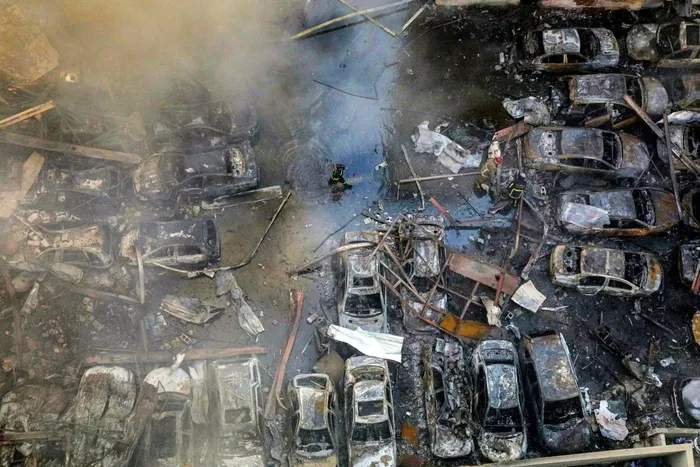
Israeli strikes on Lebanon on April 8, the heaviest since the war began in early March, left "dozens dead and hundreds wounded," according to a preliminary toll from the health ministry.
Image: IBRAHIM AMRO / AFP
The United States and Iran agreed to a two-week ceasefire on Tuesday in an 11th-hour bid to avert all-out destruction threatened by US President Donald Trump.
Here are all the details as it happens:
NATO has "turned their backs" on the United States, the White House said Wednesday, just as the alliance's secretary-general was set to meet with US President Donald Trump.
Press Secretary Karoline Leavitt said Trump would discuss the possibility of leaving the alliance in those talks with Mark Rutte.
White House added that Iran closing Hormuz would be 'completely unacceptable'
Israel renewed its bombing of the Lebanese capital Beirut on Wednesday, targeting a residential neighbourhood, state media reported, hours after simultaneous strikes on the city.
"An enemy raid targeted Tallet al-Khayyat (neighbourhood) in Beirut," the state-run National News Agency reported, while AFP journalists heard booms in the nearby Hamra area.
Earlier, Israeli forces fired warning shots at a convoy of Italian UN peacekeepers in Lebanon, damaging at least one vehicle but causing no injuries.
Defence Minister Guido Crosetto said the incident was "unacceptable" while Foreign Minister Antonio Tajani said the government was seeking clarification from the Israeli ambassador.
"To reiterate, Italian soldiers in Lebanon are not to be touched," Tajani told parliament.
Israel said it had struck around 100 Hezbollah sites across Lebanon, describing the operation as the "largest coordinated strike" since the war with Iran began.
Three Indonesian peacekeepers were killed in separate incidents in southern Lebanon at the end of March, including two who died after an explosion struck a UNIFIL logistics convoy.
The ceasefire agreed to between Iran and the United States should bring some relief to a world economy that has been roiled since the start of hostilities on February 28, even if not all sectors will rebound at the same pace.
The rand surged and oil slumped, but the relief rally may be short-lived if the fragile truce unravels, with Iran warning the pause is “not the end of the war”.
For the moment, Iraq is the only country in the region to have announced a complete reopening of its airspace.
The United Arab Emirates and Qatar, whose Dubai, Abu Dhabi and Doha hubs handle large quantities of long-haul flights, have maintained many restrictions.
Furthermore, the return to normal jet fuel supplies for the aviation sector will take "several months given the disruptions to refining capacity", warned IATA, the world's leading airline association.
Therefore, "the most immediate lever" for airlines to preserve their operating margins is to "pass on the increased costs to ticket prices".
Two ships have passed through the Strait of Hormuz since Iran agreed to reopen the waterway as part of a ceasefire deal, maritime monitor Marine Traffic said Wednesday.
"The Greek-owned bulk carrier NJ Earth crossed the Strait at 08:44 UTC, while the Liberia-flagged Daytona Beach transited earlier at 06:59 UTC, shortly after departing Bandar Abbas at 05:28 UTC", MarineTraffic said on X.
Saudi Arabia on Wednesday threw its support behind the two-week ceasefire reached between the US and Iran, calling for a comprehensive deal to bring stability back to the region.
"The kingdom hopes that the ceasefire will represent an opportunity to achieve a comprehensive and sustainable de-escalation, enhancing the security of the region, and that any attacks or policies that undermine the sovereignty, security and stability of the countries in the region will cease," the foreign ministry said.
Pakistan has emerged as a key intermediary between Iran and the United States to secure a temporary ceasefire and host negotiations to end the war in the Middle East.
On Wednesday, Prime Minister Shehbaz Sharif said the United States and Iran -- and their allies had -- agreed to a ceasefire "everywhere" following mediation by his government.
Sharif said the two-week truce - which Trump and Tehran had announced earlier - would next lead to talks in the Pakistan capital.
"Pakistan achieved one of its biggest diplomatic wins in years," said South Asia expert Michael Kugelman in an X post.
Israel renewed its strikes in south Lebanon on Wednesday, as Israeli Prime Minister Benjamin Netanyahu insisted the Iran war truce does not include Lebanon.
Israel renewed an evacuation order for an area more than 40 kilometres inside Lebanon, saying "the battle in Lebanon is ongoing".
It followed another warning to evacuate a building in the southern Tyre region, which Israel then struck, according to Lebanon's state-run National News Agency.
NNA reported several strikes across the south.
Israel's attacks in recent weeks have killed more than 1,500 people and displaced over a million, according to Lebanese authorities, especially in the country's south, east and Beirut's southern suburbs, areas where Hezbollah holds sway.
US President Donald Trump's ceasefire announcement has divided opinion among US lawmakers, with some hailing it as a positive step and others challenging the Republican president's fitness to lead.
Democratic congresswoman Alexandria Ocasio-Cortez said Trump's ceasefire announcement "changes nothing."
Republican senator Lindsey Graham, a close Trump ally and foreign policy hawk, said congressional oversight is needed to "kick the tires."
China said on Wednesday it welcomed a ceasefire between the United States and Iran.
"China welcomes relevant parties announcing the reaching of a ceasefire agreement," foreign ministry spokeswoman Mao Ning told a news conference, adding that China would continue to work towards restoring peace in the Middle East.
Oil prices plunged Wednesday while stocks soared after the United States and Iran agreed to a two-week ceasefire that will see Tehran temporarily reopen the vital Strait of Hormuz.
The news pushed down crude prices, with West Texas Intermediate losing almost 20 percent and Brent as much as 16 percent as investors heaved a huge sigh of relief after more than five weeks of war that has hammered supplies.
ALSO READ: War paused, but here’s why you shouldn’t get your hopes up for lower fuel prices
The euphoria sent global equities rocketing on hopes the crisis that has shocked the global economy for more than a month will come to an end.
Seoul jumped 6.9 percent and Tokyo 5.4 percent, while Taipei added more than four percent and Mumbai 3.8 percent.
Hong Kong advanced nearly three percent, while Sydney, Shanghai, Bangkok, Manila, Jakarta, Singapore and Wellington were also sharply higher.
London rallied out of the blocks with Paris and Frankfurt, while US futures soared.
Middle East stocks also rallied, with Dubai jumping 8.5 percent, the biggest intraday increase since December 2014, according to Bloomberg.
Stocks in Abu Dhabi climbed more than three percent, which was the largest gain since March of the same year.
Both the US and Iran have claimed to have won the more than month-long conflict that has roiled global financial markets and sent oil prices skyrocketing, with Trump telling AFP the deal was a "total and complete victory" for the US.
Iran too cast the ceasefire as a win and said it had agreed to talks with Washington to begin Friday in Pakistan on a path to end the conflict.
ALSO READ: Oil prices plunge, stocks rally as US and Iran agree to a ceasefire
"The enemy has suffered an undeniable, historic and crushing defeat in its cowardly, illegal and criminal war against the Iranian nation," said a statement from the Iranian Supreme National Security Council.
"Iran achieved a great victory."
The White House said Israel had also agreed to the ceasefire, but Prime Minister Benjamin Netanyahu said it does not include Lebanon, where Israeli assaults in response to rocket fire by Iranian-backed Hezbollah have led to more than 1,500 deaths, according to Lebanese authorities.
Israel had encouraged Trump to join the war against Iran, its arch-nemesis, and in the first strikes killed the long-serving supreme leader, Ayatollah Ali Khamenei.
Trump said he had spoken to Pakistan's leaders who "requested that I hold off the destructive force being sent tonight to Iran."
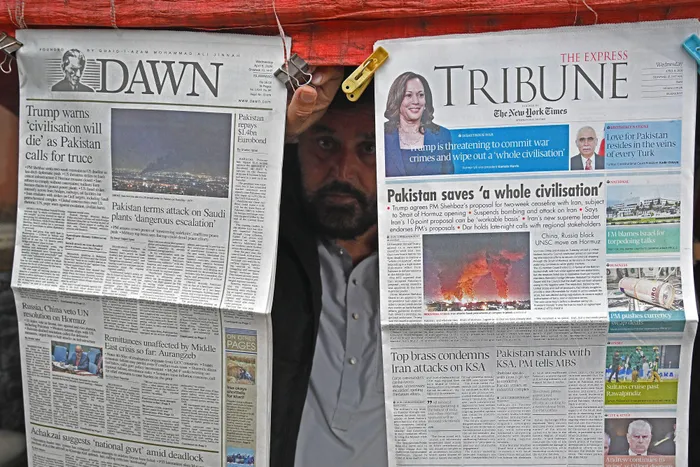
Pakistan's Prime Minister Shehbaz Sharif said on April 8 that the United States, Iran and their allies had agreed to a ceasefire "everywhere", including Lebanon, following mediation by his government to stop weeks of fighting.
Image: Aamir Qureshi / AFP
He later told AFP he believed China had helped get Tehran to negotiate.
"Subject to the Islamic Republic of Iran agreeing to the COMPLETE, IMMEDIATE, and SAFE OPENING of the Strait of Hormuz, I agree to suspend the bombing and attack of Iran for a period of two weeks," Trump wrote on his Truth Social platform on Tuesday.
Trump had set a deadline to Iran to open the Strait of Hormuz by 8:00 pm Washington time (0000 GMT Wednesday), or 3:30 am in Tehran.
Iranian Foreign Minister Abbas Araghchi confirmed safe passage for two weeks for ships through the Strait of Hormuz, the gateway for one-fifth of the world's oil which Tehran sealed off in retaliation for the war launched on February 28.
"If attacks against Iran are halted, our Powerful Armed Forces will cease their defensive operations," Araghchi said.
Oil prices plunged by more than 17 percent after the ceasefire announcement. Costs at the pump had risen sharply since the war across the globe and for ordinary Americans, putting heavy political pressure on Trump.
Stock prices also soared in early trade Wednesday in Asia.
Trump said that the United States was "very far along" in negotiating a long-term agreement with Iran, which had submitted a 10-point plan that he said was "workable."
But Iran publicly released points that took maximalist positions, including lifting long-standing US sanctions, guaranteeing its own "dominion" over the Strait of Hormuz and removing US forces from the region.
Crucially, it also said its plan would also require Washington to accept its uranium enrichment programme.
Trump has alleged that Iran was near building an atomic bomb, an assertion not backed by the UN nuclear watchdog and most observers.
Trump insisted that the nuclear material would be covered by any peace deal.
"That will be perfectly taken care of, or I wouldn't have settled," Trump told AFP, without giving any specifics about what would happen to the uranium.
Trump would not say whether he would go back to his original threats to lay waste to all power plants and bridges across the country of 90 million people if the deal fell apart.
"You're going to have to see," Trump told AFP.
Trump had made threats shocking even by his own standards when he warned that "a whole civilisation will die tonight, never to be brought back again. I don't want that to happen, but it probably will."
The United States and Israel struck key infrastructure before Trump's deadline, with Netanyahu saying attacks hit railways and bridges allegedly used by the Revolutionary Guards.
The Israeli military also offered a rare statement of regret after it acknowledged damaging a synagogue in Tehran, saying it had been targeting a senior Iranian commander.
Iran, run by Shia Muslim clerics, is home to around 100 synagogues for its historic Jewish minority.
Infrastructure attacks reported by Iranian authorities on Tuesday included a US-Israeli strike on a bridge outside the city of Qom and another on a rail bridge in central Iran that killed two people.
Iran has retaliated with weeks of drone and missile attacks on Gulf Arab states, citing their role as hubs for US troops.
The attacks have shattered the monarchies' hard-fought reputation for safety and stability.
Qatar said early Wednesday that four people were hurt by falling missile debris, including a child. AFP reporters also heard explosions in Bahrain and Saudi Arabia and the United Arab Emirates said they responded to missile threats.
Two civilians, one of them an eight-year-old child, were killed in Baghdad when a projectile crashed into their home, police told AFP.
Iranian university student Metanat, 27, whose classmate was killed two weeks ago in an attack, told AFP before Trump's suspension of the bombing she felt "terrified and so should everyone else in the country."
State media published photos purporting to show groups of Iranians forming human chains to protect power plants.
The show of patriotism in the face of attacks came several months after Iran's cleric-run government cracked down violently on mass protests, with rights groups reporting thousands of deaths.
A peace agreement would leave in place the Islamic republic despite hopes by Israel and the United States of toppling it.
The United States and Israel said that they attacked Iran to degrade its military capacity.
AFP