

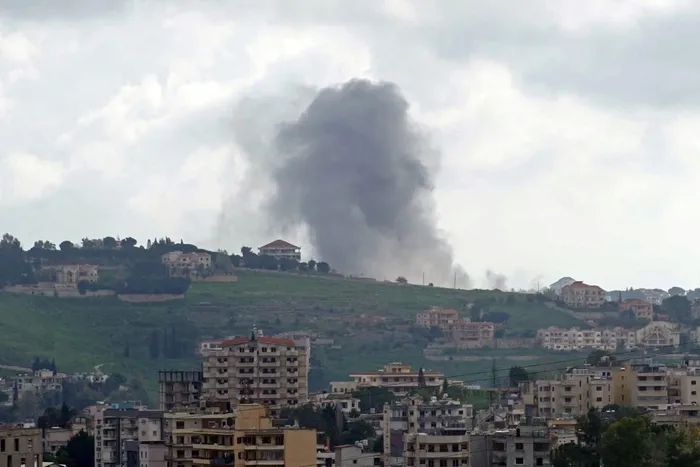
Smoke rises from the site of an Israeli strike on the outskirts of the southern Lebanese village of Choukine, on April 9, 2026. Israel vowed to continue its campaign against Hezbollah on April 9, dismissing mounting international concern that its strikes on Lebanon threaten a fragile US-Iran truce that could lead to peace negotiations.
Image: ABBAS FAKIH / AFP
Live updates from the two-week ceasefire agreement between the United States and Iran and the continued impact it's having on the rest of the world:
Israel's Prime Minister Benjamin Netanyahu ordered his ministers on Thursday to begin direct talks with Lebanon, pushing for Hezbollah's disarmament amid mounting concern that its ongoing strikes could cause the fragile US-Iran truce to unravel.
A Lebanese government official told AFP shortly after Netanyahu's announcement that Beirut "wants a ceasefire" declared before starting any negotiations with Israel, a day after deadly strikes across the country.
At least 203 people were killed and 1,000 wounded in the bombardment on Wednesday, the Lebanese health ministry said, while Hezbollah said it was engaged in close quarters combat against Israeli forces on the ground on Thursday in the south Lebanon town of Bint Jbeil.
Netanyahu's order for direct negotiations with Lebanon's government was focused on disarming Hezbollah and establishing peace, according to a statement from his office, but he offered no immediate respite from the bombardment.
"Lebanon wants a ceasefire before starting negotiations," said the Lebanese government official, who has knowledge of the matter and requested anonymity.
Even as Netanyahu spoke, Israel's military issued a new evacuation order for Beirut's southern suburbs, just a day after the wave of strikes.
"In light of Lebanon's repeated requests to open direct negotiations with Israel, I instructed the cabinet yesterday to begin direct negotiations with Lebanon as soon as possible," Netanyahu said.
"Negotiations will focus on disarming Hezbollah and establishing peace relations between Israel and Lebanon."
Brussels, Moscow and Ankara demanded that the US-Iran ceasefire be extended to Lebanon.
"We view the situation in southern Lebanon with particular concern," Germany's Chancellor Friedrich Merz said, echoing statements from Paris and London.
"The severity with which Israel is waging war there could cause the peace process as a whole to fail, and that must not be allowed to happen," he warned.
For their part, Iran's parliamentary speaker Mohammad Bagher Ghalibaf said Tehran sees Lebanon as an "inseparable part of the ceasefire" and President Masoud Pezeshkian said Israel's strikes rendered "meaningless" talks with US envoys planned for the end of the week in Pakistan.
Oil prices jumped and most stock markets fell Thursday on investor concerns over the Middle East ceasefire holding and as the key Strait of Hormuz remained largely blocked to traffic.
Equity markets across the globe had soared and crude futures plunged Wednesday after US President Donald Trump announced the two-week halt in the Middle East war, and Iran said it would reopen the waterway transporting one-fifth of the world's oil and gas.
But the ceasefire has been placed in doubt, largely by Israel's ongoing attacks against Iran-backed Hezbollah in Lebanon.
The main US oil contract, West Texas Intermediate, rebounded five percent to reach almost $100 a barrel as international calls mounted for the ceasefire to be extended after a massive wave of Israeli strikes on Lebanon killed more than 200 people.
There had been conflicting diplomatic signals about whether the fighting in Lebanon was included in the US-Iran truce -- Washington said that it was not and Israel made it clear that it has no intention of holding off.
"Oil prices will likely remain elevated and choppy until a more permanent agreement is struck between all parties," said Aarin Chiekrie, equity analyst at Hargreaves Lansdown.
With concerns spreading over the fragile truce, the dollar recovered some lost ground thanks to its safe-haven status.
"Even if the ceasefire holds it will take time for energy exports from the region to return to more normalised levels, so there will be an impact on growth and inflation that is still difficult to ascertain," said Anthony Kettle at RBC BlueBay Asset Management.
"It should also be noted that there has been significant damage to infrastructure in some major energy exporters," he said.
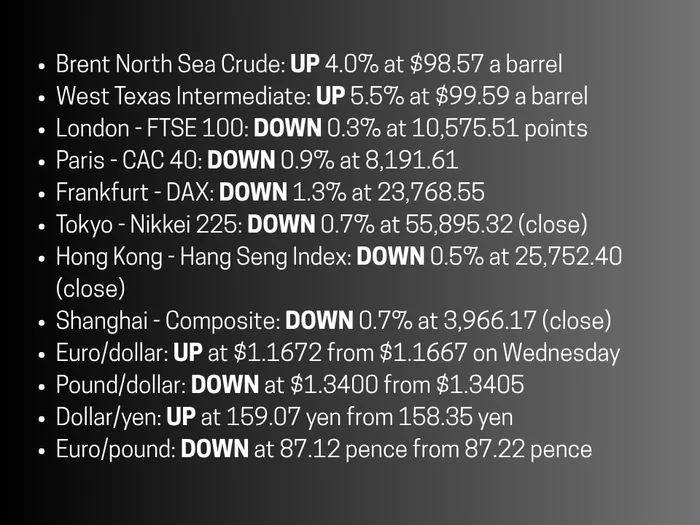
Key figures at around 1100 GMT
Image: IOL Graphics
Britain's foreign minister said Thursday the UK "strongly" wants Lebanon included in the Middle East ceasefire as Prime Minister Keir Starmer arrived in the United Arab Emirates.
"We do want to see the ceasefire extended to Lebanon. I'm deeply troubled about the escalating attacks that we saw from Israel in Lebanon yesterday," Yvette Cooper told Sky News.
"We've seen the humanitarian consequences, the huge mass displacement of people in Lebanon. So we do strongly want to see the ceasefire extended to Lebanon," she said.
Cooper's comments came as Starmer arrived in the UAE on the second leg of a visit to the Gulf to meet with regional leaders seeking to bolster the ceasefire in the Middle East war.
The fragile truce between Iran and the United States showed signs of unravelling on Thursday, with Tehran threatening to resume hostilities as Israel pummelled Lebanon.
Washington and Tehran both claimed victory after agreeing to a two-week ceasefire and negotiations aimed at ending a war that has killed thousands across the Middle East and sparked global economic upheaval.
But the deal's fractures emerged quickly on Wednesday as Israel carried out its heaviest strikes on neighboring Lebanon — including in densely packed central Beirut — since the Iran-backed militant group Hezbollah joined the war in early March.
ALSO READ: Oil rises, stocks fall as cracks show in US-Iran ceasefire
At least 182 people were killed and nearly 900 wounded on Wednesday, the Lebanese Health Ministry said.
Hezbollah responded on Thursday, saying it had fired rockets towards Israel and accusing it of violating the US-Iran truce, which was agreed late Tuesday.
Israel had said earlier its battle against the Lebanese group was not part of the ceasefire, an argument echoed by US Vice President JD Vance, days before he is due to lead talks with Tehran in Pakistan.
"If Iran wants to let this negotiation fall apart...over Lebanon, which has nothing to do with them, and which the United States never once said was part of the ceasefire, that's ultimately their choice," he said.
But Iran's parliament speaker Mohammad Bagher Ghalibaf appeared to threaten the ceasefire, posting on X that the "workable basis on which to negotiate" had already been violated, making further talks "unreasonable".
Ghalibaf listed three alleged US violations of the truce plan: the continued attacks in Lebanon, a drone entering Iranian airspace, and a denial of the country's right to enrichment.
Adding to the fragility of the truce — agreed hours before a deadline set by US President Donald Trump — a senior US official said Iran's 10-point plan was not the same set of conditions the White House had agreed to in order to pause the war.
In Lebanon, where UN rights chief Volker Turk called the scale of killing "horrific", strikes across the capital Beirut without warning triggered scenes of horror and panic.
"People started running left and right, and smoke was billowing," said Ali Younes, who was waiting for his wife near Corniche al-Mazraa, one of the areas targeted.
More than 1,700 people have been killed in Lebanon since Israel launched airstrikes and a ground invasion last month, local officials said.
Iran's Revolutionary Guards warned they would "fulfil our duty and deliver a response" if Israel did not cease its strikes, while Hezbollah said it had a "right" to respond.
Israeli Prime Minister Benjamin Netanyahu said the country remained prepared to confront Iran if necessary, as it still had "objectives to complete", with the military saying it continued to pursue the goal of "disarming" Hezbollah in Lebanon.
Pentagon chief Pete Hegseth also vowed that American forces remained at the ready if the conflict flared up again.
The belligerent rhetoric came ahead of high-stakes talks in Pakistan expected on Friday or Saturday, after Iran temporarily agreed to reopen the Strait of Hormuz under threat of annihilation by Trump, with a small number of ships passing through the strategic waterway on Wednesday.
Iran announced alternative routes on Thursday for ships travelling through the strait, citing the risk of sea mines in the main navigational zone.
But it was unclear if Tehran was allowing vessels to pass through the waterway, following reports on Wednesday suggesting it was shut -- something the White House called "completely unacceptable".
Pakistani Prime Minister Shehbaz Sharif, whose country mediated the ceasefire, urged on X for all parties to "exercise restraint and respect the ceasefire for two weeks" to allow diplomacy to take hold.
Further casting doubt on the truce's durability, Iranian state media announced fresh missile and drone attacks against US-allied Gulf states in retaliation for airstrikes on its oil facilities, with Kuwait, the UAE, Saudi Arabia and Bahrain all reporting strikes since the ceasefire took effect.
There have been no reports of fresh attacks on other countries across the region in the past hours.
In Tehran, streets were quieter than usual on Wednesday, with many shops closed after a long and anxious night for residents fearing a massive US attack.
"Everyone is at ease now," said Sakineh Mohammadi, a 50-year-old housewife, adding she was "proud" of her country.
"We are more relaxed."
On Wednesday, the leaders of several European nations, Canada and the United Kingdom said "a swift and lasting end to the war" must be negotiated, as Pope Leo hailed a moment of "real hope".
But Tehran's demands over uranium enrichment, economic sanctions and future control of the Strait of Hormuz -- a narrow waterway through which one-fifth of the world's oil passes -- remain deeply at odds with those of the United States.
The United States and Israel said they attacked Iran to degrade its military capacity.
After weeks of economic turmoil, the ceasefire announcement sent oil prices plunging 15 percent, while European natural gas dropped 20 percent.
Trump meanwhile vented his anger at NATO members he believed had been unhelpful during the conflict, saying "they won't be there" for the United States.
As Trump met with NATO's chief in Washington on Wednesday, the White House said he was expected to discuss possibly leaving the alliance.
AFP