

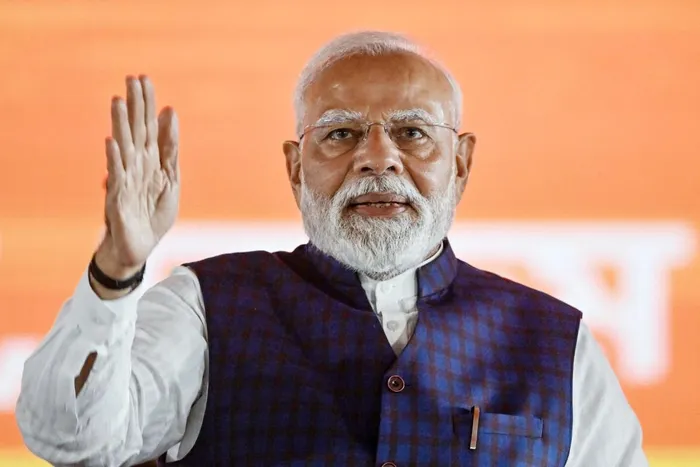
India's Prime Minister Narendra Modi has been advocating for “self-centred” economic policies and self-reliance. The writer says the genesis of the AU joining the G20 actually started seven years ago, when Modi unveiled India’s 10 “guiding principles” for ties with African countries during a speech in the Ugandan parliament.
Image: AFP
Two years ago, during India’s Presidency of the G20 at the G20 Summit in Delhi, Prime Minister Narendra Modi delivered a speech formally announcing the inclusion of the African Union as a permanent member of the group.
"India put a proposal to give permanent membership of G20 to the African Union. I believe that with we have everyone's agreement on this," Modi said in his opening address to the summit.
"With everyone's approval, I request the African Union head to take his seat as a permanent G20 member," Modi said, banging a ceremonial gavel.
This was a seismic announcement, allowing the AU the ability to give Africa a unified voice in global economic governance, promote equitable representation, and advance the continent's interests in areas like trade, climate change, and development.
The genesis of the AU joining the G20 actually started seven years ago, when Modi unveiled India’s 10 “guiding principles” for ties with African countries during a speech in the Ugandan parliament.
These priorities state that Africa is a top priority for India, India’s development partnership will be guided by African priorities, promoting trade and investment between Africa and India, exporting India’s digital revolution to the continent, cooperating in agriculture, addressing climate change, combatting terrorism and extremism, maritime security, promoting global engagement in Africa and reforming global institutions, and ensuring greater representation for Africa.
It is crucial to understand why Africa must become a priority, especially for South South relationships.
By 2050, the total population of Africa is forecast to touch 2.5 billion, or roughly 25 percent of the world’s total population. With roughly 1.4 billion people today, its economy is estimated to be close to $3 trillion.
India has been working hard, trying to increase its diplomatic outreach to African countries, from increasing its diplomatic presence in the continent, culminating in driving the process to ensure the AU becomes part of the G20, finally achieved in 2023 during the India presidency of the G20 summit.
South Africa’s presidency of the G20 - the first time the premier forum for international economic cooperation has been held on the African continent, is a highlight of the vision Modi had in 2018 when he spoke about the guiding principles for India’s ties with Africa.
India has also succeeded in opening 17 new diplomatic missions across the continent since 2018-in Burkina Faso, Cameroon, Cape Verde, Chad, Republic of the Congo, Djibouti, Equatorial Guinea, Eritrea, Guinea, Liberia, Mauritania, Rwanda, Sao Tome and Principe, Sierra Leone, Somalia, Eswatini (Swaziland), and Togo.
Indian External Affairs Minister S. Jaishankar has made it a point to visit different African countries every year since he was made a part of the Union cabinet in 2019.
During his ministerial tenure, he has visited at least 13 African countries, including Ethiopia, Uganda (twice), Nigeria, Namibia, South Africa, Mozambique, Tanzania, Egypt, Kenya, Mauritius, Seychelles, Tunisia, and Niger.
Modi has visited at least nine African countries, including Uganda, South Africa, Egypt, Kenya, Mauritius, Seychelles, Mozambique, Rwanda, and Tanzania. The majority of his visits were during his first term.
While India has been diplomatically active through multiple high-level visits over the years, its key strength is modern and ancient historical ties with the African continent. For instance, the founding of the Non-Aligned Movement (NAM) and its support for the decolonisation of the African continent found broad support from India.
Speaking in South Africa during the 2023 BRICS Summit, Modi said Africa is their top priority, adding that in the ‘development journey of the world in this century and beyond, the voice of Africa will be crucial’.
“Since India assumed the presidency of the G20, we have worked with the motto “One Earth, One Family, One Future”. It has been our priority to bring the concerns, priorities and aspirations of the global south, including the countries of Africa, to the forefront of the G20 agenda.
“We believe that we need to hear the voices who are affected the most by the decisions that are taken in the G20.”
On the reason that India strongly advocated for permanent membership for the AU in G20,”Modi said: “This stems from our belief that Africa should be given its due.
“Proper representation to Africa in global institutions would help us achieve inclusive sustainable global growth and development.”
In times of geopolitical turbulence and trade uncertainty, the connections shared through the threads of history, bound by camaraderie and shared resilience may help developing countries weather the storms to come.
* Dr Govender is an academic and a keen observer of issues related to international relations.
** The views expressed do not necessarily reflect the views of IOL or Independent Media.