

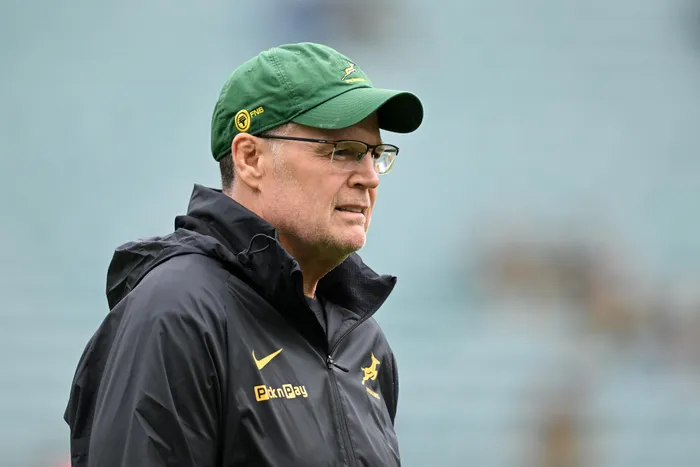
Rassie Erasmus’ long-term vision for the Springboks involves strategic squad experimentation and lineup tweaks during the 2026 Nations Championship to prepare for the 2027 Rugby World Cup, despite his contract extending to 2031.
Image: Backpagepix
As Rassie Erasmus is at pains to tell us, one of the points of his alignment camps is to get to know players new to his radar.
On closer examination, he will decide who he can use sooner rather than later, who is unlikely to make it, and who is a good bet for next season.
In 2025, Rassie involved 80 players in his alignment camps, but 30 of them did not play a Test. This year, he has had 70 players on duty in his in-person and virtual camps as he looks to add depth for today, tomorrow, and the future.
It is a brilliant way of mapping out the current and future needs of the Springboks, and it underlines the wisdom of having the same head coach for an extended period — Rassie and most of his coaching staff will go through to the 2031 World Cup in the USA, and possibly further.
The Rassie era began in 2018, and while the 2019 World Cup win was a bonus as it was the early stages of the Boks’ rebuilding, the 2023 triumph was a consequence of continuity in the player squad and coaching staff.
By 2031, Rassie and the longer-serving assistants such as Mzwandile Stick and Deon Davids would have been in the Springbok saddle for 13 years. Whether this continuity is by accident or design, it is an emulation of how the All Blacks did it during their golden era from the early 2000s to around 2018.
Graham Henry earned a knighthood for his success with the All Blacks between 2004 and 2011, and who were his assistants? Future All Blacks coaches in Steve Hansen and Ian Foster. At the time that the All Blacks were accelerating away from the Springboks, the South Africans were doing the exact opposite to the New Zealanders in terms of coaching and player continuity.
The old system of changing the coach every four years was self-defeating. Whoever had the Bok reins knew that to earn a positive judgement, he had to win as much as possible in his four-year stretch and especially at the culmination, the World Cup. Hence, the Bok coach identified his best players and stuck with them as much as possible.
Rotation? Why? Bring through youngsters for the future? Why feather the bed for the next coach?
It was a system that understandably bred selfishness and ultimately undermined the Springboks because every four years a new coach would start from scratch, often with an inexperienced squad, because a bunch of veterans had retired at the end of the World Cup.
The current Springbok system is immeasurably better because Rassie and his lieutenants control the present and the future. They can plan their options for today, the short term, and the long term. For example, Rassie has an ageing tight five.
He has not discarded his veterans en masse, rather allowing time and natural causes, if you like, to claim some of them, such as Steven Kitshoff (injury), Trevor Nyakane (age and injury), Bongi Mbonambi (age and form), and Vincent Koch (age).
But he doesn’t shut the door on those being phased out, and in an emergency, he could recall Mbonambi or Koch. At the same time, he is easing into the system long-term projects such as 18-year-old Kai Pratt, Zachary Porthen (21), Esethu Mnebelele (20), and Riley Norton.
Erasmus has looked at the age of locks Eben Etzebeth, Lood de Jager, and Franco Mostert, and brought into the fold JJ van der Mescht, the colossal 26-year-old former Junior Springbok who has made a name for himself overseas since leaving the Sharks.
This system of constant regeneration on the hoof, while still winning most of your matches, is the envy of the Springboks’ opponents, and it is why the Boks are favoured to defend their crown in Australia next year.