

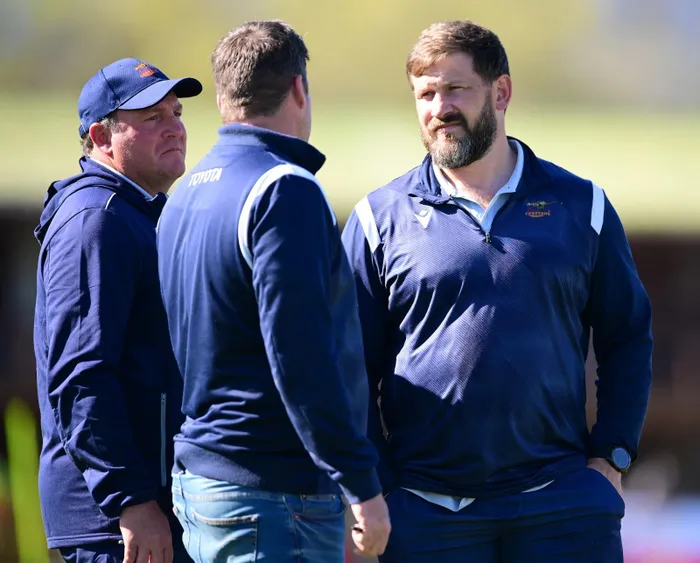
Cheetahs boss Frans Steyn, right, will be relishing a chance to play regular top-flight rugby again.
Image: Backpagepix
The breaking news this week that the Cheetahs are likely to join the United Rugby Championship (URC) is manna from heaven for a union that has been treated deplorably by the powers-that-be.
The lifeline looks set to head to the Free Staters as a result of restructuring in Welsh rugby, where one team is expected to be cut from the competition. It has been incredibly sad to watch such a proud South African team degenerate over the last decade after being cast into the wilderness.
Poignantly, and ironically, we have seen Rassie Erasmus speaking on television about the glory days of the Cheetahs when they won the full-strength Currie Cup three years in a row under Erasmus and former Springbok coach Jacques Nienaber. In the Erasmus documentary, there was the famous clip of a gleeful Ollie le Roux smoking a cigar minutes after the final whistle of the 2005 triumph over the Blue Bulls.
That made it all the more startling to hear that a decade later, the Cheetahs were in such a parlous state that they were battling to pay their electricity bills, and some players’ salaries had been paid late.
How can it be that such a cornerstone of South African rugby became a poor relation? It started with the decision by SA Rugby in late 2020 to boot the Cheetahs (and the Southern Kings) out of the PRO14 to make way for the Stormers, Sharks, Lions, and Bulls for an expanded competition named the United Rugby Championship. Those four unions had exited Super Rugby as South Africa realigned itself to the northern hemisphere.
Incidentally, Super Rugby had also seen the Cheetahs treated shabbily. They were yanked in and out of that competition as it expanded and contracted, and were always seen as the expendable South African team.
The Cheetahs are treated this way because they are financially poorer than the teams from Cape Town, Durban, Johannesburg, and Pretoria. They are lesser money-spinners, and as long as the game has been professional, the Cheetahs have been on the back foot and have perpetually struggled to hold on to the magnificent players they produce.
The Sharks, in particular, pillaged the Free State. It started in the ‘90s with Andre Joubert, Vleis Visagie, Henry Honiball, Pieter Muller, and Ollie le Roux, and continued with the likes of Ruan Pienaar, Frans Steyn, Coenie Oosthuizen, AJ Venter, Andries Strauss, and Bismarck and Jannie du Plessis.
When the Cheetahs were kicked out of the PRO14 in September 2020, they lost 23 players by January 2021. Thus began a dark patch; not only were players leaving for better opportunities, but the Cheetahs could not attract new ones. They were no longer an attraction for players who were not starting regularly at the glamour unions.
The Cheetahs have had a lifeline of sorts in the second-tier EPCR Challenge Cup, but this has been the "devil in disguise" because it has put them in the poor house. The invitation came with the clause that European teams would not travel to Bloemfontein; the Cheetahs had to stage their “home” games in Europe. They initially chose the Italian city of Parma, where each of their four home games cost them R400,000.
The Cheetahs felt the pinch in Parma to the degree that kit could only be washed every second day to save on the laundry bill. Thankfully, they have an exceptional sponsor in Toyota and passionate coaches in Steyn and Pienaar. The much-decorated Springboks have strong Free State roots and have hung in with the team despite the growing struggle.
But it looks like the corner has finally been turned with the signing of double-World Cup winner Faf de Klerk and the door opening at the URC. We can only hope that they do not get kicked out again.