

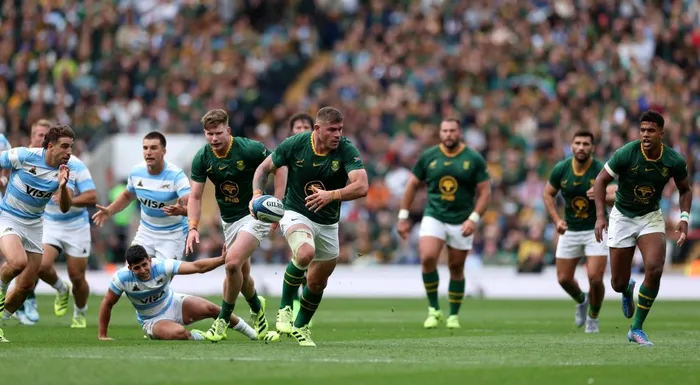
Malcolm Marx was confirmed as the best player in the world after winning the World Rugby Men's Player of the Year award earlier this year. Photo: AFP
Image: AFP
While this was not a World Cup-winning year for the Springboks — and if there had been a World Cup, they would surely have won it — the year 2025 is right up there in their “best ever” category.
If we include the warm-up match against the Barbarians, the Boks played 15 matches, losing just two for an 86% record. That is the best Springbok return in the modern era, but not the best in history.
In the first half of the 20th century, up to the famous 4-0 whitewash of the All Blacks in 1949, the Boks almost routinely finished the year unbeaten for a 100% record, but the issue is that they averaged just five Tests per year.
Maybe the best way to evaluate how good a year it was for Rassie Erasmus’s team is to gauge the international public reaction to their performances.
We know the Boks are never going to win popularity contests — for over 100 years they have been regarded as brutal Neanderthals, and it will take a long time to rub out that cliché — but after Ireland had been obliterated in Dublin, every critic in the world agreed that there was a country mile between the Springboks and the rest.
By the end of the year, the grudging respect at the beginning of it for the back-to-back world champions had given way to sheer admiration, if not outright envy.
We even had severe Springbok critics in former Scotland coach Matt Williams and All Blacks legend Sir John Kirwan singing the Boks’ praises.
Over the course of a magnificent five-match rampage through Europe, the South Africans showed that they have added exhilarating backline play to bludgeoning power. It is a recipe that no team on the planet can live with when the Boks are in the mood.
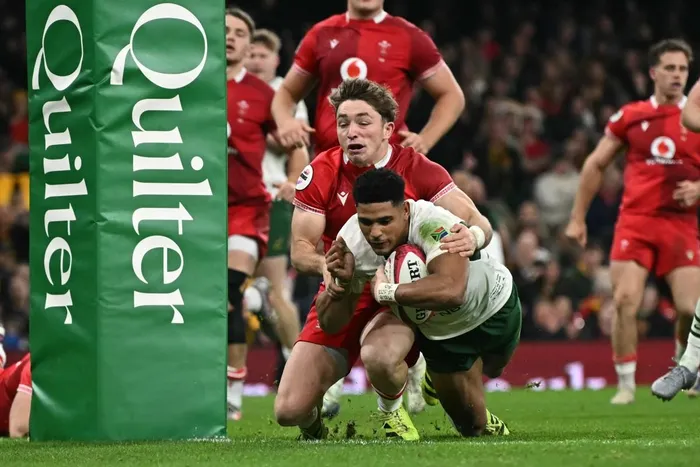
Sacha Feinberg-Mngomezulu arguably ended the year as the best flyhalf in the world. Photo: AFP
Image: AFP
What is worrying for the Boks’ rivals is how they finished the year compared to how they started it — they signed off with a stark revelation that there is much more to come. There are still almost two years to the 2027 World Cup, and the Boks can morph much further into the ultimate rugby machine.
The year began with a warm-up in the rain in Cape Town against a game Barbarians team that had spent more time in the pub than on the practice field.
The first Test of the year was in early July, against Italy, and it is a mark of the expectation this Springbok team carries that the coaching staff, not to mention the public, were disappointed with the 42-24 win in Pretoria.
The Springboks were exposed badly at the breakdown by the streetwise Italians, while flyhalf Handré Pollard lost ground with the coaching staff for his game management — over the next 13 Tests, the World Cup hero would feature just five times as he made way for Manie Libbok and Sacha Feinberg-Mngomezulu.
The Boks were better in the second Test against Italy, in Cape Town, winning 45-0, but you still had the feeling that lubricating oil was finding its way around the engine.
This was confirmed when the Boks lost to the Wallabies at Ellis Park in a curious encounter. They were 22-0 up after the first quarter, having played sublime attacking rugby, only to fall off a cliff in the second half to perish 38-22.
If the Italy series had taught the Boks to shine up on their breakdown work, the Ellis Park defeat highlighted the folly of trying to hit six off every ball. The Boks had overplayed, opening themselves up repeatedly to counterattacks from turnovers and mistakes.
A better balance between attacking and percentage rugby was quickly restored.

Springbok No 8 Jasper Wiese was a powerhouse for the team this past year. Photo: AFP
Image: AFP
A solid return-match defeat of the Wallabies warmed the Boks up for one of the matches that had been circled on their calendar since the year’s itinerary had been confirmed — the monumental “Eden Park hoodoo” encounter.
Pollard was restored to flyhalf, and once more he took much of the blame when the Boks lost 24-17 to the All Blacks, although it was the soft tries the team gave away in defence in the opening fifteen minutes that made it difficult for them to win.
Still, they finished that game strongly in a caution of what was to come the next week in Wellington.
But what we witnessed few could have predicted — the Kiwis were blown away by a near-perfect performance of poise, power and precision, with Libbok and Feinberg-Mngomezulu pulling the strings. Towards the end of the record 43-10 walloping, the All Blacks were looking to the referee as a beaten boxer looks to his corner in the hope of a white towel.
Springbok euphoria soared yet further when the Boks returned home to annihilate the Pumas 67-30 in Durban. It will be remembered chiefly for Sacha FM broadcasting his class to the world. Feinberg-Mngomezulu scored three tries in his mammoth thirty-seven points.
The Rugby Championship title was defended by the Boks for the first time when they saw off the Pumas in London.
That left the end-of-year tour, and two peaks the Boks were determined to scale — the setting-the-record-straight clash with France and the score-to-settle encounter with Ireland.
The French had not stopped whining since they were “robbed of the World Cup” in the 2023 quarter-finals, but the Stade de France was rendered silent when the Boks delivered a masterclass, even without red-carded Lood de Jager.
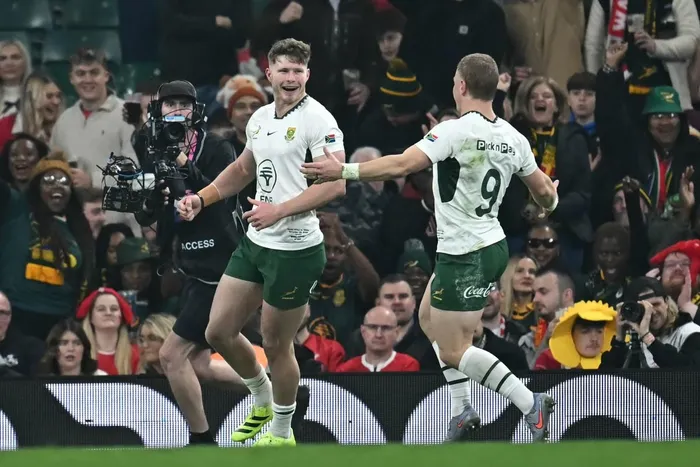
Ethan Hooker had a breakout year in national colours this year. Photo: AFP
Image: AFP
The ability to defiantly adapt to adversity was reprised against Italy when Franco Mostert was unfairly sent off — his red card was later rescinded.
In Dublin, it was the Irish who suffered card after card as the Boks pulverised them into submission and ill-discipline.
For the Springboks and their fans in Dublin, the Guinness has never tasted better, and when supporters toast a magnificent Springbok year on New Year’s Eve, the champagne never crisper.
Best Player — Malcolm Marx
Best match — 43-10 defeat of New Zealand in Wellington
Best try — André Esterhuizen v All Blacks in Wellington. Damian Willemse slips through the defence out wide, Grant Williams scorches towards the line before offloading to Esterhuizen, who steam-trains through Beauden Barrett for the breath-taking score.
Best Youngster — Sacha Feinberg-Mngomezulu
Most Valuable Player — Jasper Wiese. Seldom has a No 8 been so conspicuous by his absence and so appreciated on his return.
Newcomer of the Year — Ethan Hooker
Most Bizarre Moment — Cheslin Kolbe dots down behind the tryline and drop-kicks to Santiago Chocobares, who scores.
Non-Event of the Year — World Rugby gifts the Coach of the Year Award to England Women’s coach John Mitchell in September, scorning Rassie Erasmus and his exploits of November.