

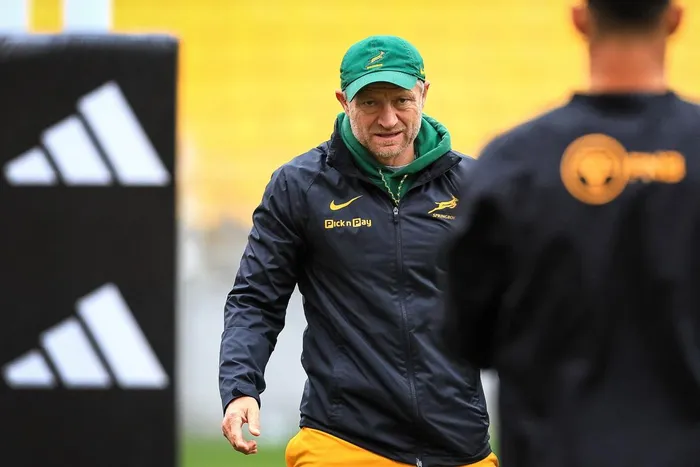
Springbok attack coach Tony Brown has been such a breath of fresh air for the national rugby team.
Image: AFP
Not long after Natal defeated Transvaal in the epic 1996 Currie Cup final, James Small went to the Natal management and asked to be released from his contract to go to Western Province.
It seemed a strange request given that Natal rugby was arguably at its strongest level. That was the year that Natal began their transition to the Sharks. It was exciting times. But Small had a romantic interest in Cape Town. That was where he wanted to be. Small was granted his wish, and Sharks fans were livid. They wanted their hero to stay in black and white.
Ian McIntosh, the legendary coach, explained to me why they let Small go. He said that when a player’s heart is no longer in it, you have lost him as a player, so instead of having a sulking presence, let the guy go and replace him with someone who wants to play for you. These things happen, and contracts are seldom bulletproof.
The point I am getting to is about Springbok attack coach Tony Brown, the Kiwi who is at the centre of a storm of media speculation — especially in his native New Zealand — in the aftermath of the clumsy sacking of All Black coach Razor Robertson.
It quickly emerged that NZ Rugby have lined up the former All Black Jamie Joseph, and his old coaching mucker at Otago, the Highlanders, Sunwolves, and Japan, happens to be Tony Brown. Subsequently, Rassie Erasmus has colourfully announced on social media that Brown is staying, and Brown himself told NZ media that he has no “out” clause in his contract with the Boks. He signed a four-year contract with SA Rugby and has two years to go.
But, to reiterate, contracts are just pieces of paper that can be torn up when adults maturely negotiate. Erasmus will tell you so. He was in a “watertight” contract with Munster, but with two years to go in Ireland, he was released to take the Springbok reins from Allister Coetzee.
And if we hear the tone of Brown’s answers to media questions in New Zealand, he bleeds black and would love to coach his native country. Brown says that not long before Robertson was fired, he was asked by Robertson to jump ship at the Springboks and join his coaching staff. He declined the offer because he is contracted to the Boks until the end of next year’s World Cup in Australia.
But here is the thing … Brown, a former All Black flyhalf, confirmed that if he had been offered a role at the All Blacks two years ago, he would have taken it.
“One hundred per cent I would have taken the job. And in the future, it’s definitely something I want to do. Just timing hasn’t worked. My commitment to South Africa was four years, and I’ve always had the plan to honour that commitment,” Brown said.
“I told him (Robertson) that I’m so frustrated that no one talked to me two years ago. But that’s rugby, and that’s coaching. He had his coaches, and I just had to go and find another job.”
Brown says that the sacking of Robertson last week suggests that NZ Rugby have had an agenda regarding a new coaching staff because Robertson had mixed success over the last two years.
“They (the All Blacks) didn’t seem as though they were playing overly poorly … and to then just pull stumps and get rid of the head coach has put them in a pretty massive situation around getting ready for 2026," Brown said.
And next is a candid line that tells us Brown has known something that others didn’t.
“NZ Rugby definitely set up a process where it is Scott Robertson’s team versus Jamie Joseph’s team …” Brown said.
So let’s get to the million-dollar question. If Joseph gets the job and sends an SOS to Brown, will he ask SA Rugby for a release?
This is my gut feel: The mild-mannered Brown is a man of honour. He has spent the last two years accumulating intimate intelligence on the Springbok players. I can’t imagine him contemplating jumping over the fence into the All Black camp like a spy defecting from east to west during the Cold War.
Brown will feel the pull of patriotism, but his integrity will win the day.