

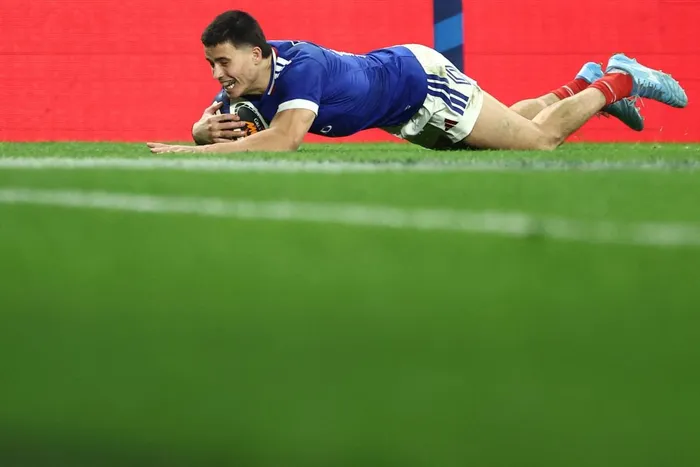
France wing Gaël Dréan dives across the whitewash to score a try during their Six Nations victory over Italy at the Stade Pierre-Mauroy in Villeneuve-d'Ascq, northern France, on Sunday. Les Bleus won the match 33-8. Photo: AFP
Image: AFP
After a hammering at Murrayfield was followed by humiliation at Twickenham, England coach Steve Borthwick might well be contemplating the famous line by Scottish poet Robbie Burns: The best-laid plans of mice and men often go awry.
The England empire Borthwick thought he was building indeed lies in tatters after Ireland humiliated the home team at the weekend by a record score of 41-21, rubbing salt into the wounds inflicted by Scotland the week before in Edinburgh. England’s much-talked-about sequence of 12 consecutive wins has turned into two consecutive heavy losses, and the talk that the team were on course to emulate their 2003 World Cup win next year in Australia has faded into deafening silence.
Lawrence Dallaglio, one of England’s greatest players and the No 8 when Australia were beaten in the 2003 final, wrote in The Sunday Times: “England got bashed to pieces.
"You could have been forgiven for thinking that the fire alarm was going off in the second half, because English supporters were heading for the exits in their droves. I can’t remember a match in which the difference between expectation and reality has been so great.”
Well put, Mr Dallaglio.
The reason England are the team the world loves to hate is that their fans, most of their media, and the players themselves are forever convinced they are in a golden chariot destined for World Cup glory, despite wheels coming off the chariot every year.
The English brashness is personified by Henry Pollock, the blond-haired TikTok dancer who has pizzazz to match his admittedly impressive rugby skills. But even Pollock fizzled out as the Irish delivered a famous performance, which was the perfect riposte to their own army of critics.
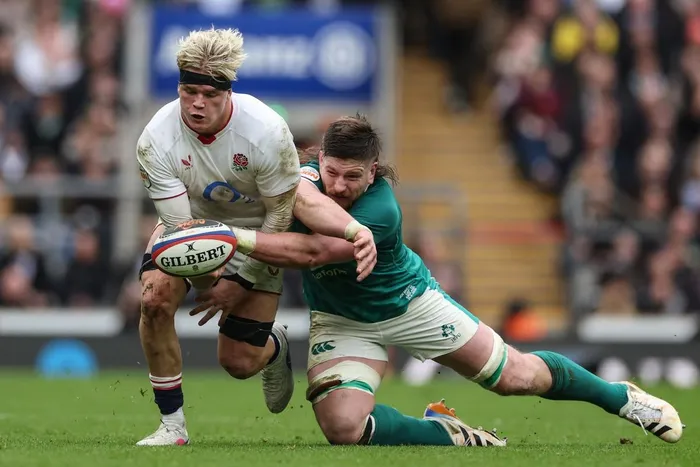
Henry Pollock of England. Photo: AFP
Image: AFP
The five-try demolition was so total that the England players did not know where to look when they trudged off after the final whistle. If we are to offer England a smidgeon of comfort, Scotland at Murrayfield played like men possessed — 15 Bravehearts defending their castle from the Auld Enemy. Ireland were something similar as they, like Scotland, set out to prove that they were not a team in terminal decline.
The Irish had a tumultuous week. One of their players, Edwin Edogbo, was subjected to awful racial abuse on social media, leading to coach Andy Farrell asking the Irish nation if it had lost their soul. That nastiness might have sparked the galvanising action that clearly happened in the Irish camp. Even Farrell might have been wondering if his players were, indeed, over the hill, past their best, and ready for the pipe and slippers.
They had been terrible in losing to the All Blacks and Springboks in November, and in this Six Nations, they were swept aside by France and were lucky to beat Italy in Dublin last week. Hence, Farrell asked his team if public opinion was accurate: were they finished and no longer the side that, not long ago, won back-to-back Six Nations titles?
Farrell got his answer — the critics of Ireland were humbled. Ireland are back, the Guinness tastes good again, and the world rugby order looks sounder.
Also on Saturday, Wales came within a whisker of winning their first Six Nations game since they beat Italy in 2023. Any rugby fan with a heart would have shed a tear for the Welsh as Scotland snatched a late try to win 26-23.
The Scots’ passion of the England match predictably tapered off, while Wales, with the little fly-half Sam Costelow pluckily pulling the strings, have at last bottomed out and are pulling themselves up by their bootlaces.
On Sunday, France v Italy
Mike Greenaway is a senior rugby reporter at Independent Media and contributor on our Last World on Rugby podcast on our YouTube channel, The Clutch