

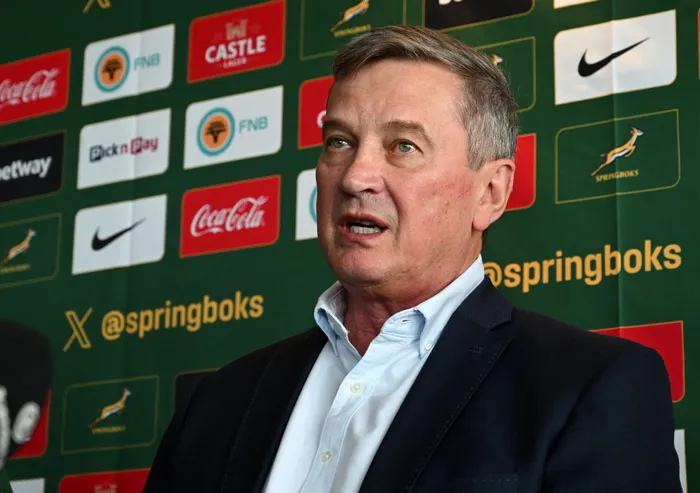
SA Rugby CEO Rian Oberholzer and Rassie Erasmus have confirmed that the Springboks are leading the way both on the scoreboard and the balance sheet. With 14 massive matches ahead in 2026, the green-and-gold machine shows no signs of slowing down. Photo: Backpagepix
Image: Backpagepix
Thanks to the Springboks’ back-to-back Rugby World Cup wins, South African rugby is in rude health and the envy of their rivals.
This was clear from a media day at SA Rugby’s headquarters in Cape Town, where CEO Rian Oberholzer and coach Rassie Erasmus gave their thoughts on the state of the game.
“We are in a very good space, on and off the field,” said Oberholzer. “Of the 12 tier one nations — and we talk amongst ourselves — we are the only one that is going to show a bit of a profit.
“It is a simple system that feeds off itself,” he explained.
“If the Springbok team does not perform, we won’t attract commercial money. If we do not have commercial money, we can’t feed the system from the bottom to ensure the players keep coming through.
“The majority of our funds go back to the unions to feed the system. We are in the best position since Covid. We are very fortunate to be in a stable place right now,” Oberholzer added.
Success breeds success, it would seem. When the Springboks were so poor in the years prior to Erasmus taking over the coaching reins in 2018, sponsors departed the Boks in droves. Now they are queuing at SA Rugby’s door to get a piece of the juicy Springbok pie.
In 2026, the Springbok brand could further blossom. They have 14 matches as Erasmus fine-tunes ahead of next year’s World Cup in Australia, and given the form of the team and the calibre of players coming through, it is hard to see a green-and-gold implosion.
“It is a massive year for us,” Oberholzer said.
"The Nations Cup is brand new, and the Rugby’s Greatest Rivalry series with the All Blacks is unique. But we are feeling good about all of our teams. The structures are working, and the high performance has gone up across the board.
“The Nations Cup is exciting in that it is the top six northern teams playing the top six southern teams,” Oberholzer said.
“We are now playing for a reason, not just friendlies in June and November, building up to a finals weekend where the team that finishes sixth in the northern pool will play the corresponding finisher in the south pool. Five will play five, four versus four, and so on as we build up to a final. It gives more meaning to the international season.”
The Rivalry series will take place every four years, similar to the British and Irish Lions tours. In 2026, the Boks will be in camp for 135 days for their 14 matches. They are 579 days from RWC 2027 and their opening pool match against Italy in Adelaide.
Erasmus said he has a good idea what his squad will look like for the World Cup.
“When you are 18 months out from the World Cup, you start to know who is going to make it and who won’t. You certainly know much more than you did 36 months ago.
“If you look at the schedule for 2026, you try to target when you can rotate. Will it be after the England game? Last year, we averaged nine changes to the match-23 per game.
“But this year we are not under as much pressure to grow depth because we have learned some lessons. We have found out who can do it and who can’t.”
* Mike Greenaway is a senior rugby reporter at Independent Media and contributor on our Last World on Rugby podcast on our YouTube channel, The Clutch