

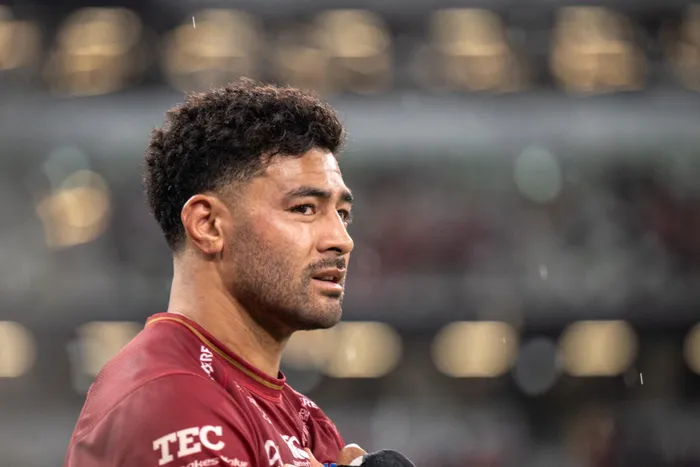
Dave Rennie is reportedly looking to end NZ Rugby’s "home-only" rule to bring back superstars like Richie Mo’unga, pictured, and Brodie Retallick from Japan. Photo: AFP
Image: AFP
The new All Blacks coach, Dave Rennie, wants to twist the arm of NZ Rugby into allowing him to pick All Blacks based in Japan, and if he gets it right, it could be a game-changer.
There are two players in particular that Scott Robertson’s successor wants back in the All Blacks starting line-up, one in the engine and one in charge of the backline — Brodie Retallick and Richie Mo’unga, respectively. But there are plenty more.
Currently, around 50 South Africans are playing in various Japanese leagues, including 10 current Springboks, and there are probably more Kiwis than that the number, given that New Zealand is much closer to Japan than South Africa.
All Blacks fans have long lamented NZ Rugby’s stance on (not picking) overseas-based players, and point out the significant advantage the Springboks have in being able to pick Japan-based stars such as Pieter-Steph du Toit, Malcolm Marx, Cheslin Kolbe, Manie Libbok, Jesse Kriel, Damian de Allende, Lood de Jager, Faf de Klerk, and Kwagga Smith.
The Japanese national team coach, Eddie Jones, is the latest high-profile rugby figure to point out the benefits of playing in Japan’s less physically demanding leagues.
As Bok coach Rassie Erasmus has often said, Jones points out that playing in Japan as opposed to the arduous French Top 14, Super Rugby, or URC, extends a player’s career.
Jesse Kriel, in his seventh season in Japan, told a rugby magazine last year why he feels he is a better player for having moved there.
“There’s money involved for every South African who goes overseas, and that’s one of the motivators,” Kriel said.
“The main thing for me is that there are a lot fewer distractions in Japan. You eat, sleep rugby, and get so much time to hone in on your skills and become a better rugby player. I think that’s the reason I’ve been here for six seasons.”
Jones recently told the Rugby Unity podcast that in the Japanese leagues, players handle the ball far more than in other competitions.
“They get good training time in, they get enough practice, they get plenty of touches on the ball, which is an advantage,” Jones said.
“It reminds me of the early days of Super Rugby. There’s plenty of ball movement and plenty of touches of the ball,” he explained. “It’s that hybrid rugby without the hard contest at the breakdown, so it’s a good league to play in".
And the rugby must be of a reasonable quality, given that Malcolm Marx and Pieter-Steph du Toit have won World Rugby Player of the Year Awards while based in Japan.
As Kriel says, “It’s definitely not easy rugby.
"There are so many international players here – and some absolute freaks, including guys from rugby league. If I look at my position, outside centre, every weekend you’re coming up against quality international players like (Wallaby) Samu Kerevi and (All Black and Fijian) Seta Tamanivalu, who are constantly challenging you and bringing out the best in you.
“You also get to learn from different coaches,” he adds.
‘I’ve been coached by Australians, New Zealanders, and Japanese who all see the game differently. You can listen to all of that and then decide what best applies to you and what you can add to your game. That’s really been stimulating for me as a rugby player.’
It is fair to say that much of the Springbok success in the last two World Cups is thanks to SA Rugby allowing Erasmus to pick the Japan-based contingent.
Springbok fans will be holding thumbs that Dave Rennie does not get carte blanche to do the same.
*Mike Greenawayis a senior rugby reporter at Independent Media and contributor on ourLast World on Rugby podcast on our YouTube channel, The Clutch. He is the author of the best-selling books The Fireside Springbok and Bok to Bok.