

With the Six Nations wrapping up, the Springboks’ July opponents have found their spark. From England's Paris thriller to the Welsh revival, Rassie Erasmus and the Boks have plenty to ponder before the winter tests kick off. Photo: AFP
Image: AFP
COMMENT
At the next Springbok alignment camp, Rassie Erasmus needs only to show a highlights package of the Six Nations tournament to set the scene for the imminent international season.
Between July and November, the Boks play 14 matches, and all of the Six Nations teams will be among their opponents. Further, the Boks' first three opponents — England, Scotland, and Wales — will arrive in South Africa in July confident after strong finishes to the Six Nations.
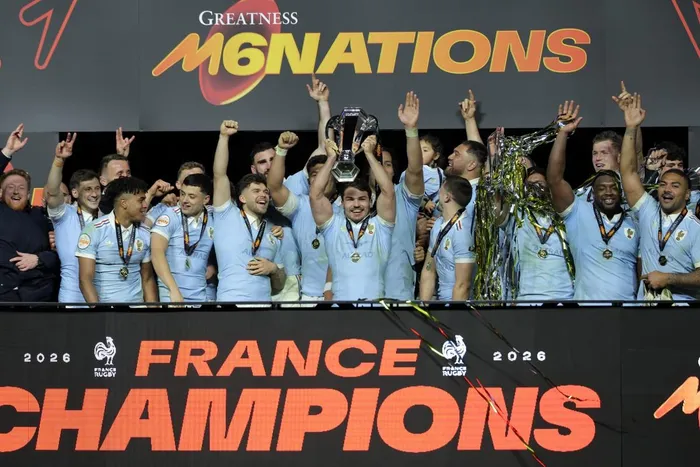
On 4 July, at Ellis Park, the Boks host an England team that did not have a statement win in the Six Nations but made a massive statement in Paris at the weekend. They were unlucky to lose 48-46 to France, succumbing to a heartbreaking final-minute penalty by Thomas Ramos.
In Dublin, Scotland lost to Ireland but did so with honour. The Irish were written off by most in the early stages of the Six Nations because of unconvincing displays, but in the second half of the tournament, they insisted that they are no Dad’s Army, and that there is more to come from their squad of household names.
Indeed, Ireland finished second in the Six Nations behind France, with Scotland third, Italy fourth, and England just two points ahead of Wales. Scotland, who the Boks host in Pretoria on 11 July, also started the tournament sluggishly but rebounded with unforgettable victories over England and France. In Dublin at the weekend, they went toe-to-toe with an Irish team that has rediscovered its mojo, and the final score of 43-21 was not a fair reflection of what was a tight tussle.
In Cardiff, there was barely a dry eye in the Principality Stadium when Wales ended a losing Six Nations streak that dated back to 2023. True rugby supporters around the globe would have rejoiced at the result. Wales is a country with a population of three million, and when you are born in the valleys, you receive a rugby ball instead of a rattle.
There are three truly rugby-mad countries in the world — South Africa, New Zealand, and Wales — and to see the latter suffer such ignominy in recent years has been heartbreaking. Wales ended the Six Nations at the bottom of the table, but the manner in which they destroyed Italy — the same team that well beat England the week before — suggests they have bottomed out and will confidently begin climbing the World Rugby ladder from their current worst-ever position of 11th.
Wales have made the quarter-finals of every World Cup, and they hopefully will continue that trend in Australia next year. Their long-suffering supporters deserve as much.
The encouraging aspect of their 31-17 defeat of the Italians is that it was predicted by wiser rugby pundits — in each round of the Six Nations, the Welsh have been incrementally better. Coach Steve Tandy has stuck with a largely youthful team, and they have dragged themselves up by their boot laces, round after painful round.
Wales’ next game is in Durban on 18 July, and Erasmus knows he has to take them seriously. But it is the England performance that will have Erasmus scratching his head the most. Steve Borthwick’s team had won 12 games on the trot before their performances fell off a cliff, with despairing defeats to Scotland, Ireland, and Italy.
Their trip to the Stade de France doubled as Last Chance Saloon for Borthwick and captain Maro Itoje. The latter’s captaincy credentials were in tatters because his team had been found desperately wanting when the pressure was cranked up in games. There appeared to be zero leadership as the England players racked up the most penalties and yellow cards in the tournament.
But the English players rocked up for work at the coal face in Paris, and had they enjoyed the rub of the green from the match officials, they would have recorded a famous victory. What Borthwick and Itoje have to work out between now and Ellis Park is why it took a date with a firing squad for their team to perform to their potential, and how to make the Paris performance their standard.