

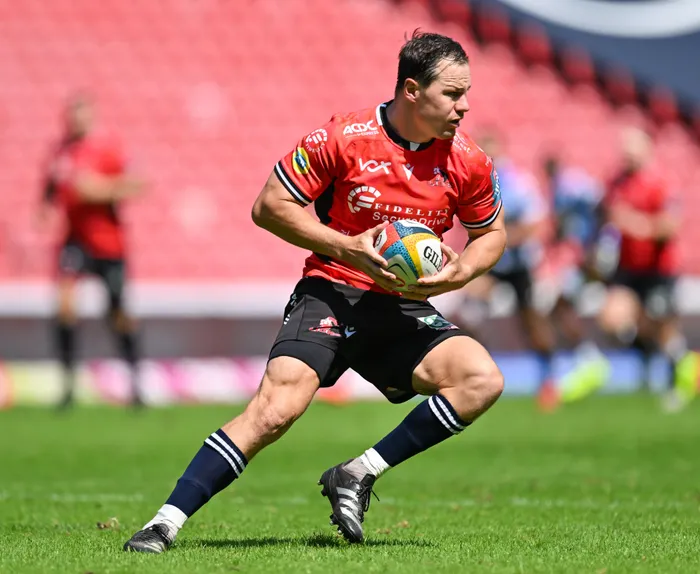
We look at why the "criminally underrated" Chris Smith has been the missing piece of the puzzle for Ivan van Rooyen’s men this season. Photo: Backpagepix
Image: Backpagepix
COMMENT
There are many moving parts in the current Lions setup, which have laid the groundwork for the team’s final push towards a first-ever play-off spot in the United Rugby Championship (URC).
Currently fifth in the standings with 43 points, the Joburg-based team are within touching distance of finishing in the top eight and claiming a quarter-final berth. They have four matches remaining in the regular season, including two home games against the table-topping Glasgow Warriors and Connacht.
One would hope that before they travel for their final two matches — against Leinster and Munster, respectively, in Ireland — coach Ivan van Rooyen and his men will have already secured their progression to the next phase of the tournament.
While it is true that an improved attack, a more staunch defence, and a heightened degree of physicality have made the road to the final eight more realistic, the stability afforded in the No 10 jumper is arguably the catalyst that has allowed the charge.
Flyhalf Chris Smith has been near impervious for the Doornfontein-based outfit so far this season. The 31-year-old is the leading points scorer in the URC by a fair margin, having collected 123 points during the campaign.
He has slotted 16 penalties and 35 conversions, which have kept the Lions’ scoreline ticking over nicely. Add to that a try scored, three assists, five clean breaks, 17 defenders beaten, 73 carries, and 298m gained, three turnovers, and the Lions have only benefited from his calm demeanour and experience.
Consider for a moment the flyhalves before his arrival in Joburg — Jordan Hendrikse, Gianni Lombard, Kade Wolhuter, Sam Francis, Lubabalo Dobela, and Fred Zeilinga — and the improved stability at pivot points to a game-changing and season-defining signing by the Lions hierarchy.
Indeed, not since the Elton Jantjies-era have the Lions enjoyed such reliability in the No 10 jumper. During those heady days, the Lions contested three Super Rugby finals, while Jantjies — despite the controversial end to his career — went on to become a Rugby World Cup winner.
I would venture that there is a direct correlation between the arrival of Smith and the upturn of the Lions’ fortunes.
Smith, a product of SACS, remains criminally underrated. He did the business for the Bulls during a five-year stint there and enjoyed a relatively fruitful season for Oyonnax in France. He is now doing the same for the Lions.
He has given the backline shape and direction, allowing Springbok Morne van den Berg and his fellow scrumhalves — Nico Steyn and Haashim Pead — to play their natural game. On his outside shoulder, he has done the same for the preferred centre pairing of Bronson Mills and Henco van Wyk.
He has struck a health balance between attacking play and tactical kicking — his unerring boot has ensured scoreboard pressure and territorial relief and dominance. Perhaps his only short-coming has been a lack of defensive soundness, as he has missed 20 for a 71% tackle success, while losing possession to 11 turnovers.
Nonetheless, and most importantly, Smith has bought into the team culture of the Lions — in the handful of discussions with him since joining the union last year, his positive affirmation of his team has been tangible.
In Smith, the Lions have finally found the tactical compass they’ve lacked for years and his impact in Doornfontein thus far is already indelible. If he can navigate the Lions through the gauntlet of Glasgow and Connacht, and steer them safely through the Irish storms of Munster and Leinster, he won't just be a 'good signing' — he will be the man who finally brought play-off rugby back to Ellis Park.
Morgan Bolton is Independent Media's National Sports Editor and editor of our YouTube channel The Clutch.