

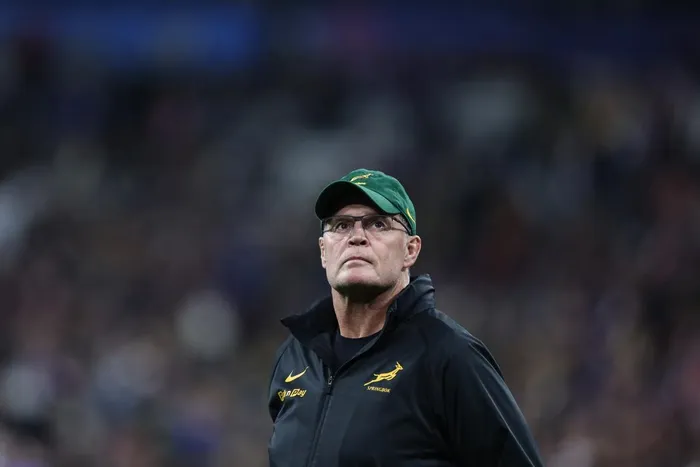
Locked in until 2031. Springboks coach Rassie Erasmus will be at the helm of the world champions until after the 2031 Rugby World Cup following a successful contract extension with SA Rugby. 2026 will be the most challenge no World Cup year for Erasmus and his Springboks.
Image: AFP
As we move into the second half of January and get out of the habit of writing 2025 instead of 2026, the reality of the new year is upon us.
In terms of rugby, Rassie Erasmus will have already put the cork in the champagne bottles, silenced his ghetto blaster, taken off his dancing shoes, and got back to the blackboard as he ponders arguably the toughest non-World Cup year in the history of the Springboks.
Gone are the days when the tricky third year before a World Cup was about honing game plans, putting the finishing touches to player experimentation and, where possible, keeping powder dry before the next year’s global gathering. By that I mean, managing key but veteran players, and holding back some of the game strategy.
But I’m not sure how much Rassie can keep in reserve in a 2026 that heralds the Greatest Rivalry series with the All Blacks and the inaugural Nations Cup.
It is an axiom of rugby that a Test match between the Springboks and the All Blacks is open warfare, and four battles are coming up, three in South Africa and one at a neutral venue, probably in the USA.
The Nations Cup promises to be similarly competitive. It can only be that way when first up is swaggering England, full of themselves after a strong 2025.
For those who are still foreign to the intricacies of the Nations Cup, it basically replaces the southern hemisphere incoming tours from the north in July, and the south’s November tours to the north.
The difference is that there is a different team each match, and log points are awarded. After each country has played its six games (three in the south and three in the north), the top finishing teams play a Finals Weekend at Twickenham.
The Nations Cup is billed as the “Battle of the Hemispheres”, a showdown between the Six Nations and the Rugby Championship, and the biggest rugby tournament outside of the World Cup. It will be played every second year.
Given the ultra-competitiveness that dominates the DNA of the Springbok team, Rassie surely will want to add this trophy to his already groaning mantelpiece while getting into the heads of the Boks’ major opponents just months before RWC Australia 2027.
The thing with a year of brutal battles is that serious casualties are inevitable. Erasmus’s wise policy of rotation and blooding of new talent over the last two seasons is going to stand the Boks in good stead.
We hope that the injury fallout from the Greatest Rivalry and the Nations Cup does not adversely impact squad selection for next year’s World Cup, but do not be surprised if there are not more Steven Kitshoff-type setbacks for the Boks this year.
The marketing of the All Blacks’ tour as rugby’s Greatest Rivalry has led to some grumbling from the Six Nations countries. The reality, though, is that it’s factually true, the rivalry between England and France, and England and Scotland notwithstanding.
Since world rankings began in 2003, the All Blacks have enjoyed a total of 747 weeks as the world’s No 1 team. The Springboks are second at 297 weeks. Ireland have had a total of 74 weeks at the summit, and England have been at the top for a total of 40 weeks.
Looking at the winning percentages of the top teams, the All Blacks lead at 76 percent, the Boks are second at 64 percent, and third are England (56 percent).
The bottom line when it comes to the Greatest Rivalry is the net haul of World Cups between South Africa and New Zealand — of the 10 World Cup tournaments played since 1987, New Zealand have won three, and South Africa four.
The balance goes to Australia (two), and the northern hemisphere has won just once (England in 2003).
Some critics question the validity of the New Zealand-South Africa rivalry, given that the All Blacks dominated the Springboks in the new millennium until Erasmus took charge of the Boks in 2018.
But this is a short-sighted view. Older Springbok fans know that in the first 74years of the 105-year rivalry (the amateur era from 1921 to 1995), the Springboks beat the All Blacks more times than they lost (20 South African victories to 17 of New Zealand).