

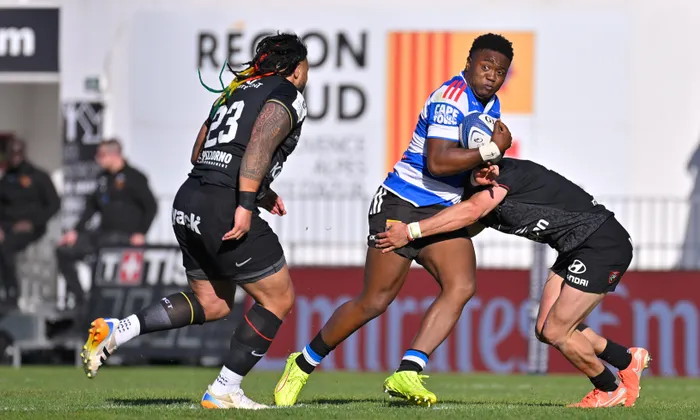
Stormers utility back Wandisile Simelane is tackled by Dan Biggar of Toulon in the build-up to the head-high tackle by Ma'a Nonu (left) that led to a yellow card only.
Image: EPCR
Why should South African franchises send their strongest sides to away matches in the European Champions and Challenge Cups when they so often find themselves on the wrong side of the whistle?
That’s the big question this week following a tough Round of 16, where both the Stormers and Bulls fell short. The Cape side, in particular, came off second-best against Toulon — and referee Christophe Ridley — in France.
Small incidents disrupted their momentum, while the bigger calls consistently kept the home side in the contest and energised their supporters.
One such moment came when a rolling maul was pulled down right in front of the try line. In most cases, that warrants both a penalty try and a yellow card. Instead, only a yellow was issued in the 72nd minute. At 28-20, with eight minutes remaining, a penalty try would have narrowed the score to 28-27 and completely altered the complexion of the closing stages.
Yet Ridley opted against it, leaving Stormers director of rugby John Dobson choosing his words carefully afterwards.
Moments later, veteran Ma’a Nonu made direct head contact with Wandisile Simelane in a forceful tackle. Ridley and his TMO deemed it worthy of only a yellow card. Days later, however, Nonu was cited and handed a three-match suspension — raising further questions about the officiating on the day.
Another crucial decision went Toulon’s way in the dying minutes. As the Stormers pressed for a match-winning score, it appeared that lock Adré Smith had grounded the ball. Replays suggested he was tackled by a player on the ground and in an offside position. Once again, Ridley and his TMO declined to penalise the home side, ruling the ball held up — effectively ending the match.
It left the Stormers wondering what more they need to do, particularly in Europe, to get the benefit of key decisions.
They had fielded a full-strength side and showed real fight against both a fired-up Toulon team and a hostile home crowd. That resilience, along with the Bulls’ effort, suggests there has been progress in terms of South African competitiveness in the Champions Cup — even if neither side reached the quarter-finals.
Yet the continued struggles with officiating feel like a step backwards.
It echoes the Springboks’ experience on last season’s year-end tour, where questionable calls were also a talking point. The difference, however, was that they found ways to win regardless, finishing the tour unbeaten.
Hopefully, this will serve as a valuable learning curve for the South African sides, particularly the Stormers. They had opportunities to take the referee out of the equation — but ultimately did not capitalise enough to secure a place in the Champions Cup quarter-finals.