

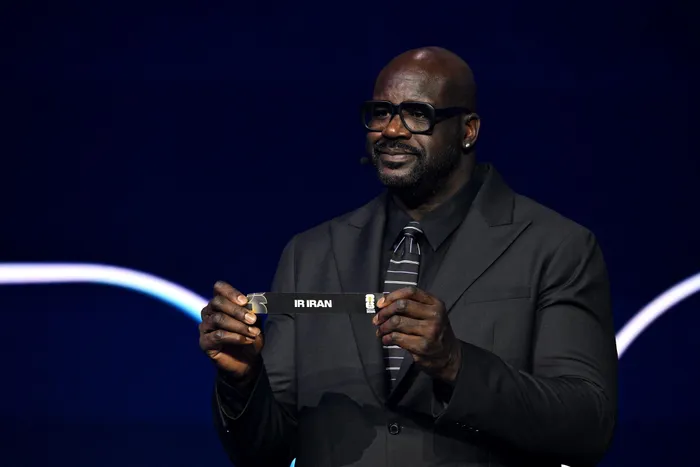
NBA legend Shaquille O’Neal draws out the card of Iran during the FIFA World Cup 2026 Official Draw at John F. Kennedy Center for the Performing Arts in December. Iran were drawn into Group G alongside Belgium, Egypt, and New Zealand.
Image: AFP
Iran is reportedly contemplating a boycott of the 2026 FIFA World Cup as tensions escalate in the Middle East following recent attacks by the United States and Israel.
Over the past two weeks, these countries launched coordinated strikes on various sites within Iran, resulting in the death of the nation’s Supreme Leader, Ayatollah Ali Khamenei. This significant development has ignited discussions about Iran potentially withdrawing from the tournament, which is set to be co-hosted by the United States, Canada, and Mexico.
“After this attack, we cannot be expected to look forward to the World Cup with hope,” Mehdi Taj, president of Iran’s football federation, expressed to local sports outlet Varzesh3 last week, encapsulating the nation’s disillusionment amidst rising geopolitical strife.
Iran was one of the first teams to secure qualification for the World Cup. In the draw held on December 5 in Washington, D.C., Iran found itself placed in Group G alongside formidable opponents Belgium, Egypt, and New Zealand.
Meanwhile, FIFA has opted not to comment on Iran’s possible withdrawal at this time. Should the country indeed pull out, the governing body will be tasked with nominating a replacement team, with reports indicating that another nation from the Asian Football Confederation could potentially take Iran's place.
According to the UK’s Guardian, US President Donald said he “really doesn’t care” when asked for comment on reports that Iran would withdraw from the tournament.
FIFA statutes say nations that withdraw from the tournament face heavy sanctions, including fines ranging from €275,000 (R5.1 million) to €555,000 (R10 million), as well as possible suspension from future tournaments.
Interestingly, Spain has also emerged in discussions regarding its participation in the tournament. Amid a budding diplomatic standoff with the United States tied to critiques made by Trump, Spain is weighing its options. Trump remarked sharply after Spain declined to allow the US to use its military bases for Middle Eastern operations, stating, “Spain is behaving terribly… We want nothing to do with Spain.”
While countries around the world weigh their positions, South Africa's Sports Minister Gayton McKenzie has said the government will not endorse calls for Bafana Bafana to boycott the tournament. “Football should not become a casualty of geopolitics,” he asserted, highlighting the difficult balance between sport and politics that FIFA now faces on the global stage.
With tensions already at a boiling point in the Middle East, the political fallout intertwining with football's most prestigious tournament has become increasingly real. Whether Iran ultimately participates or withdraws highlights the precarious balance FIFA must maintain between sport and politics – but for a country dragged into a war with one of the tournament’s co-hosts, does football even matter?
IOL Sport