

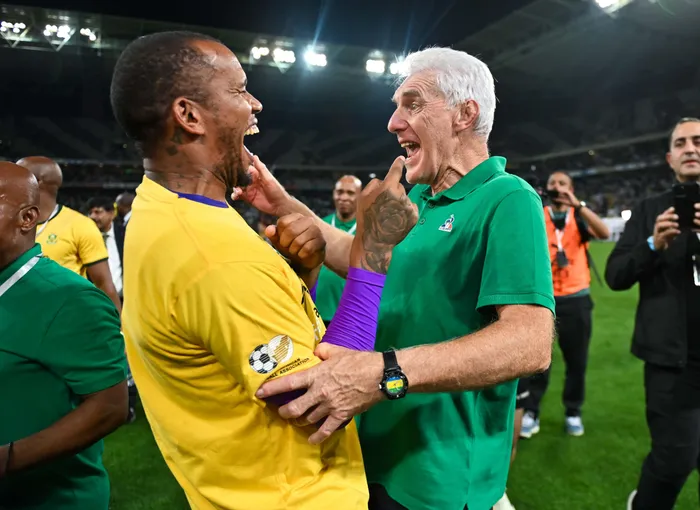
Former Bafana Bafana striker Katlego Mphela says coach Hugo Broos has transformed the national team into a cohesive unit ahead of next year's Fifa World Cup.
Image: Backpagepix
Bafana Bafana’s 2010 Fifa World Cup frontman Katlego "Killer" Mphela is positive about the current team’s chances of reaching the knockout stage of the 2026 edition ahead of the group stage draw on Friday (7pm start) in Washington DC.
Bafana are in Pot 3 for the draw, and while much still depends on the draw procedure itself, one thing is certain: Bafana will not be in the same group as any of the eight other African teams that have automatically qualified for the showpiece in North America.
South Africa’s return to the World Cup has restored national pride, especially given that it will have been 16 years since they last played at the event — they were hosts in 2010 — and 24 years since they last qualified automatically.
While the 2002 edition in Japan/Korea spoke to the country’s strides in international football, the 2010 edition remains relevant and historic. It brought the country and the globe together, football being the conveyor.
As the country prepares to learn the three teams Bafana will battle for a spot in the knockout stage — for the first time in four editions — there’s a growing belief that qualification is more possible than ever, given the current crop of players. Bafana have forged a core group driven by a never-say-die attitude, relentlessness, and camaraderie under coach Hugo Broos. And that’s not all. Broos has ensured he injects young players into the team — the future — and they have not disappointed.
Mphela, who scored in the 2-1 win over France in 2010, has credited the team’s upward trajectory, along with its main supplier, the PSL. He also emphasised why Broos must retain the core of the team heading to the World Cup based on form, not status or popularity.
“It’s important,” Mphela reiterated. “Personally, it doesn’t matter where you play. We’ve seen before that it can work, and sometimes it might not. So, I think whoever is in form or deserves to be in the national team at that time must be given a chance. The most important thing is the core of the team — it doesn’t matter who’s playing where. We’ve seen it with other national teams as well.”
Broos’ strategy and readiness for the World Cup will be tested at the upcoming AFCON in Morocco this month. The tournament will serve as a curtain-raiser for the global showpiece, just as the Confederations Cup did for Mphela and his teammates in 2009. And having finished fourth in the Confed Cup then, Mphela believes Bafana should aim for at least another third-place finish at AFCON, as in the last edition, as long as they do not regress.
“It would be very good to do that,” Mphela said. “It’s going to be difficult now. We are not seen as underdogs anymore. You can hear from interviews that other nations don’t want to face South Africa now. We are up there with them. So, also thanks to the PSL for raising the standard of the league.”
Mphela fancies Bafana’s chances of doing better than their disappointing group-stage exit in 2010 — in a group which featured France, Mexico and Uruguay — because the current team has been together for some time and knows each other well. Unlike the current crop, the 2010 squad was made up of players who either joined the team close to the tournament or had coach Carlos Alberto Parreira return shortly before the World Cup.
And while Parreira went to the World Cup with more experience — having won it with Brazil — compared to Broos, who is coaching at the tournament for the first time, Mphela says that might not matter.
“The World Cup is a different beast altogether — there are all these big nations and players that you’ll face,” he said. “Some you’ve never faced before, and you need that experience. But we also had Parreira, who had experience with the group, and we still didn’t go far.
"So, it’s a matter of applying yourself according to the demands of the situation and taking things game by game. Analyse the opponent as much as you can. They still have a few months (more than half a year) to do that. It’ll be enough time to prepare.”
Mphela has stressed that Broos and his technical team cannot depend only on “analysing opponents” to get past the group. SAFA must play its part by organising friendlies that will help the team prepare for the three matches.
“That’s a must!” Mphela affirmed. “After the draw they’ll know who they are playing. They might play against Japan or Brazil — you never know. All they must ensure is that next year we play friendlies against similar types of opponents.
"They don’t necessarily have to play against the same nations, but they need to be reasonable. Even teams in the PSL or the Champions League do that when they go to pre-season or prepare for tournaments.”