

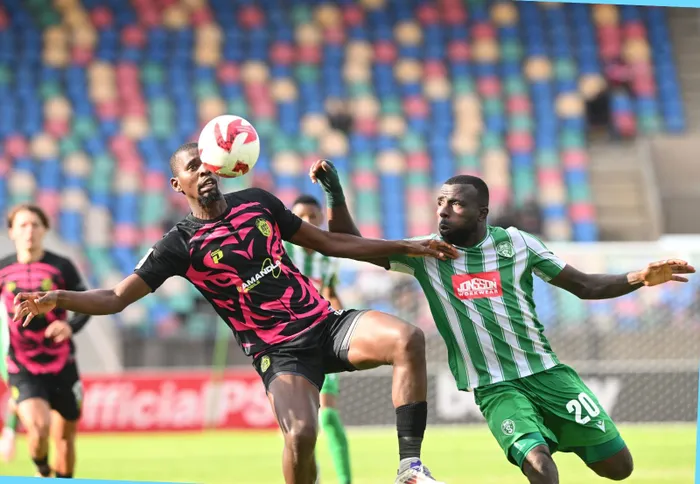
Chibuke Ohizu of Siwelele FC challenges Sandile Mthethwa of AmaZulu during the Betway Premiership match they drew 1-1 at the Dr Molemela Stadium in Bloemfontein on Saturday. Usuthu need a late Mlondi Mbanjwa goal to salvage a point.
Image: BackpagePix
AmaZulu’s fightback to earn a point away to Siwelele in Saturday’s Betway Premiership clash may have underlined their resilience, but it also reinforced a concern that is becoming harder to ignore – that the KZN side are increasingly reliant on being rescued.
In the space of a week, Usuthu have dropped four points in matches where they enjoyed enough control to expect more. In a congested race, that is not simply a stumble; it is the kind of gradual drift that can quietly undo a Top 3 push.
The 1-1 draw in Bloemfontein followed a now-familiar script. AmaZulu found themselves chasing the game before turning, once again, to the bench for a solution, with Mlondi Mbanjwa delivering a late equaliser after they were reduced to 10 men.
On its own, that speaks to character. In context, it points to a deeper issue.
This is not about a “super bench” consistently outshining the starters. Rather, it is about a side that too often leaves matches unresolved, forcing late interventions to salvage outcomes. Whether it was Thandolwenkosi Ngwenya’s brace off the bench in the win over TS Galaxy or Mbanjwa’s latest contribution, the pattern is less about depth winning games and more about a first XI failing to put them to bed.
The numbers underline the concern. AmaZulu’s return of 25 goals from 24 matches is modest for a side with pan-African tournament ambitions, hovering around a goal a game, with no single player taking control of the scoring burden. Ngwenya leads with just six, while midfielder Hendrick Ekstein is next best on five.
Without a reliable focal point in attack, periods of dominance are not translating into decisive leads – or maximum points. And that is where the real cost lies.
Arthur Zwane’s side are not being outplayed. In many respects, they are controlling matches. But control without incision is proving ineffective, leaving the door open for opponents and placing unnecessary pressure on late-game scenarios.
It is a risky way to live.
Relying on moments – a substitution, a set-piece, a flash of individual brilliance from the bench – is far less sustainable than establishing authority early. While AmaZulu have shown they can respond under pressure, repeatedly needing to do so hints at structural inefficiencies, whether in chance creation, finishing, or attacking cohesion.
Dropped points against sides they might have beaten, including this week’s 2-2 draw at home to Sekhukhune United followed by the stalemate in Bloemfontein, are chipping away at their margin for error. In a league where the gap between third and the chasing pack can be razor-thin, those margins matter.
And the issue is not unique to Usuthu, who are currently in fourth place. The other KZN sides in the top flight are not exactly firing either.
If AmaZulu are to secure a top-three finish, the adjustment is as clear as it is urgent: they need to turn control into goals, and matches into statements rather than recovery missions. With a tricky trip to Orlando to face Pirates next up, the four dropped points could yet prove a damaging blow to their continental ambitions.